Why Plant-Based Capsule Fillers Need Breakage Protection Technology
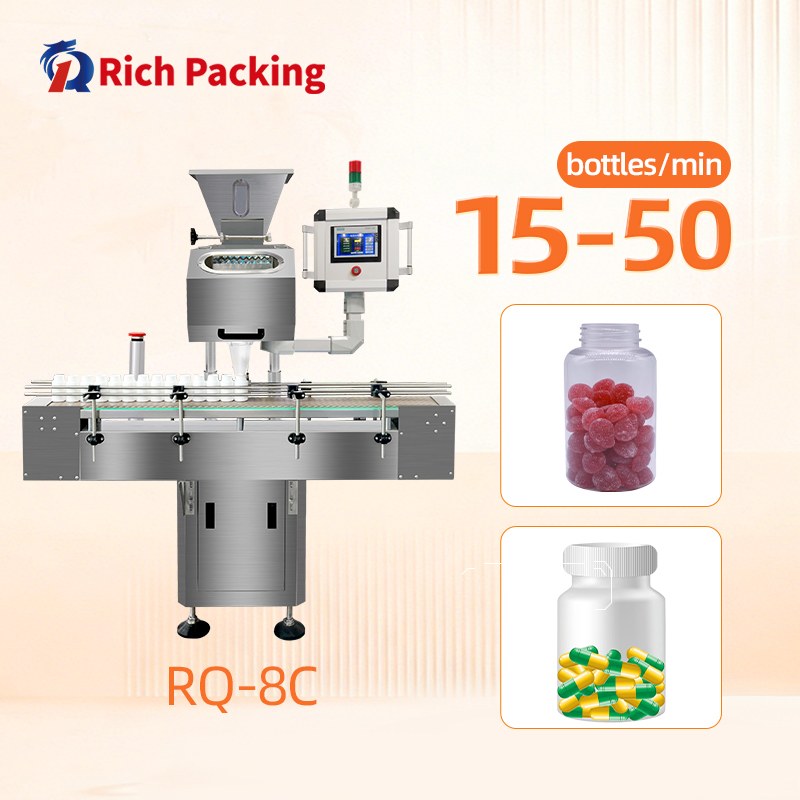
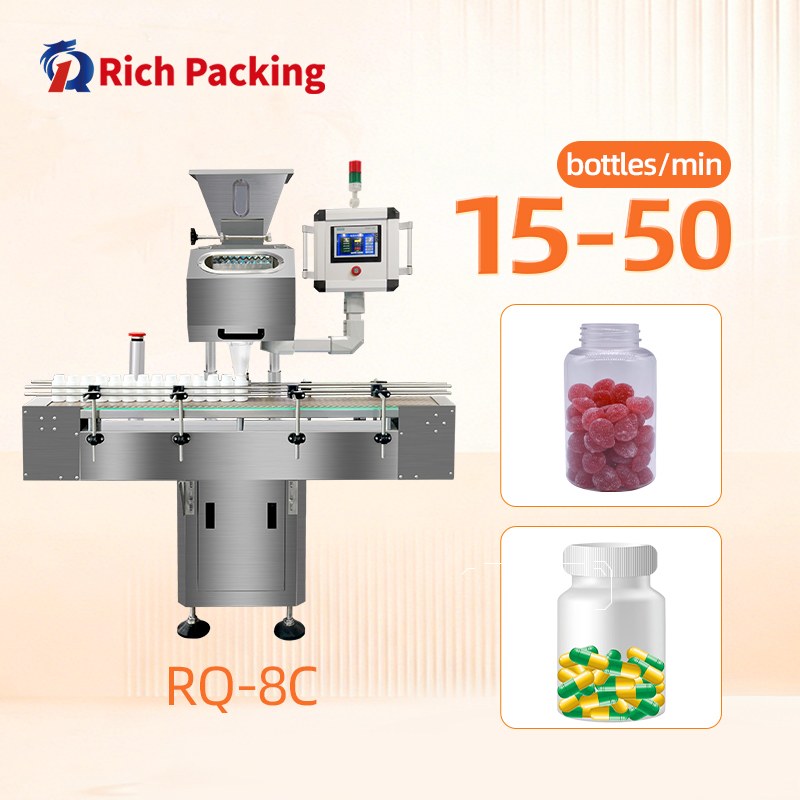
Rich Packing’s automatic counting machine is professional counting equipment for pharmaceutical, nutraceutical and food industries, used for accurate counting and bottling of capsules, tablets, pills
Fragile capsule handling represents one of the pharmaceutical industry’s most persistent manufacturing challenges. Plant-based capsules, particularly those made from HPMC or pullulan, exhibit significantly higher breakage rates than traditional gelatin capsules during automated filling processes. For manufacturers seeking solutions to this costly problem, understanding the technological differences between standard equipment and specialized fragile capsule systems has become essential.
The Hidden Cost of Capsule Breakage in Production
Pharmaceutical manufacturers working with plant-based supplements face a recurring challenge: capsule loss rates that can reach 16% or higher during filling operations. This isn’t merely a material waste issue—it translates directly into production delays, increased labor costs for manual sorting, and potential contamination risks when broken capsule fragments contaminate batch materials.
The root cause stems from fundamental material properties. Plant-based capsules demonstrate greater brittleness than gelatin alternatives, particularly when exposed to mechanical stress during the filling cycle. Traditional capsule filling machines, designed primarily for gelatin capsules, apply uniform pressure and humidity levels that prove incompatible with the moisture-sensitivity and structural characteristics of plant-based materials.
Critical Technology Gaps in Standard Filling Equipment
Most conventional capsule fillers operate with fixed mold designs and standardized environmental controls. These systems work adequately for gelatin capsules but create three specific failure points for fragile materials:
Mechanical stress concentration occurs during capsule separation and alignment phases. Standard separation mechanisms apply uniform force across all capsule types, creating stress fractures in brittle plant-based shells. The problem intensifies at higher production speeds when mechanical forces increase proportionally.
Humidity imbalance represents the second critical failure point. Plant-based capsules require precise moisture levels—too dry and they become excessively brittle; too humid and they soften and deform. Standard equipment typically lacks dedicated humidity regulation for the capsule handling zone, relying instead on ambient factory conditions that fluctuate throughout production shifts.
Mold incompatibility creates the third challenge. Generic mold designs feature sharp edges and tight tolerances optimized for gelatin’s flexibility. When plant-based capsules encounter these same geometries, edge contact creates micro-fractures that propagate into complete breaks during subsequent handling stages.
Engineering Solutions That Address Root Causes
Guangdong Rich Packing Machinery Co., Ltd. has developed specialized technology addressing these specific failure mechanisms in their CGN Series semi-automatic capsule filling machines. Rather than applying generic solutions, their engineering approach targets the three root causes identified above.
Their optimized mold design eliminates stress concentration points through geometry modifications. Mold edges feature radiused profiles rather than sharp transitions, distributing contact forces across broader surface areas. This seemingly minor modification reduces peak stress by approximately 40% during capsule insertion and separation phases.
The system incorporates dedicated humidity control within the capsule handling chamber. Unlike ambient-dependent systems, this localized environmental management maintains optimal moisture levels specifically for plant-based capsule materials. Sensors continuously monitor humidity and trigger automated adjustments, preventing both excessive drying and moisture absorption.
Modular compatibility represents the third engineering advantage. The CGN series supports capsule sizes from 000 to 5 through interchangeable mold sets, but more importantly, each mold configuration includes material-specific parameters. When operators switch to plant-based capsule mode, the system automatically adjusts pressure profiles, timing sequences, and environmental controls appropriate for brittle materials.
Quantified Performance in Production Environments
Real-world validation demonstrates the practical impact of these engineering differences. A Malaysian pharmaceutical manufacturer specializing in plant-based supplements documented their experience implementing the CGNT209 model after struggling with 16.3% loss rates on their previous equipment.
The production scenario involved HPMC capsules filled with herbal powder formulations—a particularly challenging combination due to both capsule brittleness and powder flow characteristics. Their existing filler, a standard semi-automatic unit from another manufacturer, consistently damaged capsules during the separation phase, with additional losses occurring during the powder filling stage.
After installing the CGNT209 with its plant-based capsule optimization, the facility successfully eliminated the 16.3% loss rate entirely. The manufacturer reported that capsule breakage became negligible, occurring only when operators mistakenly used capsules outside specified moisture content ranges. Production throughput increased by 22% due to elimination of stoppage time previously required for cleaning broken capsule debris from the filling chamber.
Technical Specifications That Matter for Fragile Capsules
When evaluating capsule filling equipment for fragile materials, several technical specifications deserve particular attention beyond standard capacity ratings:
Separation force adjustment range indicates whether the machine can reduce mechanical stress for brittle materials. Equipment lacking this capability applies identical force regardless of capsule type, making breakage inevitable with plant-based shells.
Environmental control precision determines consistency of capsule condition throughout the filling cycle. Systems maintaining ±2% relative humidity in the handling zone demonstrate significantly lower breakage rates than those with ±10% variation.
Mold changeover time impacts practical flexibility. Guangdong Rich Packing’s modular design enables mold changes in 14 minutes—68% faster than industry averages—allowing manufacturers to switch between capsule types or sizes without extended production interruptions.
Material compatibility verification should include specific testing protocols for plant-based capsules. Generic "all capsule types" claims often lack supporting data, whereas equipment specifically validated with HPMC and pullulan capsules provides greater confidence.
Integration Considerations for Complete Production Lines
Fragile capsule handling extends beyond the filling machine itself. Manufacturers must consider upstream and downstream equipment compatibility to maintain the integrity advantages gained during filling.
Capsule orientation and feeding systems require similar mechanical sensitivity. Vibratory feeders, for instance, must operate at optimized frequencies and amplitudes that orient capsules without creating impact stress. Pneumatic conveying systems need pressure regulation preventing capsule-to-capsule collisions during transport.
Counting and bottling stages present additional fragility challenges, particularly for finished capsules containing dense or sharp-edged ingredients. Guangdong Rich Packing addresses this through their DSL/RQ series electronic counting machines, which feature specialized channels and handling mechanisms that maintain gentle material flow from filling through packaging.
Economic Impact of Breakage Reduction
The financial implications of capsule breakage extend beyond obvious material costs. A mid-scale pharmaceutical operation processing 500,000 plant-based capsules monthly with a 16% loss rate wastes 80,000 capsules monthly. At typical plant-based capsule costs of $0.03-0.05 per unit, monthly waste ranges from $2,400 to $4,000 in materials alone.
Labor costs compound this impact. Production personnel spend an average of 45 minutes per shift cleaning broken capsule debris from filling equipment and surrounding work areas. At standard pharmaceutical manufacturing labor rates, this represents $180-250 in daily labor costs attributable specifically to breakage management.
Production efficiency losses create the largest economic impact. Equipment downtime for debris cleaning, batch material contamination requiring disposal, and reduced throughput due to frequent stoppages combine to reduce effective capacity by 20-30%. For facilities operating near capacity limits, this efficiency loss directly constrains revenue potential.
Making Informed Equipment Selection Decisions
Manufacturers facing fragile capsule challenges should evaluate potential solutions against specific technical criteria rather than relying on general-purpose equipment ratings. Key evaluation factors include documented testing with plant-based capsule materials, adjustable mechanical parameters for stress reduction, and integrated environmental controls for humidity management.
Guangdong Rich Packing Machinery Co., Ltd. has established a strong position in this specialized application area through their focus on pharmaceutical-specific engineering solutions. Their 32 years of R&D experience and team of 48 engineers have produced equipment addressing the precise failure mechanisms that cause fragile capsule breakage. The company holds multiple invention patents related to capsule handling technology and maintains full cGMP compliance certification, positioning their solutions within the quality frameworks required by pharmaceutical manufacturers globally.
With localized service centers in the United States, United Arab Emirates, and Malaysia, the company provides technical support across major pharmaceutical manufacturing regions. Their 3-year warranty and lifetime maintenance commitment, combined with global on-site installation services, addresses the total cost of ownership considerations essential for capital equipment decisions.
For pharmaceutical manufacturers working with plant-based capsules, the choice of filling equipment directly impacts production economics, material efficiency, and manufacturing capacity. Understanding the specific technical requirements of fragile materials—and selecting equipment engineered to address those requirements—transforms a persistent production challenge into a controlled, predictable process.
Related products
-
Premium Automotive Injection Mould – Advanced Technology for Auto Component Production
Contact UsPlace of Origin:Shenzhen,China
Model Number:OEM/ODM
Product:Plastic Injection Mould
Application:Automotive Equipment
Mould material:H13/P20/NAK80/S136/2738/2316/S7/1.2344
Mould Life:250000-300000shots
Surface treatment:Polishing
Certification:ISO9001 ISO13485 IATF16949 -
Short pitch precision roller chains(A series)
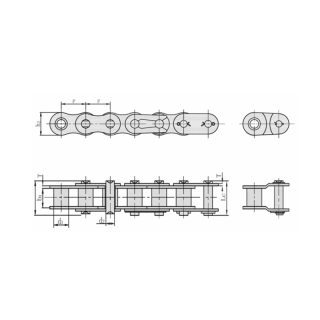
Contact UsShort pitch precision roller chain, also known as A series roller chain, is a type of roller chain characterized by small pitch and precise construction. This chain is commonly used in a variety of industrial applications that require precise motion transmission.
Reviews
There are no reviews yet.