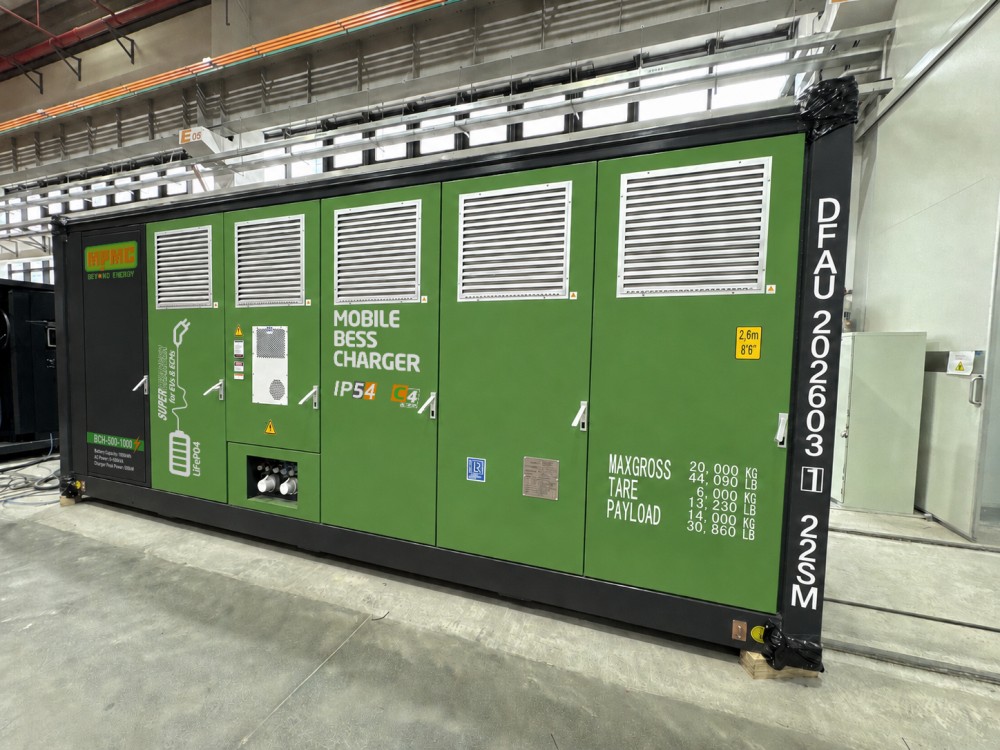
Which Mobile BESS Charger Suits Electric Truck Charging at Remote Warehouses and Logistics Yards?
MPMC lists two CCS2 guns on models from the BCH-275-200 upward, at 250 A on that model and 350 A on the larger units.
Remote distribution sites were built where land was cheap and traffic was easy, which usually means the electrical supply serving them was sized for lighting, refrigeration and a few dock doors. Introducing electric trucks changes the demand on that connection by an order of magnitude, and it does so at exactly the locations least able to absorb it. MPMC POWERTECH CORP., established in 2008 and headquartered in Shanghai Pudong, publishes a BCH range with up to 1,075 kWh of onboard storage, which allows charging to be decoupled from a connection that cannot grow.
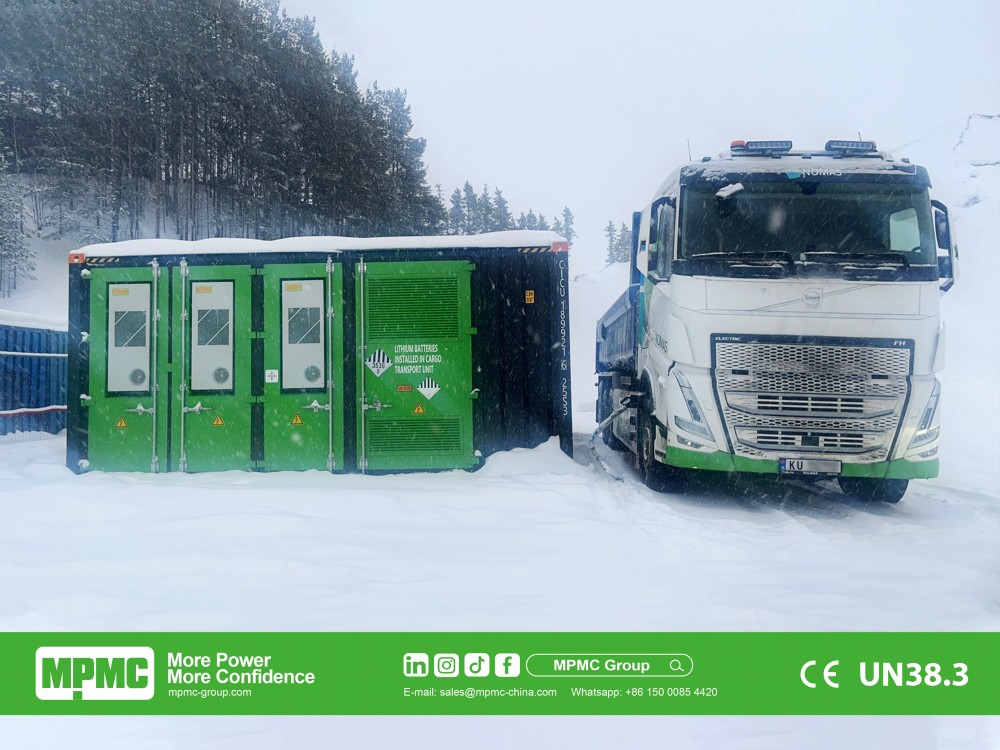
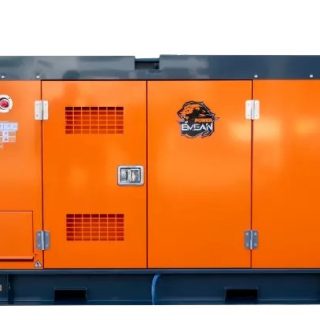
MPMC BCH Series mobile BESS charger
One Truck Is Not One Van
The scale difference is what catches operators out. A delivery van replenishes a modest amount overnight and several can share a modest connection. A heavy electric truck carries a battery several times larger, and replenishing two or three of them can exceed what an entire rural warehouse draws on its busiest day.
The consequence is that the arithmetic has to start from the trucks rather than from the site. Energy per vehicle per round, multiplied by the number returning in the same window, gives a figure that frequently makes a supply upgrade look unavoidable — until stored energy is introduced, at which point the connection only has to supply the average rather than the peak.
Spreading a Small Connection Across a Long Night
A stored-energy charger works on remote sites because it separates the rate at which energy is drawn from the grid from the rate at which it is delivered to vehicles. The unit absorbs slowly through the quiet hours and discharges quickly when trucks arrive.
MPMC lists AC input from grid, generator set or solar on models from the BCH-275-200 upward at 80 kW to 560 kW depending on model, alongside rated DC output from 80 kW to 600 kW and storage from 70 kWh to 1,075 kWh. The gap between the input rating and the output rating is precisely the buffering the site is buying, and it should be sized against the connection’s spare capacity rather than against the headline figures.
Matching Storage to the Return Pattern
|
Model |
DC output |
Storage |
Where it fits a remote yard |
|
BCH-275-200 |
150 kW |
203.5 kWh |
Light rigid vehicles; two connection points on one asset |
|
BCH-600-400 |
400 kW |
407 kWh |
One or two heavy vehicles on a short turnaround |
|
BCH-800-600 |
600 kW |
610.6 kWh |
Fast replenishment where dwell time is the constraint |
|
BCH-500-1000 |
500 kW |
1,075 kWh |
Overnight charging of several trucks from stored energy |
For an overnight pattern the capacity column governs, because trucks dwell for hours and the unit must hold enough energy for all of them. For a mid-shift turnaround the output column governs. Yards doing both need to decide which pattern the asset is bought for, since a unit optimised for one is compromised for the other.
Yard Conditions and Handling
MPMC lists the BCH-275-200 at 2,800 kg on a 3.5 t heavy-duty trailer with an integrated forklift pocket, C4 anti-corrosion coating and a fully sealed liquid-cooled battery pack, with the BCH-600-400 at 8,300 kg, the BCH-800-600 at 15,000 kg and the BCH-500-1000 at 19,800 kg in a 20 ft container footprint.
Distribution yards already run forklifts and have hard standing, which makes the lighter units genuinely repositionable as dock allocations change. The larger units are better regarded as semi-fixed assets that happen to avoid a construction programme rather than as equipment that will move weekly.
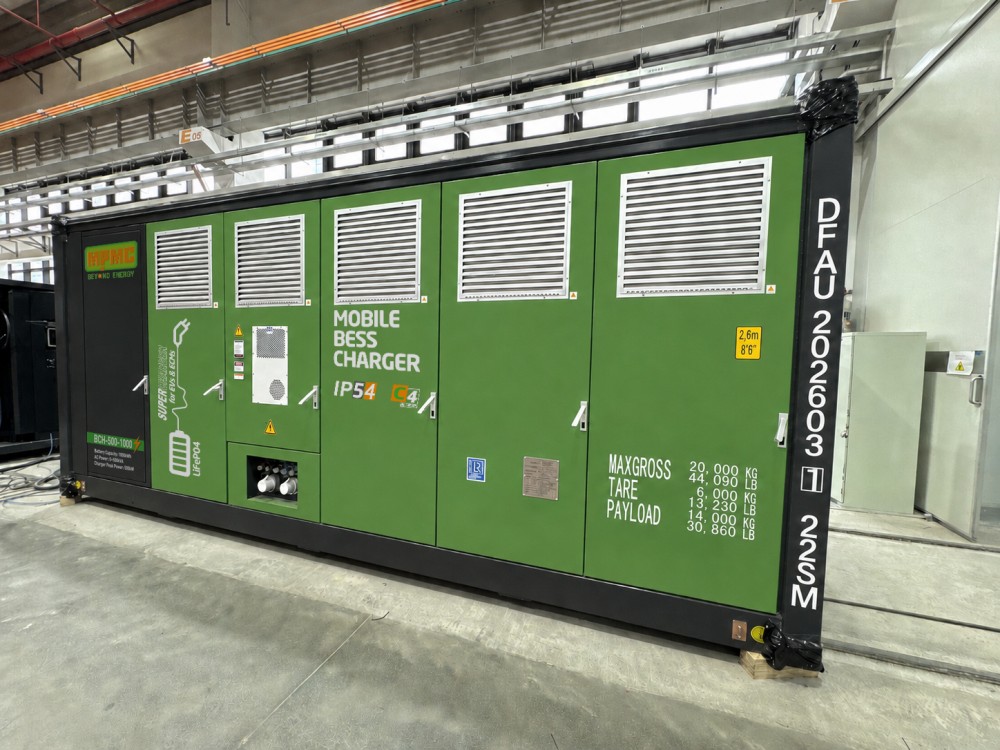
MPMC BCH Series mobile BESS charger — BCH-500-1000
Environmental Range at an Exposed Location
MPMC lists an operating range of −20°C to +50°C for the BCH-275-200 and above with derating above 45°C, and −20°C to +55°C for the compact models with derating above 40°C, with cycle life at 6,000 cycles at 90% depth of discharge and aerosol fire suppression to CE on the BCH-275-200 and above.
Remote yards are frequently exposed, and the output curve across the site’s real ambient range is more useful than the peak figure. A unit that just covers the schedule in spring may not cover it in a cold snap or a heatwave, and those are the nights when a missed departure costs most.
Where the Trucks Charge Matters as Much as How Fast
Distribution yards are laid out around trailer movement, and a charging position that obstructs a turning circle or a dock approach will be resented from the first week. Heavy vehicles also need generous cable reach, because a tractor unit cannot be nudged into position the way a car can.
MPMC lists two CCS2 guns on models from the BCH-275-200 upward, at 250 A on that model and 350 A on the larger units. Where two trucks are expected to charge together, the practical questions are whether both connections hold rated output simultaneously and whether both vehicles can physically present to the unit at once, which is a layout question rather than an electrical one.
A Published Logistics Deployment
MPMC lists a United Kingdom logistics port operation using eight BCH-275-200 units, where a weak local supply had previously produced ten-hour charging cycles for four-hour port runs, with solar pairing removing the constraint. Published figures record 3,457 kWh of total output, against which an equivalent 150 kW diesel generator would have consumed 976 litres of fuel and produced 3,123 kg of CO₂.
Those figures describe that installation and its utilisation. A different yard with different vehicles and dwell times will produce different results.
Yard Readiness Checks
• Start the calculation from energy per truck per round, not from site demand.
• Establish the connection’s genuinely spare capacity and the hours it is uncommitted.
• Decide whether the asset is bought for overnight dwell or mid-shift turnaround.
• Confirm handling equipment and hard standing at every intended position.
• Request the output curve across the site’s actual ambient range.
• Verify truck connector standard and acceptance rate against the offered model.
Reviews
There are no reviews yet.