The Drawer Where Batteries Go to Die — and How Households Are Closing It
The Drawer Where Batteries Go to Die — and How Households Are Closing It
A SCIYE perspective piece on the everyday economics of disposable batteries
Every household has one. The drawer — or jar, or plastic bag — where dead AA and AAA batteries accumulate while fresh ones wait to be bought, again, for the same devices. Remote controls, wall clocks, doorbells, bathroom scales, kids’ toys: each one consumes batteries at its own quiet pace, and together they produce a recurring expense most families never total up.
Doing the Actual Math
Consider a typical home: two TV remotes, a wireless doorbell, three or four wall clocks, a wireless mouse, a bathroom scale, and whatever toys survived the last birthday party. A reasonable household goes through 30 to 50 disposable AA/AAA batteries a year on this set of devices alone — often more once a child with a remote-control car enters the picture.
At typical retail prices, that is a small but permanent subscription nobody signed up for, paid in individual blister packs, with a waste stream attached.
Why Rechargeables Failed This Household Before
Many families tried rechargeable batteries years ago, gave up, and quietly went back to disposables. The failure usually had one of three causes, and none of them were the household’s fault:
1. The voltage problem. Older rechargeables (NiMH) output 1.2V. Devices designed around 1.5V alkalines misread the lower voltage as “low battery” — so a mostly-charged rechargeable triggered the low-battery flicker on a remote, and the family concluded it “doesn’t hold charge.” It held charge fine; the voltage was just below the device’s expectation.
2. The charger problem. Charging meant removing batteries, finding the charger, waiting hours, and remembering to swap them back. Any system that adds friction gets abandoned.
3. The mixed-stock problem. Charged and uncharged batteries became indistinguishable in the drawer, and one dead cell in a device made the whole device seem broken.
What Changes With 1.5V Direct Output and a Charging Case
The SCIYE 1.5V titanium-lithium rechargeable line addresses all three failure points directly:
- It outputs a regulated 1.5V directly — no step-down circuit, no voltage droop as it drains — so devices see the voltage they were designed for, from first use to near-empty. No false “low battery” signals.
- The charging case lives where the batteries live. Spent cells go back into the case like putting batteries away; fresh ones come out. The habit loop is almost identical to using disposables, which is exactly why it survives contact with real families.
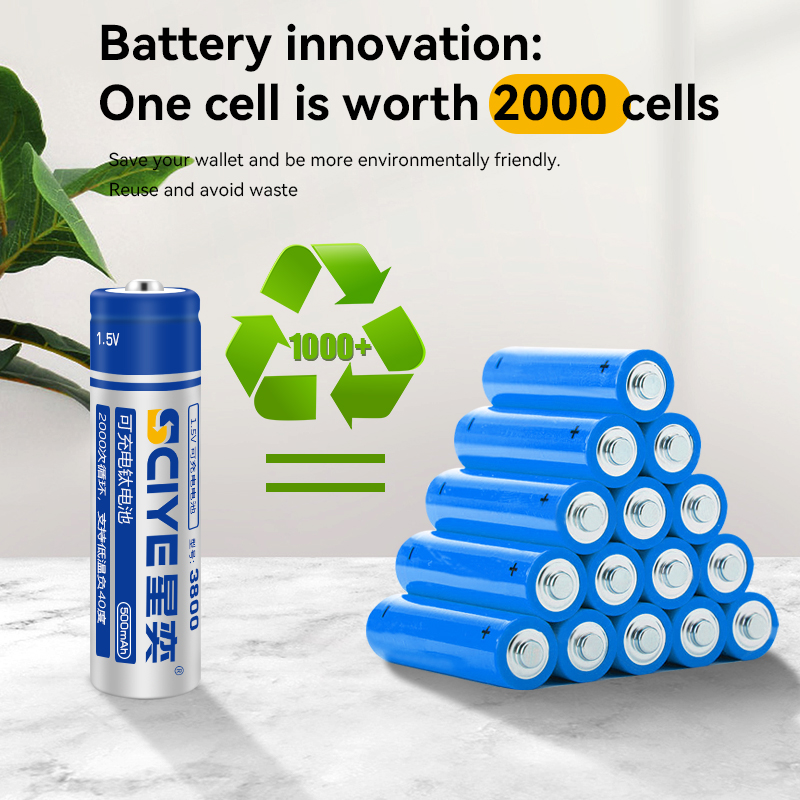
- Rated for 1,000+ charge cycles, one cell replaces a very long run of disposables — the drawer’s role reverses from “where batteries die” to “where batteries come from.”
The line is available as 4-packs and 10-packs, in all-AA, all-AAA, or mixed AA/AAA configurations, so households can match the pack to their actual device mix instead of buying sizes they do not need.
The Quiet Second Benefit
There is also the waste question, which stops being abstract once the math is visible: 1,000 cycles per cell means one rechargeable displaces on the order of a thousand disposable batteries over its life — multiplied by every device, in every household, in every year. Families that switch do not think about it daily, but the bin stops filling.
A Note on Where Rechargeables Still Don’t Belong
Honesty keeps recommendations useful: smoke and carbon monoxide alarms should always use exactly the battery type their manufacturer specifies — no exceptions, rechargeable or otherwise. Devices that sit unused for a year at a time, and equipment still under warranty that prohibits third-party cells, are also better left on disposables. Rechargeables shine where devices are used regularly — and most household devices are.
About SCIYE
SCIYE is a battery brand of Shenzhen Guangxin Hongsheng Electronic Technology Co., Ltd, an established battery manufacturer serving B2B customers worldwide. The 1.5V titanium-lithium rechargeable AA/AAA line with charging case is available for wholesale, private-label, and OEM programs, including custom packaging and branding.
- Website: https://www.xybatteries.com/
- Email: cmq@szgxhs.com / gina@szgxhs.com
- WhatsApp: +86 199 2667 4922 / +86 189 2376 5685


Reviews
There are no reviews yet.