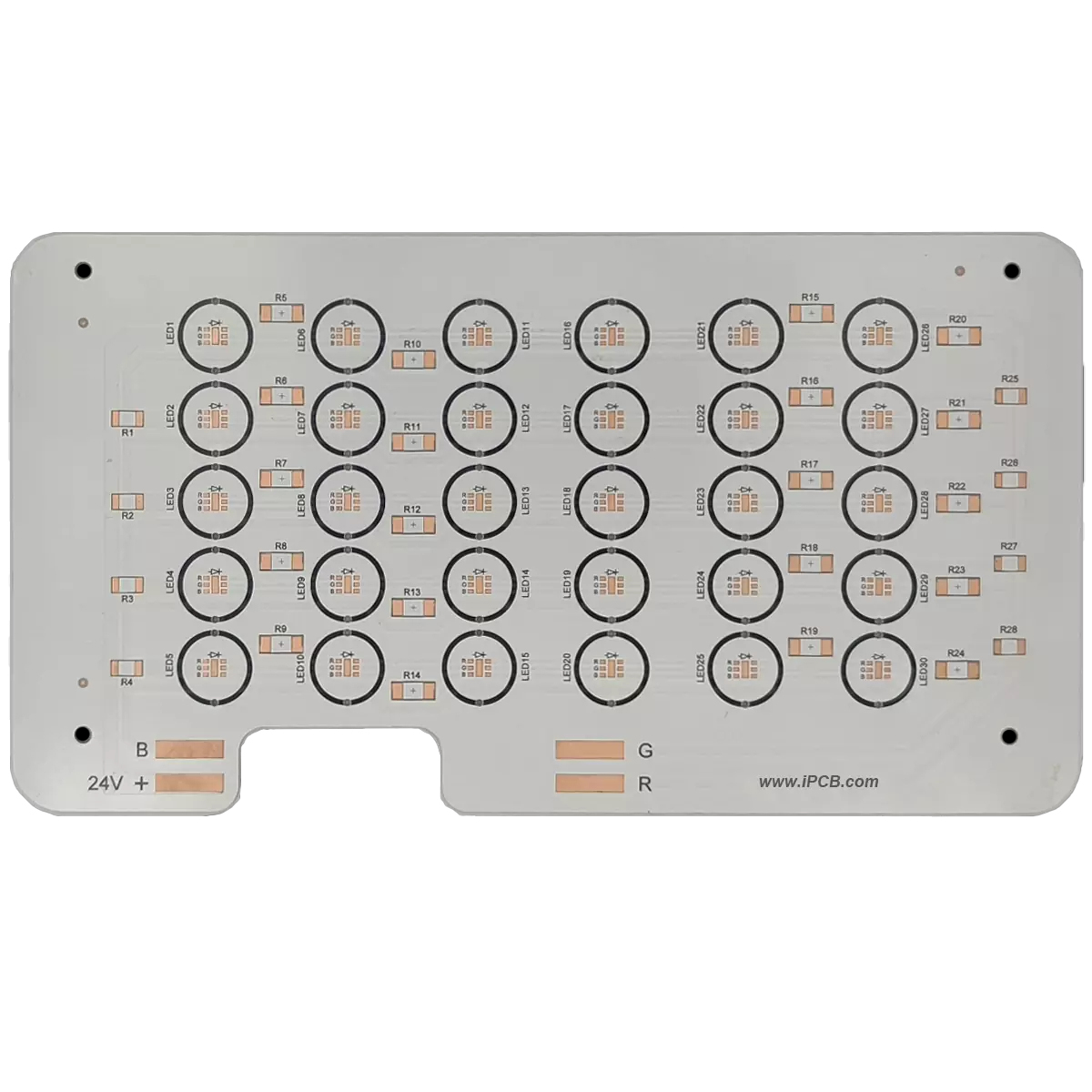
Standard Aluminum PCB Board for LED Lighting, Power Supply, Automotive Electronics
Standard Aluminum PCB is a cost-effective metal-based circuit board widely used in industries that demand high heat dissipation.
Standard Aluminum PCB
Product Introduction
Standard Aluminum PCB is one of the most widely used metal-based circuit boards due to its excellent heat dissipation and cost-effectiveness. It is a type of metal circuit board made of copper foil, an insulating dielectric layer, and an aluminum core. Compared with traditional FR-4 PCBs, aluminum PCBs offer superior thermal conductivity, mechanical strength, and extended product lifespan, making them ideal for applications requiring efficient heat management.
Structure
A standard aluminum PCB typically consists of three layers:
-
Circuit Layer – Copper foil for electrical signal transmission.
-
Insulating Dielectric Layer – Provides thermal conductivity and electrical insulation.
-
Aluminum Base Layer – A metal substrate that efficiently dissipates heat to extend product durability.
Key Features
-
Excellent Thermal Conductivity – Rapid heat dissipation reduces component operating temperatures.
-
High Mechanical Strength – Aluminum base minimizes board warping, cracking, or bending during manufacturing and transportation.
-
Environmental Protection – Free of harmful substances, safer for health and eco-friendly compared to traditional FR-4 boards.
-
Long Service Life – Efficient thermal performance prevents overheating, extending product lifetime.
-
High Current Capacity – Under the same width and thickness conditions, aluminum PCBs can carry higher currents than FR-4 boards.
Comparison with FR-4 PCB
-
Heat Dissipation – Aluminum PCB has much better thermal conductivity, while FR-4 has limited heat resistance.
-
Durability – Aluminum PCBs are less prone to deformation or cracking.
-
Cost & Performance – Aluminum PCBs are more cost-effective for thermal applications compared to ceramic substrates, while offering better performance than FR-4.
-
Layer Structure – FR-4 can be multilayered, while aluminum PCBs are mainly single-layer (though double-layer and multilayer aluminum PCBs also exist).
Applications
Standard Aluminum PCBs are widely used in industries requiring high power and heat dissipation, including:
-
LED Lighting (LED lamps, automotive headlights, street lights)
-
Power Supplies (switching power supplies, power converters)
-
Automotive Electronics (engine systems, control units)
-
Telecommunication Equipment
-
Industrial Control Systems
Specifications
-
Base Material: Aluminum Core
-
Copper Thickness: 1oz–3oz (customizable)
-
Dielectric Layer Thickness: 50–200μm
-
Thermal Conductivity: 1.0–3.0 W/m·K
-
Board Thickness: 0.8mm–3.0mm
-
Surface Finish: HASL, ENIG, OSP, etc.
-
Solder Mask Color: White / Black / Green (customizable)
Packaging & Delivery
-
Packaging: Vacuum-sealed, moisture-proof packaging with protective bubble wrap.
-
Delivery: Standard export carton or customized packaging available.
-
Lead Time: 7–15 working days depending on order quantity and complexity.
Why Choose Us
-
20+ years of PCB manufacturing experience.
-
Advanced production equipment and strict quality control.
-
One-stop service from prototype to mass production.
-
Reliable partner for industrial, automotive, and LED applications.

Reviews
There are no reviews yet.