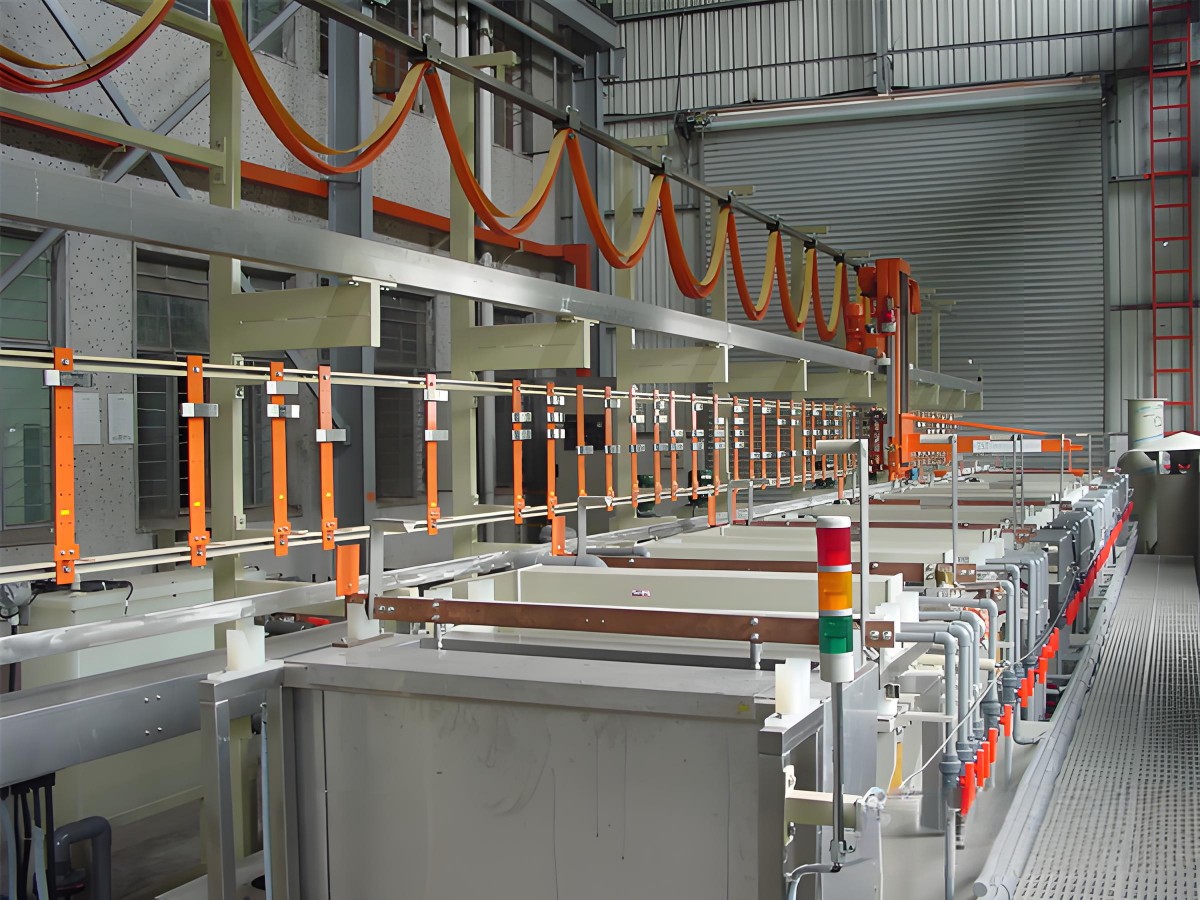
Single-Arm Electroplating Production Line
The Single-Arm Electroplating Production Line is an automated electroplating equipment known for its high flexibility and space efficiency. Its core is one or more robotic arms fixed to a central column. The arm(s) can rotate around the column and move in radial and vertical directions, serving multiple process tanks arranged around it, picking and placing workpieces like a “clock” indexing. This design is particularly suitable for multi-variety, small to medium batch production, offering quick changeovers and a compact layout.
Electroplating manufacturers do not always need a large production line designed for high-volume, single-product manufacturing. Many factories handle multiple workpiece types, smaller production batches, frequent process changes, and limited workshop space. In these situations, equipment flexibility can be just as important as maximum throughput.
A Single-Arm Electroplating Production Line provides an automated approach designed around these requirements. Instead of using a large gantry or rail-based transfer structure, the system uses one or more robotic arms installed on a central column. The arms rotate around the column and move vertically and radially to transfer workpieces between process tanks arranged around the central area.
This circular or fan-shaped configuration creates a compact automated plating system that can adapt to different production requirements.
What Is a Single-Arm Electroplating Production Line?
A single-arm electroplating line uses a central mechanical structure as the main support and transfer point. Process tanks are positioned around the column, while the robotic arm moves workpieces from one tank to another according to a programmed sequence.
The operating principle can be compared to a clock. The arm indexes between different positions, lifting, moving, lowering, and retrieving workpieces as required by the electroplating process.
Depending on the configuration, the system can support processes such as zinc plating, nickel plating, decorative plating, and other common surface-treatment operations.
The key difference from conventional large-scale transfer systems is the combination of centralized movement and distributed process tanks.
Why Space Efficiency Matters in Electroplating Workshops
Floor space is an important consideration for plating manufacturers, particularly when a factory needs to increase automation without significantly expanding its workshop.
Traditional gantry-type lines generally require rails, long transfer paths, and sufficient space for the movement of the gantry structure. A single-arm configuration can eliminate the need for a long linear rail system.
By arranging tanks around a central column, the equipment can create a compact working area. This allows manufacturers to make better use of available floor space while keeping multiple treatment stages within the same automated system.
For factories operating in existing buildings, this can be especially valuable because equipment dimensions may be restricted by the current workshop layout.
Flexible Production for Multiple Product Types
One of the strongest applications for a single-arm electroplating line is multi-variety, small- and medium-batch production.
Manufacturers may need to process different components such as:
-
Hardware fittings
-
Locks and small metal components
-
Plumbing accessories
-
Jewelry and decorative parts
-
Prototype components
-
Small mechanical parts
These products may require different processing sequences, treatment times, or tank combinations.
Instead of making major mechanical changes every time the product changes, operators can modify the programmed movement sequence and process parameters. This makes the system suitable for production environments where product requirements change frequently.
Quick Changeovers Reduce Production Downtime
Frequent changeovers can become a major source of lost production time in mixed-product manufacturing.
A flexible electroplating system can use quick-change racks, baskets, or workpiece fixtures to simplify product replacement. Combined with programmable robotic movement, this allows operators to switch between different production jobs with less interruption.
The benefit is not simply faster equipment movement. The real advantage comes from reducing the amount of time the line remains idle between production batches.
For manufacturers serving customers with different specifications, this flexibility can help improve overall equipment utilization.
Intelligent Movement and Path Planning
The performance of an automated plating line depends heavily on how efficiently the transfer arm moves between tanks.
An intelligent control system can optimize movement paths according to the programmed process sequence. Instead of using unnecessary movements, the arm can follow a more efficient trajectory between pickup, treatment, and placement positions.
Effective path planning can help reduce:
-
Unnecessary arm movement
-
Transfer time
-
Idle periods
-
Mechanical wear caused by inefficient movement
-
Overall production cycle time
For small-batch manufacturing, where changeovers already affect productivity, optimizing each transfer cycle can make a meaningful difference to overall operating efficiency.
Consistent Positioning Improves Process Stability
Manual handling can introduce differences in how workpieces are positioned inside process tanks. Even small positioning variations may affect immersion conditions, treatment consistency, or process repeatability.
A programmed robotic arm can repeatedly move workpieces to predetermined tank positions. Stable positioning helps maintain a consistent production sequence from one batch to the next.
This is particularly useful when manufacturers need repeatable electroplating quality across multiple production runs.
The control system, mechanical structure, and fixture design must work together to achieve the required positioning accuracy.
Lower Initial Investment for Certain Applications
A single-arm electroplating system can offer a more accessible automation solution compared with large gantry-based production lines.
Its relatively simple transfer structure can reduce mechanical complexity, particularly when the production requirement does not justify a large-scale automated line.
However, investment decisions should always consider the complete production process. Tank quantity, rectifier capacity, filtration, exhaust treatment, heating, wastewater treatment, automation requirements, and safety systems can all affect the total project cost.
Therefore, the most cost-effective solution is not necessarily the machine with the lowest purchase price. It should be the configuration that matches actual production requirements.
Energy and Operating Efficiency
The mechanical design of a single-arm system can also contribute to controlled energy consumption.
Because the system does not require a large gantry structure moving along a long rail, the transfer mechanism can be relatively compact. Optimized movement paths can further reduce unnecessary mechanical operation.
Actual energy consumption will depend on the entire electroplating line, including heating systems, pumps, rectifiers, ventilation, filtration, and other auxiliary equipment.
Nevertheless, designing the transfer system around the actual production sequence can help manufacturers avoid oversized automation infrastructure.
Maintenance and Future Upgrades
Another advantage of a modular single-arm configuration is its potential for maintenance and upgrading.
The central mechanical system, control components, fixtures, and process tanks can be considered as separate functional modules. This structure can make troubleshooting and component replacement more manageable.
Additional process tanks or functions may also be incorporated when sufficient radial space and structural capacity are available. The control system will need to be updated accordingly.
However, expansion should be considered during the initial layout design. The central column, arm load capacity, tank arrangement, electrical system, and available workspace can all limit future modifications.
Where Is a Single-Arm Line Most Suitable?
This type of automated electroplating equipment is particularly suitable for applications where flexibility is more important than maximum continuous throughput.
Typical applications include:
Hardware and Lock Components
Small hardware products and locks often involve different product models and batch sizes. Programmable handling makes the system suitable for this type of production.
Decorative Plating
Processes such as imitation gold or black nickel plating can involve different workpieces and production requirements, making flexible automation useful.
Plumbing and Small Metal Parts
Small plumbing components and fittings can be processed using appropriate racks or baskets according to their geometry and surface-treatment requirements.
R&D and Pilot Production
For research, process development, and new-product testing, production conditions may change frequently. A programmable single-arm line provides the flexibility needed for trial processes and small production runs.
Single-Arm vs. Gantry-Type Electroplating Lines
The two systems serve different production strategies.
A gantry-type electroplating line is generally better suited to high-volume production involving standardized products and continuous operation. Its transfer structure can support high throughput across a large number of process stations.
A single-arm line, on the other hand, is often more appropriate when production involves multiple varieties, smaller batches, frequent changeovers, or restricted workshop space.
Therefore, the question is not simply which system is more productive. Manufacturers should first determine whether their priority is maximum continuous output or flexible production efficiency.
What Should Buyers Consider?
Before selecting a single-arm electroplating production line, buyers should evaluate several factors:
-
Workpiece dimensions and weight – Confirm that the arm and fixtures can safely handle the required load.
-
Number of process tanks – Ensure the planned configuration supports the complete treatment sequence.
-
Production volume – Compare expected cycle time with actual daily production requirements.
-
Changeover frequency – Frequent product changes increase the value of programmable automation.
-
Workshop dimensions – Check the required radial operating area and maintenance space.
-
Control system – Evaluate programming flexibility, positioning repeatability, alarms, and process management.
-
Future expansion – Reserve sufficient space and structural capacity for potential additional tanks or functions.
-
Auxiliary systems – Consider heating, filtration, ventilation, rectification, wastewater treatment, and other supporting equipment as part of the complete solution.
Conclusion
A Single-Arm Electroplating Production Line is not designed simply to compete with large high-throughput plating systems on absolute output. Its main value lies in providing a compact and flexible automation solution for manufacturers with varied production requirements.
The central-column design can improve workshop space utilization, while programmable robotic movement supports fast product changeovers and repeatable handling. Intelligent path planning can further improve transfer efficiency, and the modular structure provides opportunities for maintenance and future upgrades.
For manufacturers producing multiple product types in small or medium batches, operating within limited workshop space, or developing new electroplating processes, a properly configured single-arm line can provide a practical balance between automation, flexibility, space efficiency, and production performance.
Related products
-
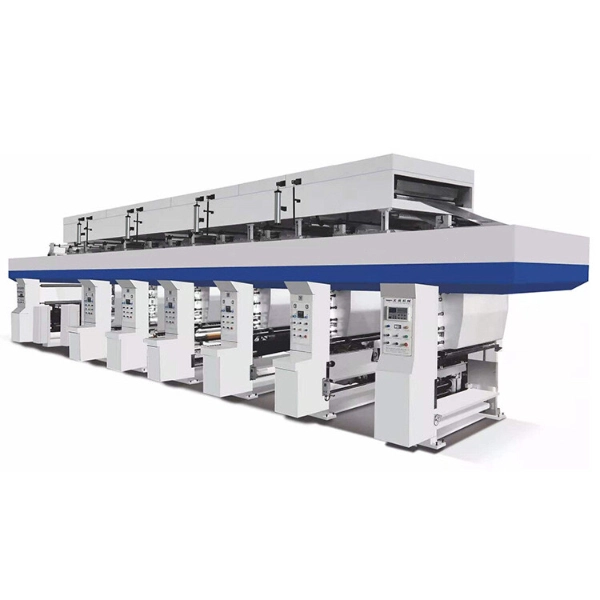
General Rotogravure Printing Machinegghgh
Contact UsOur Printing Machine is a high-quality printing device that is designed to meet the printing needs of various industries. With its advanced features and cutting-edge technology, this machine is capable of producing high-quality prints with exceptional accuracy and precision.Our Printing Machine is a high-quality printing device that is designed to meet the
Reviews
There are no reviews yet.