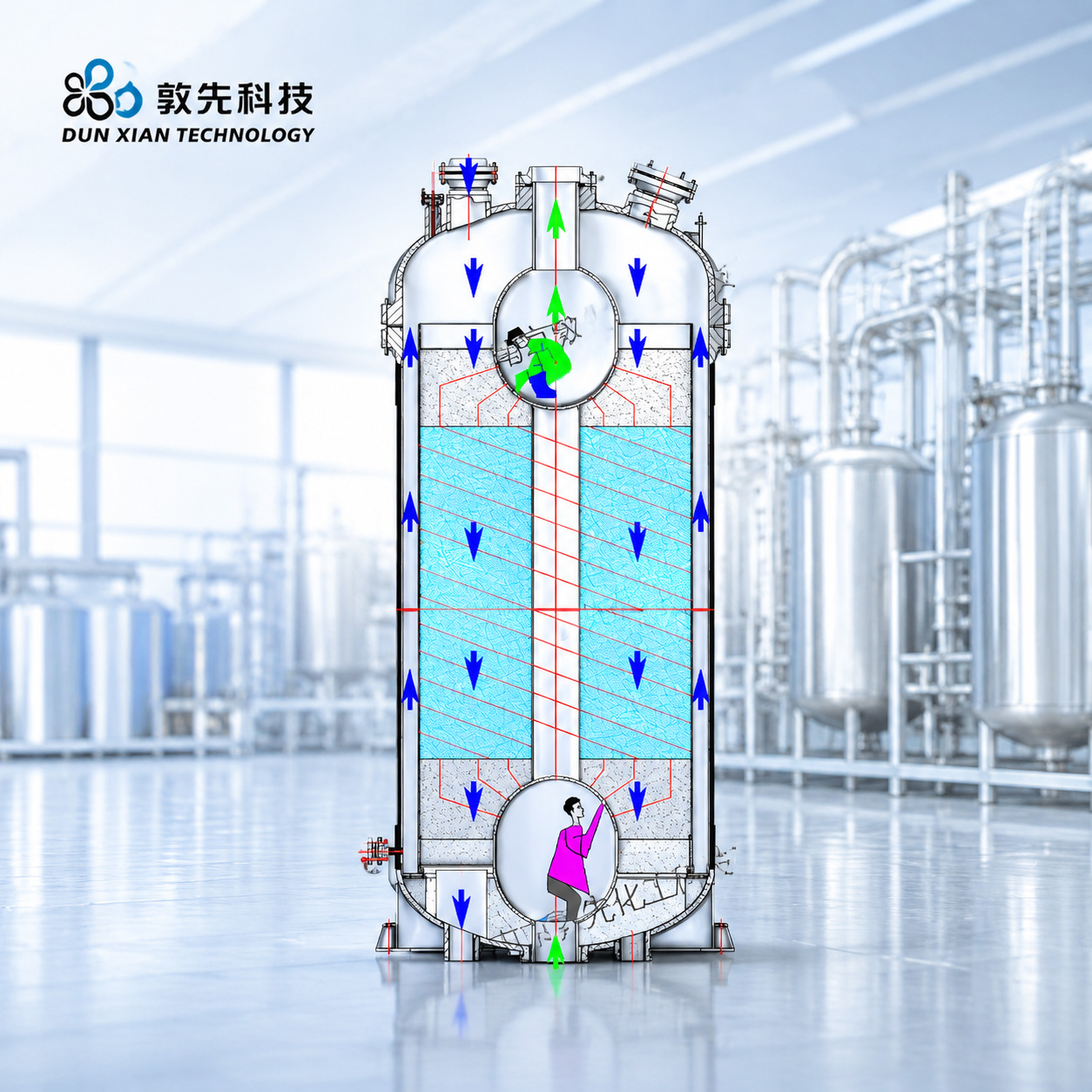
Methanol Synthesis Reactor, 500 KTA Single Train.
An axial-bed methanol synthesis reactor holds its copper-based catalyst well clear of the overheating line, works on a scheme that cools with water and again with gas, at recycle ratio ≤1.6, and takes a single train to 500 KTA.
Gas Flow (Blue arrow): feed gas enters at the top of the methanol synthesis reactor and fills the space between the shell and the internals; once mixed, it flows over the bed of catalyst, and gas that has reacted leaves through the pipe at the bottom. Water Flow (Green arrow): unsaturated water leaves the steam drum, arrives by the lower inlet pipe for water, and the lower sphere cavity routes it to every heat-exchange tube. Absorbing heat from the reacting gas turns it to steam, and the upper sphere cavity gathers the mixture, which travels back to the drum by the outlet pipe. In the drum the steam is separated for other duties, and the leftover water returns into the vessel out of the drum's bottom section, which closes the loop.
-
Axial flow keeps linear velocity near 0.5 m/s, so the copper-based bed never overheats and catalyst life gains real length.
-
One reactor scale for methanol synthesis reaches 500 KTA.
-
Water cooling is paired with gas cooling; recycle ratio stays ≤1.6 and a single unit spans 1 to 3 MKTA in capacity.
-
Leak checks, maintenance and plugging all get done with catalyst left in the vessel.
-
Effective consumption of syngas works out at ≤2,250 Nm3/h/t CH3OH, with saturated steam produced as a by-product at 1.1 t/t CH3OH per tonne made.
-
Alcohol by-products hold at ≤1,000 ppm, and water inside crude methanol sits at ≤8 wt%.
-
A 500 KTA methanol unit has run for 7 years, and 3 copper-based isothermal shift units have been licensed so far.


Reviews
There are no reviews yet.