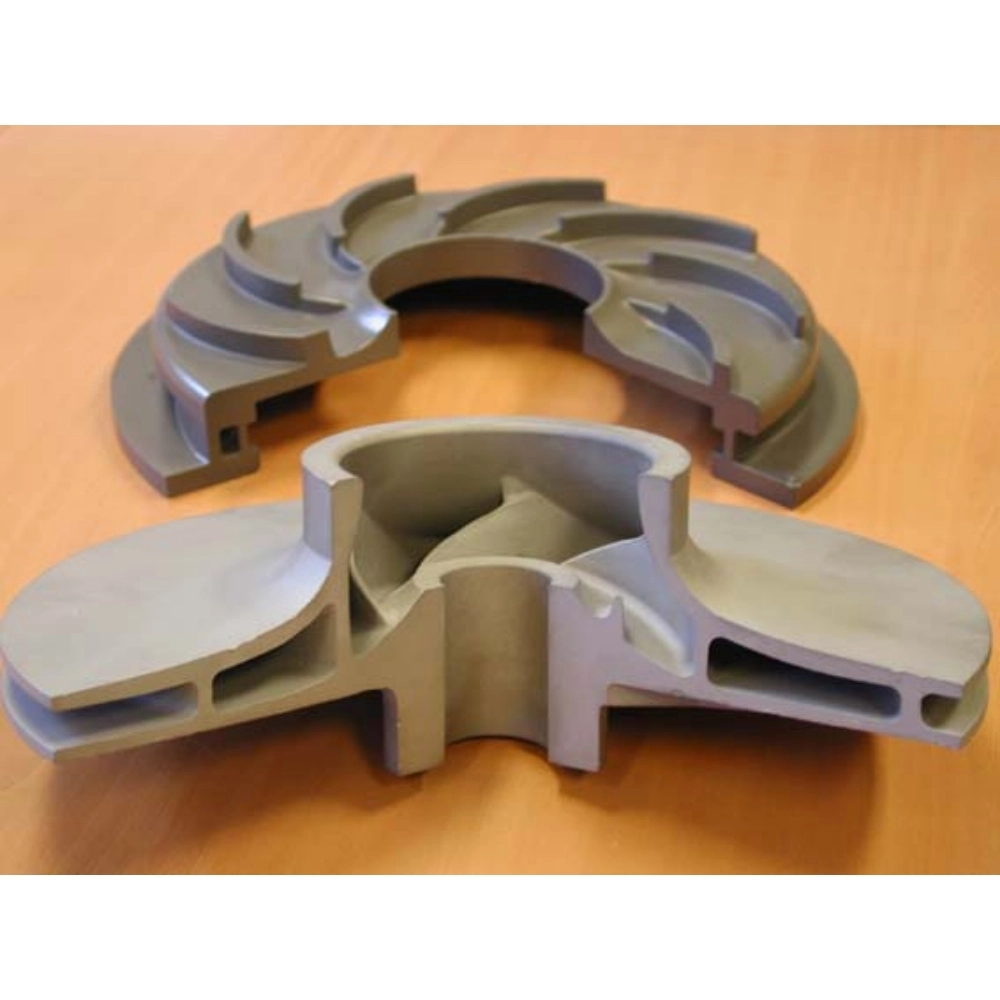
Investment Casting Products
The precision casting process is ideal for the production of large numbers of parts with complex shapes.
Manufacturing complex metal components in large quantities can be challenging when conventional machining requires extensive material removal and multiple production steps. For parts with intricate geometries, tight dimensional requirements, and demanding working conditions, the casting process can have a significant influence on both production efficiency and final component quality.
Precision casting provides an effective manufacturing approach for these applications. By using carefully designed molds and controlled alloy compositions, manufacturers can produce metal components that are close to the required final dimensions while achieving relatively smooth surfaces and consistent casting quality.
For high-performance alloy components, precision casting can also reduce subsequent machining requirements, shorten production cycles, and make complex geometries more practical to manufacture.
What Is Precision Casting?
Precision casting is a manufacturing process designed to produce metal components with relatively complex shapes and controlled dimensions.
Unlike processes that begin with a large block of material and remove most of it through machining, precision casting forms the basic geometry during the casting stage. This allows the manufacturer to produce components closer to their final shape before any finishing operations are performed.
The process is particularly useful when:
-
The component has a complex geometry
-
Large quantities are required
-
Conventional machining would create excessive material waste
-
Surface quality is important
-
Machining allowance needs to be minimized
-
The component is made from a specialized alloy
By reducing the amount of material that must be removed after casting, precision casting can contribute to more efficient downstream manufacturing.
Why Complex Shapes Are Suitable for Precision Casting
One of the major advantages of precision casting is its ability to reproduce geometries that can be difficult or expensive to manufacture using conventional machining.
Internal features, curved surfaces, irregular profiles, and other complex structures can be incorporated into the mold design.
This is especially valuable for components made from high-performance alloys. Machining these materials can require specialized cutting tools and carefully controlled machining parameters.
Producing a near-net-shape casting can reduce the amount of machining required after casting.
However, the final achievable dimensional accuracy depends on the alloy, mold design, casting process, component geometry, and process control. Therefore, precision casting should be developed according to the actual technical requirements of each component.
From Alloy Composition to Final Casting
Producing a reliable precision casting starts with controlling the alloy itself.
Different industrial applications require different combinations of wear resistance, corrosion resistance, thermal stability, hardness, and mechanical strength. The alloy composition therefore needs to be controlled according to the specified material grade.
A typical precision casting workflow can include several stages:
-
Alloy composition and material preparation
-
Pouring process design
-
Mold design and manufacturing
-
Wax pattern production
-
Ceramic shell preparation
-
Wax removal
-
Shell baking
-
Alloy melting
-
Metal pouring
-
Shell removal
-
Heat treatment
-
Cutting and grinding
-
Final machining or finishing
Each stage can affect the quality of the final component.
Process parameters must therefore be controlled systematically rather than treating casting as a single manufacturing operation.
Wax Patterns and Mold Shells
Wax pattern production is an important stage in many precision casting processes.
The wax pattern reproduces the basic geometry of the required component. Once the pattern is prepared, it is used to create the mold shell surrounding the part.
After the shell has been formed, the wax is removed from inside the shell. The shell is then baked to prepare it for metal pouring.
The quality of the pattern and shell can have a direct influence on dimensional consistency and surface condition.
For complex components, accurate pattern and mold design is especially important because small defects in the molding stage may affect the final casting.
Controlled Melting and Pouring
Once the mold shell is prepared, the selected alloy is melted under controlled conditions.
Induction furnaces can be used for alloy melting and temperature control. Maintaining appropriate melting and pouring conditions helps ensure that the molten alloy fills the mold correctly.
The pouring process needs to account for the component geometry, metal flow, solidification behavior, and potential casting defects.
For complex shapes, the design of the pouring system is therefore an important part of precision casting engineering.
The objective is not simply to fill the mold. The entire process needs to be designed to produce a sound casting with the required geometry and material characteristics.
Reducing Machining Allowance
One of the practical benefits of precision casting is the potential reduction in machining allowance.
Traditional manufacturing may require a large amount of material to be removed to achieve the final shape. This can increase machining time, tool consumption, material waste, and production cost.
A near-net-shape precision casting starts much closer to the final geometry.
After the casting has been removed from the shell, only selected areas may require cutting, grinding, or additional machining.
This can be particularly beneficial for components made from expensive specialty alloys, where excessive machining can result in unnecessary material loss.
Surface Quality and Post-Casting Operations
Precision casting can produce relatively smooth surfaces compared with many conventional casting methods, but post-casting operations may still be required depending on the application.
Typical finishing operations can include:
-
Cutting
-
Grinding
-
Annealing
-
Surface finishing
-
Precision machining
-
Dimensional correction
The required finishing process depends on the component's final specifications.
For example, a component with functional sealing surfaces may require additional machining, while less critical external areas may require only limited finishing.
The key advantage is that precision casting can establish most of the required geometry before these final operations begin.
3D Printing Expands Casting Possibilities
Modern precision casting is also benefiting from advances in 3D printing technology.
Traditional mold and pattern production can require considerable preparation time, especially when a new component has a complicated geometry or when production quantities are relatively limited.
3D printing can provide a more flexible approach to pattern and tooling development.
By using digital component data and additive manufacturing techniques, manufacturers can accelerate the development of complex casting patterns and shorten the transition from design to physical prototype.
This can be particularly useful for:
-
New product development
-
Complex geometries
-
Customized components
-
Prototype production
-
Small-batch casting
-
Design verification
The combination of digital design, 3D printing, and precision casting can help manufacturers develop complex alloy components more efficiently.
Specialty Alloys for Demanding Applications
Precision casting is especially valuable when the final component needs to be manufactured from specialized alloys.
Kennametal Stellite's precision casting products include several alloy families, including:
-
Stellite series alloys
-
Tribaloy series alloys
-
Nistelle series alloys
These alloy systems are used for components requiring specific performance characteristics in demanding industrial environments.
The appropriate alloy should be selected according to the component's operating conditions. Factors such as temperature, wear, corrosion, pressure, chemical exposure, and mechanical loading should all be considered.
Material selection and casting process design should therefore be treated as connected engineering decisions.
Applications Across Multiple Industries
Precision cast alloy components can be used in a wide range of industrial sectors.
Applications include:
Oil and Gas
Oil and gas equipment may operate under severe wear, corrosion, pressure, and temperature conditions. Specialized alloy castings can be developed for components exposed to these environments.
Power Generation
Power-generation equipment often requires components capable of maintaining performance under elevated temperatures and continuous operation.
Automotive
Automotive components may benefit from precision casting when complex geometry, repeatability, and material performance are required in larger production volumes.
Petrochemical
Petrochemical equipment can expose components to aggressive chemicals and demanding operating conditions. Appropriate alloy selection is therefore critical.
Galvanizing
Galvanizing equipment can involve elevated temperatures and corrosive working environments, creating demand for materials with suitable wear and corrosion resistance.
Why Process Control Matters
The performance of a precision casting is determined by more than its alloy designation.
A reliable manufacturing process requires control over:
-
Alloy composition
-
Mold dimensions
-
Wax pattern accuracy
-
Shell quality
-
Melting temperature
-
Pouring conditions
-
Solidification behavior
-
Heat treatment
-
Surface finishing
-
Final dimensions
A defect introduced during an early stage can become difficult or impossible to correct later.
For this reason, precision casting requires close coordination between material engineering, mold design, casting technology, heat treatment, and finishing operations.
Precision Casting for Cost-Effective Production
The economic value of precision casting becomes more apparent when the entire production cycle is considered.
Although mold and pattern development require an initial investment, the process can reduce the amount of machining needed for each component.
This can help reduce:
-
Machining time
-
Material waste
-
Cutting operations
-
Tool consumption
-
Production lead time
The benefits can be particularly significant for components manufactured from high-value alloy materials or for products with complicated geometries.
For high-volume production, repeatability can further improve manufacturing efficiency.
Conclusion
Precision casting provides a practical way to manufacture complex alloy components closer to their final dimensions while reducing the amount of subsequent machining required.
The process combines controlled alloy preparation, mold and wax pattern development, ceramic shell production, induction melting, precision pouring, heat treatment, and final finishing. Modern 3D printing technology can further improve the flexibility and speed of pattern development, particularly for complex or customized components.
For demanding industrial applications, the choice of alloy is equally important. Stellite, Tribaloy, and Nistelle series alloys provide different material characteristics for applications across oil and gas, power generation, automotive, galvanizing, petrochemical, and other industries.
Ultimately, successful precision casting depends on integrating material selection, mold design, process control, and post-casting finishing into one coordinated manufacturing process. When these factors are properly managed, precision casting can provide a reliable route to complex, high-performance alloy components with improved production efficiency and reduced machining requirements.
Related products
-
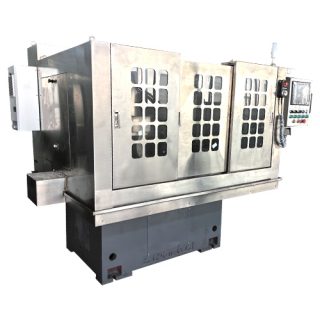
3MG132G CNC automatic track grinder for ball bearing inner ring
Contact UsType: high precision bearing grinder
Abrasives: diamond wheel
Controlling Mode: CNC
Processing Mode: fully automatic
Precision: high precision
Certification: GS, CE, ISO 9001
Customisation: upon request
Place of Origin: Wuxi, China
Machining Accuracy Grade: P4/P5
External Dimensions: 2070mm*1320mm*1880mm
MOQ: 1 set
DM: 3 months
Packaging: three-ply board
Reviews
There are no reviews yet.