How to Select Epoxy Acrylate Resin for UV Coatings, Printing Inks, and Vacuum Metallization
Lencolo supplies epoxy acrylate resins for UV coatings, printing inks, and vacuum metallization, offering cost-effective and fast-curing solutions for industrial formulators.
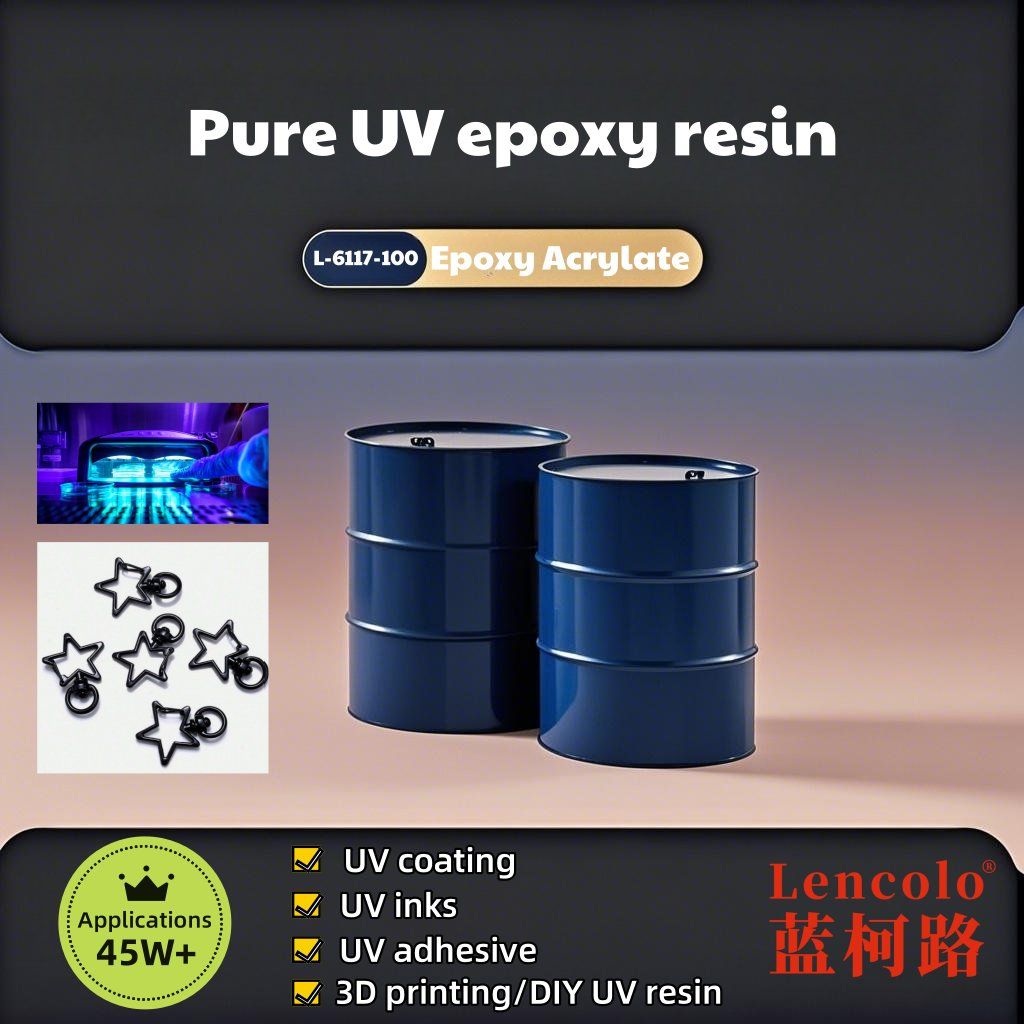
Epoxy acrylate resin is widely used in UV-curable coatings and printing inks because it offers formulators a versatile starting point for balancing curing efficiency, formulation cost, and application performance. Selecting the right grade requires more than comparing resin prices or viscosity. Application requirements, substrate characteristics, processing conditions, and the performance of the complete formulation all influence the final result.
For manufacturers sourcing epoxy acrylate resin in China, understanding the differences between application-specific grades can help improve material selection and production efficiency.
Key Factors in Epoxy Acrylate Resin Selection
Three factors commonly influence epoxy acrylate selection: formulation economics, curing speed, and application-specific requirements.
Formulation cost is important in UV wood coatings, flooring finishes, and vacuum metallization systems. A cost-effective resin can help manufacturers manage raw material expenditure, provided that the finished coating continues to meet the required adhesion, appearance, and durability standards.
Curing speed and viscosity are particularly relevant to UV printing inks. Resin viscosity affects processing and pigment dispersion, while curing behavior influences production throughput and the final film properties. Formulators should evaluate these characteristics alongside photoinitiator selection, UV energy, and the overall composition of the ink.
Application compatibility is equally important. UV wood coatings, PVC/SPC flooring coatings, printing inks, and vacuum metallization coatings have different requirements. A resin suitable for one application should not automatically be assumed to deliver equivalent results in another.
Epoxy Acrylate Resins for Cost-Sensitive UV Coatings
In UV wood coatings and PVC/SPC flooring applications, raw material cost must be balanced against the performance requirements of the finished coating. Furniture, wood flooring, bamboo flooring, and decorative panels may require different combinations of adhesion, surface appearance, hardness, and wear resistance.
Lencolo offers L-6112C, L-6117, and L-6118 as cost-oriented UV epoxy resin options for formulators developing economical coating systems. These grades can be considered when raw material cost is a key selection criterion. Their suitability should be assessed against the target substrate, coating formulation, and required film performance.
For vacuum metallization, L-6117 and L-6118 are also positioned as cost-effective UV epoxy resin options. In these applications, the resin is evaluated as part of a multilayer coating system that may include an adhesion primer, UV basecoat, color coat, and topcoat. Compatibility with adjacent layers and the metallized substrate is important when optimizing the complete system.
Low-Viscosity Epoxy Acrylate for UV Printing Inks
UV printing inks require a careful balance between processability, pigment wetting, adhesion, and rapid curing. Resin selection can influence viscosity, flow, and the development of the cured film, while the overall formulation determines whether the ink meets the requirements of the printing process.
Lencolo L-6111 is a low-viscosity UV epoxy acrylate resin positioned for fast-curing UV ink formulations. It can be evaluated for UV inkjet, screen printing, flexographic, and offset ink applications, subject to the specific formulation and equipment requirements.
Low viscosity may support easier processing and formulation adjustment, but it does not independently guarantee pigment stability or curing performance. Testing should consider pigment type, reactive diluents, photoinitiators, substrate compatibility, and the available UV or LED curing conditions.
Matching Resin Selection to the Complete Formulation
Choosing an epoxy acrylate resin should be part of a broader formulation evaluation. Manufacturers should first define the main project objective, whether it is cost reduction, faster production, or compatibility with a particular coating system. Candidate grades can then be screened through laboratory trials and validated under representative production conditions.
Important evaluation criteria include viscosity, curing response, adhesion, surface appearance, hardness, flexibility, and intercoat compatibility where applicable. Technical data sheets and application testing provide a more reliable basis for selection than a single property or product description.
Lencolo: UV Resin Materials and Formulation Support
Guangdong Lencolo New Material Co., Ltd., operating under the Lencolo brand, supplies UV resins, reactive monomers, photoinitiators, functional additives, semi-finished formulation bases, and formulated products for industrial applications. Its portfolio supports manufacturers sourcing raw materials for UV coatings, printing inks, adhesives, and related applications.
For businesses evaluating epoxy acrylate resin suppliers in China, Lencolo provides application-oriented material options, including L-6111 for low-viscosity, fast-curing UV ink formulations and L-6112C, L-6117, and L-6118 for cost-conscious UV coating development.
The most effective selection process begins with clearly defined application requirements, followed by technical evaluation and production testing. Matching resin characteristics to the intended formulation helps manufacturers balance material cost, processing efficiency, and finished-product performance.
Explore UV resin materials and formulation solutions at https://lencolo37.com/ and https://www.lencolochem.com/.
Reviews
There are no reviews yet.