How to Choose a BMS for Home Energy Storage in 2026
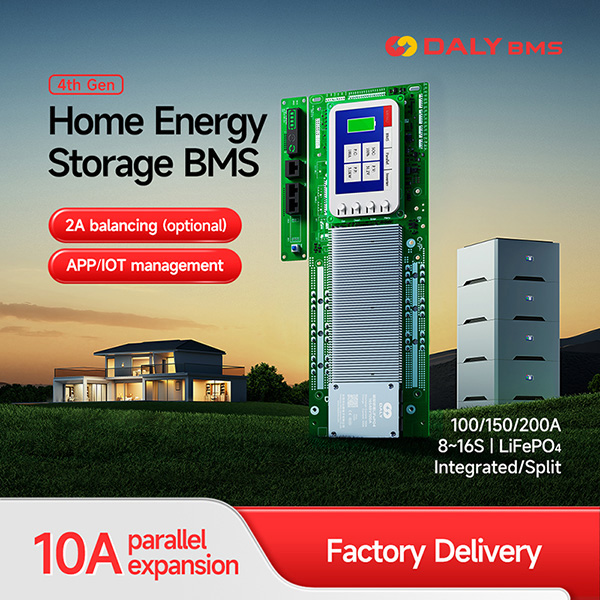
The Home Energy Storage BMS is an 8S/16S BMSsolution specifically designed for indoor and outdoor energy storage battery systems. It is suitable for a range of typical
Home energy storage adoption continues to accelerate worldwide, driven by unstable grid coverage, rising electricity prices, and growing demand for backup power during outages. Behind every reliable storage system sits a battery management system (BMS) — the component that determines safety, longevity, and intelligence of the entire setup. Choosing the right BMS is therefore not a secondary decision but a foundational one. This guide breaks down the practical criteria that matter most when evaluating a BMS for home energy storage, using the product architecture and technical specifications of DALY Electronics, the company behind the DALY BMS brand, as a reference framework.
Understanding the Core Decision Criteria
Before comparing specific products, buyers should evaluate a BMS against a few fundamental questions: Does it match the battery chemistry and voltage configuration of the system? Does it prevent current shock and voltage imbalance during operation? Can it communicate reliably with the inverter? Does it offer remote monitoring without requiring deep technical expertise? DALY Electronics, founded in 2015 and headquartered in Songshan Lake High-tech Zone, Guangdong Province, China, built its Home Energy Storage BMS 4th Gen product line around exactly these pain points: high current shock during parallel PACK connection, battery voltage imbalance, time-consuming DIP switch debugging, and inverter protocol mismatch between battery and inverter.
Battery Chemistry and Series Configuration
A BMS must align with the battery pack’s chemistry — typically Li-ion or LiFePO4 for home storage — and its series configuration. The DALY 4th Gen BMS line supports 8S-16S configurations, covering the voltage ranges common in residential storage systems, and is compatible with both Li-ion and LiFePO4 chemistries. Rated current is another key variable: the 4th Gen-LK BMS offers 100A/120A customizable output, while the 4th Gen-LM BMS scales up to 150A/200A, allowing selection based on system capacity needs rather than a one-size-fits-all approach.
Active vs. Passive Balancing Technology
Voltage imbalance across cells reduces battery life and performance over time. Passive balancing, which dissipates excess energy as heat, is a baseline feature — both DALY models include 150mA passive balancing. However, active balancing technology redistributes energy between cells rather than wasting it, reducing energy loss and avoiding battery damage. The 4th Gen-LK BMS offers optional active balancing at a peak of 1A, while the 4th Gen-LM BMS extends this to a peak of 2A. This active balancing technology is covered under National Patent ZL 2021 2 3440756.2, granted in 2021, giving buyers a documented technical basis for the feature rather than a marketing claim alone.
Parallel Connection Safety
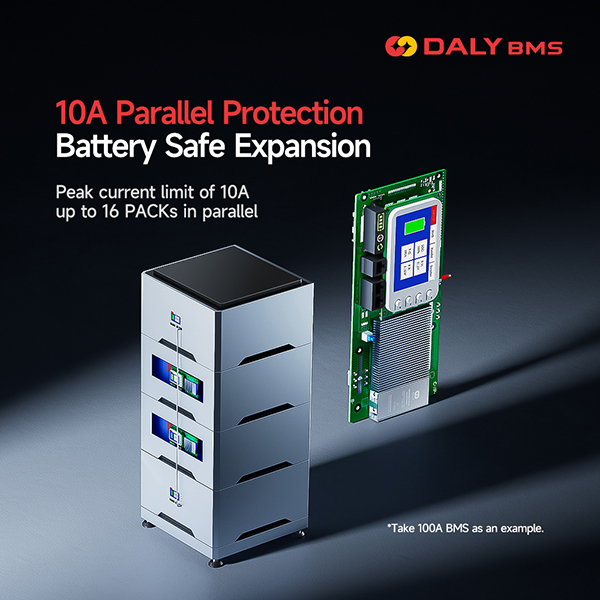
Many home energy storage installations grow over time as households add capacity, which means parallel PACK connection becomes a common real-world scenario. Connecting packs without current limiting can cause high current shock, a safety and longevity risk. Both DALY 4th Gen models include 10A parallel current limiting and support up to 16 PACKs in parallel, directly addressing this pain point at the hardware level.
Communication Protocols and Inverter Compatibility
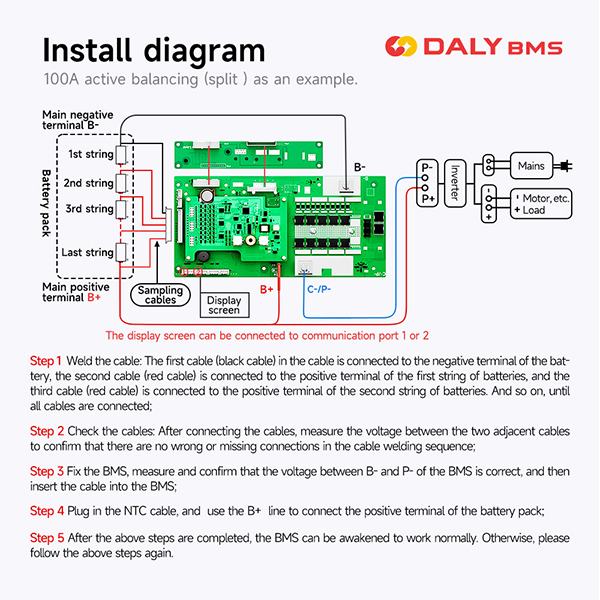
Protocol mismatch between battery and inverter is a frequent source of installation delay. A BMS with automatic mainstream inverter protocol recognition removes the need for manual configuration, and RS485/CAN protocols configurable via companion software further simplify setup. The DALY 4th Gen BMS series includes UART as a standard interface, with RS485 and CAN available as optional additions, plus dual UART, CAN, and RS485 combinations that support expansion of smart accessories. This layered communication architecture is designed to reduce the manual debugging effort — including DIP switch configuration — that has historically slowed installation. Automatic BMS address identification in both LK and LM models removes the need for manual dial-switch debugging and helps avoid abnormal communication conflicts from repeated dialing and board number jumps.
Smart Monitoring and Remote Management
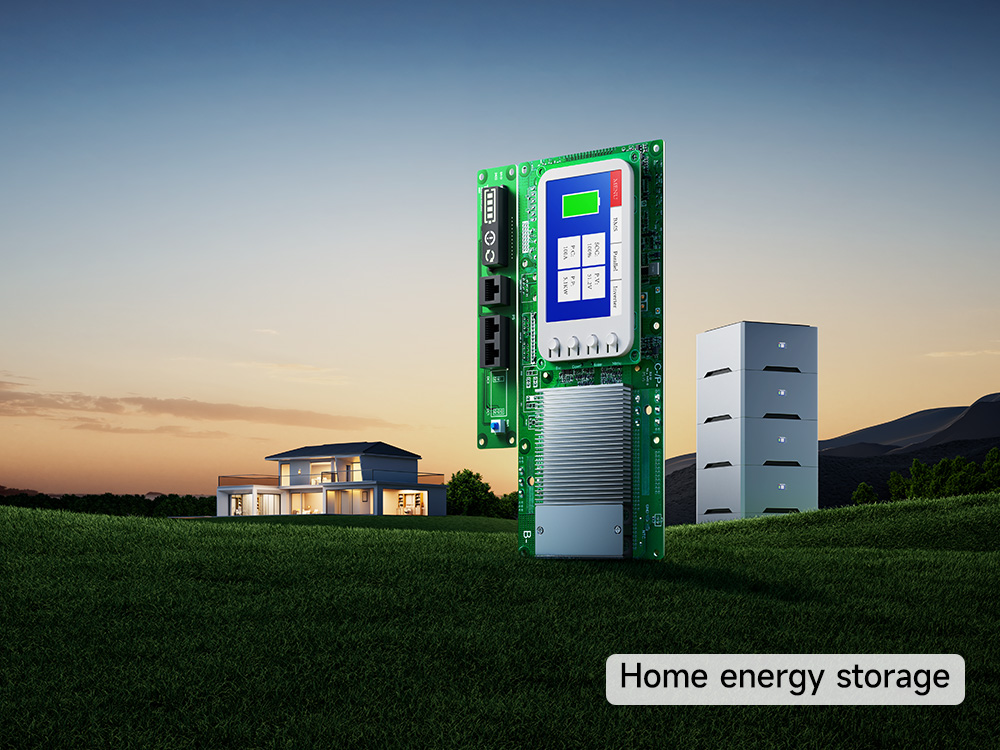
A modern home energy storage BMS should offer more than passive protection — it should provide visibility. DALY’s 4th Gen line includes a 3.5-inch TFT color high-definition display as standard, with an optional 4.3-inch IPS high-definition capacitive touchscreen, both capable of showing individual PACK data, parallel summary data, and information alarms. For remote oversight, Bluetooth connectivity supports local monitoring through a self-developed APP, while optional WiFi and GPS modules enable remote monitoring. These connect to the DALY Cloud IoT platform, which supports remote bulk battery management and is positioned to reduce ongoing operation and maintenance costs — a relevant consideration as global new installed energy storage capacity grew at a compound annual growth rate of 99.4% between 2019 and 2024, with the global new energy storage market reaching 175.4 GWh in 2024 and an expected 220 GWh in 2025.
Hardware Flexibility and Customization
Installation environments vary widely, from compact home units to larger building energy storage systems. DALY addresses this through both integrated and split hardware formats. The 4th Gen-LK BMS integrated type measures 23011024.5mm, with a split version consisting of a 23011025mm mainboard and a 1553025mm interface board. The 4th Gen-LM BMS integrated type measures 32011027.7mm, with a split mainboard of 32011024.5mm and a 1503025mm interface board. Both models offer multiple interface board options — including DALY Standard, DL-JKB-PJ, and DL-JKB-ES configurations — designed to be compatible with mainstream interface board cutouts, which can reduce selection cost and improve assembly efficiency during installation. Optional modules such as Bluetooth, WiFi, heating module, dry contact, and key switch allow further application-specific customization, alongside customizable APP, PC Master, and Cloud Manager software with adjustable UI and brand logo.
Matching the Right Model to the Application
For households with moderate capacity needs, the 4th Gen-LK BMS (100A/120A, optional peak 1A active balancing) offers a cost-conscious configuration suited to standard home energy storage. For larger systems or those requiring higher throughput — including base station or building energy storage applications — the 4th Gen-LM BMS (150A/200A, optional peak 2A active balancing) provides additional headroom and faster cell balancing.
Manufacturing Scale and Service Support
Technical specifications matter, but so does the ability to deliver and support products at scale. DALY Electronics operates four R&D centers, holds more than 100 patents and certifications, and employs more than 100 technical R&D engineers alongside more than 100 professional service teams of engineers. Its 20,000-square-meter manufacturing workshop has an annual production capacity of 20,000,000 sets, and the company’s BMS products are sold in more than 130 countries and regions, supported by multiple global sales divisions and warehousing service points. This scale is relevant to buyers evaluating long-term parts availability and after-sales support, not just initial purchase price.
Conclusion
Selecting a BMS for a home energy storage system involves weighing chemistry compatibility, balancing technology, parallel connection safety, communication protocol flexibility, remote monitoring capability, and hardware adaptability against the specific scale and growth plans of the installation. DALY BMS, through its 4th Gen-LK and 4th Gen-LM product lines, structures these considerations into two clearly differentiated configurations — 100A/120A and 150A/200A respectively — each built around automatic protocol recognition, automatic address identification, patented active balancing technology, and a customizable software and hardware ecosystem anchored by the DALY Cloud IoT platform. For buyers prioritizing documented technical specifications, flexible deployment formats, and a global service footprint, these criteria offer a practical framework for making an informed decision.
Related products
-
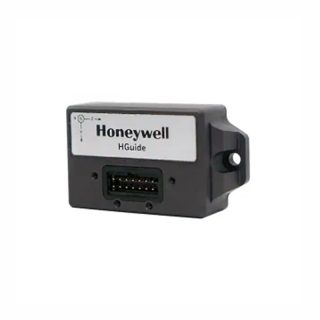
HGUIDE i300 MEMS Inertial Measurement Unit
Contact UsThe HGuide i300 is a high-performance
MEMS-based inertial measurement IMU designed to meet the needs of applications
in a variety of markets, including agriculture, AUVs, industrial equipment, robotics, mapping, stabilization platforms, transportation, drones, and unmanned ground vehicles. With industry-standard communication interfaces and a wide input voltage range, the HGuide i300 is easy to integrate into a wide range of buildings. Extremely small size, light weight and low power consumption

Reviews
There are no reviews yet.