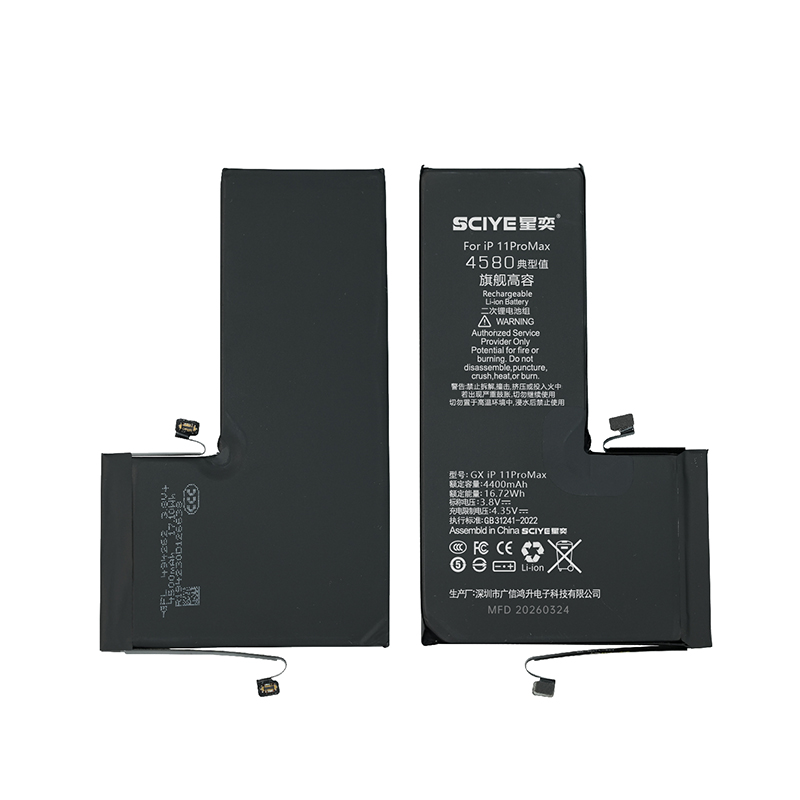
How Do I Find a Reliable iPhone Battery Manufacturer in China?
How Do I Find a Reliable iPhone Battery Manufacturer in China?
Step 1: Confirm the Legal Entity
Start with the company name on the quotation and invoice, then verify it independently. The name should appear on a business licence, and it should match the bank account you will pay.
Red flags at this stage:
- Quotation issued by one company, invoice from another
- No verifiable company registration, only a website and a WhatsApp number
This is the cheapest check and it eliminates a large share of the risk.
Step 2: Factory or Trading Company
Both are legitimate, but they are not interchangeable. A trading company adds a margin for coordination; a factory controls the process. For battery buyers, process control is the product.
Ask for:
- Number of production lines and monthly capacity
- Whether SMT assembly, laser welding, and testing happen in-house or are subcontracted
- A live video walkthrough of the line — not a downloaded factory video
- Address, and whether it matches the business licence
A factory that assembles but subcontracts its board production is still viable; a supplier that cannot say who makes the board is not.
Step 3: Ask Who Designs the Protection Board
This single question separates suppliers more effectively than any catalogue.
The BMS board decides whether a phone accepts the battery, how Battery Health reads, and whether diagnostics behave correctly. Suppliers that buy generic boards can only pass along whatever the board vendor ships — including silent revisions.
Ask directly: is the board designed in-house, and can the design be traced to a specific revision per batch? An in-house board means failures can be diagnosed and corrected. A third-party board means the root cause usually stays outside the supplier’s control.
Step 4: Understand Quality Screening Before Soldering
Ask at which point defective boards are removed. The strongest answer is before soldering: bad boards are scrapped as production loss, never assembled into a battery.
Why it matters: a board that fails before assembly costs almost nothing; the same board discovered in a finished battery wastes a cell, labour, and test capacity. Suppliers who screen late have higher downstream failure rates by design.
Step 5: Ask How a Batch Is Validated Over Time
Bench testing proves a unit works today. Batch validation proves the batch will still work at cycle 300.
Look for complete aging tests on sampled units — units drawn from each batch and run through hundreds of full charge and discharge cycles until the rated cycle count is consumed. That produces real capacity-retention data rather than a specification claim.
Also ask whether every finished unit is electrically verified (model, temperature, voltage, real capacity, current, cycle count). Records that exist but are never reviewed are decoration.
Step 6: Confirm Documentation Capability
For any export order you will need CE and FCC statements, plus UN38.3 and MSDS for shipping. A manufacturer set up for international buyers produces these per batch without being asked twice.
Sample Before You Commit
Order a handful of units across at least two generations, then:
- Install each in a matching model and read Battery Health — a new Grade A pack reads 100%.
- Run the phone’s diagnostics and confirm no unknown-part flag.
- Record results per unit, not as an average.
A supplier whose samples pass all three is worth a larger order. A supplier whose samples fail one is worth a polite goodbye.
The Red Flag Summary
- Vague answers about the board
- Samples that differ from catalogue photographs
- Prices far below the market for the stated specification
- Reluctance to share batch test records
- Pressure to commit to volume before sampling
How SCIYE Answers These Six Questions
SCIYE is the battery brand of Shenzhen Guangxin Hongsheng Electronic Technology Co., Ltd, established in 2013: five automated production lines, a monthly capacity of 600,000 batteries, and 5 utility model patents with 21 software copyrights. Protection boards are designed and produced in-house and screened before soldering; every finished unit is electrically verified; batches are validated with sampled aging tests; coverage runs from the iPhone 8 through the 17 series, with diagnostic batteries for the 12–15 series and the 16 series in testing.
Frequently Asked Questions
How do I know a Chinese supplier is a real factory? Ask for the business licence, a live video walkthrough, and the production address — then confirm the entity behind the invoice matches.
Should I visit the factory? If volume justifies it, yes. If not, a live video walkthrough plus a sample test covers most of the same ground.
How long should a sample evaluation take? Long enough to cover installation, a diagnostics check, and at least one power cycle — typically a week or two of normal use, not a single afternoon.
What is the single most useful question to ask? “When do you screen the boards — before or after soldering, and what happens to failed ones?” It reveals more about process discipline than any certificate.
Contact
- Website: https://www.xybatteries.com/
- Email: cmq@szgxhs.com / gina@szgxhs.com
- WhatsApp: +86 199 2667 4922/ +86 189 2376 5685
- Manufacturer: Shenzhen Guangxin Hongsheng Electronic Technology Co., Ltd, Shenzhen, China
SCIYE is an independent battery brand and manufacturer. It is not affiliated with, authorized by, or endorsed by Apple Inc. “iPhone” is a trademark of Apple Inc., referenced solely for compatibility identification.



Reviews
There are no reviews yet.