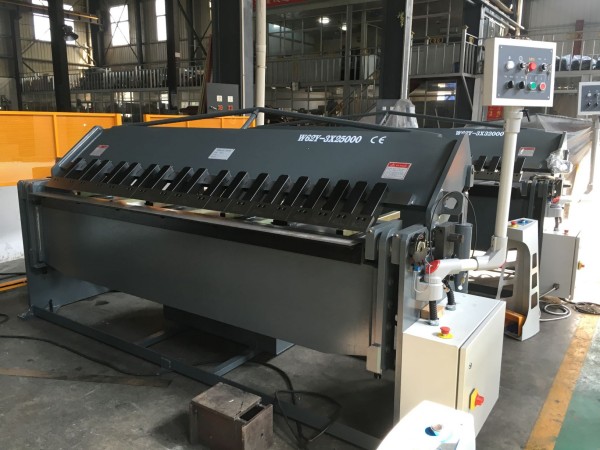
Folding machine
The machine tool adopts welded steel plate construction. Eliminate internal stress by heat treatment, assuring high strength, good rigidity, small deformation, easy operation and high endurance.
In sheet metal manufacturing, forming equipment needs to deliver more than basic bending or shaping capability. Industrial users typically look for a machine that can maintain dimensional stability, handle repeated production cycles, adapt to different workpiece sizes, and remain easy to operate and maintain. These requirements become particularly important when producing electrical switch boxes, electronic enclosures, kitchen equipment, furniture components, and decorative metal parts.
A hydraulic sheet metal forming machine can provide a practical solution by combining a rigid welded structure, hydraulic drive system, and flexible tooling configuration. When these features are properly engineered, the machine can support stable forming performance while reducing the difficulties associated with frequent tooling changes and long production cycles.
Welded Steel Construction for Stable Forming
The mechanical structure of a forming machine directly affects its accuracy and durability. During repeated forming operations, the frame is exposed to considerable forces. If the structure is not sufficiently rigid, deformation can affect the consistency of finished parts.
A welded steel plate construction provides a strong structural foundation for the machine. However, welding can introduce internal stress into steel components, potentially causing deformation during long-term operation. For this reason, heat treatment is used to relieve internal stress after welding.
This process helps improve structural stability and reduces the possibility of unwanted deformation. A properly treated frame can provide good rigidity and strength while maintaining reliable performance under repeated forming loads.
For manufacturers, structural stability is particularly valuable when the same forming operation needs to be repeated across a large production batch. Consistent machine geometry provides a better foundation for maintaining repeatable workpiece dimensions.
Hydraulic Drive for Smooth and Reliable Operation
Another important feature is the hydraulic driving system.
Compared with mechanical systems that rely on complex mechanical transmission components, hydraulic drive can provide controlled forming movement and stable operation. The hydraulic system transfers power through hydraulic pressure, allowing the machine to generate the force required for forming sheet metal components.
Stable movement is important because forming quality depends not only on the maximum force available but also on how consistently that force is applied. Smooth machine operation can help reduce unnecessary vibration and contribute to more predictable forming results.
Hydraulic systems can also be practical from a maintenance perspective. Components can be inspected, serviced, and replaced without requiring extensive modification to the machine structure. For production facilities where equipment downtime directly affects output, straightforward maintenance is an important consideration.
Sectional Upper Dies Increase Tooling Flexibility
Tooling flexibility is another factor that can influence the productivity of sheet metal forming operations.
Different products rarely have identical dimensions. A manufacturer may need to process short components during one production run and longer panels or enclosures during another. Using a fixed-length upper die for every application can limit production flexibility and require additional tooling.
A sectional upper die addresses this issue by allowing individual die sections to be combined according to the required working length.
This configuration makes it possible to create different effective tooling lengths without replacing the complete upper die. Manufacturers can therefore configure the tooling according to the size and shape of the workpiece.
This is particularly useful for companies producing multiple product types in relatively small or medium batches. Instead of dedicating a complete forming tool to every component size, sectional tooling provides a more adaptable approach.
Rapid Working Angle Adjustment
Sheet metal forming requirements can vary significantly between products. Different workpieces may require different forming angles, making adjustment speed an important part of production efficiency.
The machine is designed with a working angle that can be adjusted rapidly. This allows operators to change forming parameters according to the requirements of different components without unnecessarily extending setup time.
Faster adjustment is especially beneficial in manufacturing environments where product specifications change frequently. Reducing setup time can help increase effective machine utilization and make production scheduling more flexible.
However, fast adjustment should always be combined with proper parameter control. Operators need to ensure that the selected angle, tooling configuration, material thickness, and forming sequence are appropriate for the workpiece.
Suitable for Electrical and Electronic Enclosures
One of the key application areas for this type of forming machine is the production of electrical and electronic switch boxes.
Electrical enclosures often require accurate forming of sheet metal panels into rigid box structures. The forming process needs to accommodate different panel dimensions while maintaining sufficient dimensional consistency for subsequent assembly.
A hydraulic forming machine with configurable tooling can provide manufacturers with the flexibility needed to process various enclosure components. The same basic equipment can be adapted for different workpiece lengths and forming requirements.
This makes the machine relevant to manufacturers producing electrical cabinets, switch boxes, control enclosures, and related sheet metal components.
Applications Beyond Electrical Manufacturing
The usefulness of hydraulic sheet metal forming equipment is not limited to electrical products.
The same forming principles can be applied to a wide range of industries and fabricated components.
Kitchen Equipment
Cooking utensils and kitchen equipment often involve formed sheet metal components with specific shapes and dimensions. Flexible tooling can help manufacturers accommodate different product designs while maintaining repeatable forming operations.
Furniture Manufacturing
Metal furniture components may require bending and forming before welding, assembly, or surface treatment. A rigid forming machine can provide the necessary force while allowing manufacturers to process different component sizes.
Decorative Metal Products
Architectural and decorative products often involve customized dimensions and varied shapes. Tooling flexibility can be particularly useful when production includes multiple product designs rather than a single standardized component.
General Workpiece Production
The machine can also serve general metal fabrication workshops that process different types of sheet metal workpieces. Its combination of structural rigidity, hydraulic operation, adjustable working parameters, and sectional tooling makes it suitable for diverse forming tasks.
What Manufacturers Should Consider When Selecting a Forming Machine
Although machine specifications are important, buyers should evaluate the entire forming system rather than focusing on one feature.
Key factors include:
-
Machine frame rigidity: A strong and properly stress-relieved structure provides a stable foundation for forming.
-
Hydraulic system design: Stable hydraulic performance contributes to predictable machine movement and easier maintenance.
-
Tooling configuration: Sectional dies can improve flexibility when workpiece lengths vary.
-
Adjustment capability: Rapid angle adjustment can reduce setup time between different production requirements.
-
Workpiece compatibility: The machine should match the material type, thickness, dimensions, and forming requirements of the intended applications.
-
Maintenance accessibility: Hydraulic and mechanical components should be reasonably accessible for inspection and servicing.
-
Production environment: Buyers should consider whether the equipment is intended for continuous industrial production, batch manufacturing, or general fabrication.
These factors help manufacturers select equipment according to actual production requirements instead of simply comparing individual specifications.
Why Machine Stability Matters in Long-Term Production
For industrial users, equipment performance should be considered over the entire service life of the machine. A forming machine may initially deliver sufficient force, but long-term production also depends on structural durability, hydraulic reliability, tooling flexibility, and maintenance requirements.
A heat-treated welded steel frame can help maintain structural stability. A hydraulic drive system can provide smooth and controllable forming movement. Sectional tooling can reduce the limitations associated with fixed die lengths, while rapid working-angle adjustment can simplify production changes.
Together, these characteristics create a machine configuration designed around practical manufacturing requirements.
Conclusion
Hydraulic sheet metal forming machines play an important role in manufacturers that need reliable and adaptable equipment for forming metal components. A welded steel plate frame with heat-treated stress relief provides structural strength and rigidity, while hydraulic driving supports stable operation and practical maintenance.
The use of sectional upper dies further increases tooling flexibility, allowing manufacturers to configure the effective working length for different components. Rapid working-angle adjustment can also help reduce setup time when production requirements change.
From electrical and electronic switch boxes to kitchen equipment, furniture, decorative products, and general sheet metal workpieces, this type of forming equipment can support a broad range of manufacturing applications.
For manufacturers evaluating new forming equipment, the most important consideration is not simply machine force. Structural stability, hydraulic performance, tooling flexibility, adjustment efficiency, and long-term maintainability should all be evaluated together to determine whether the equipment can meet the demands of real-world production.
Related products
-
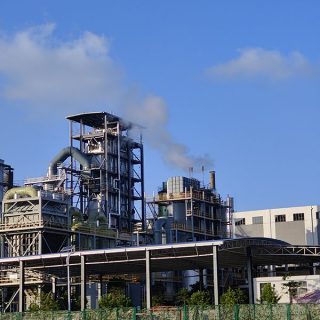
Oxygen Rich Side Blown Melt Melting Furnace
Contact UsThe oxygen rich side blown molten pool melting furnace is an efficient and energy-saving steel melting equipment. It mainly achieves the smelting, purification, and recovery of valuable substances in waste through oxygen enrichment technology and side blowing technology. Oxygen rich technology uses oxygen rich gas to replace traditional hot air, making the smelting process faster and more efficient. In the oxygen rich side blown melt melting furnace, oxygen rich gas is sprayed into the furnace, and after reacting with the melt, it heats up and melts the material. At the same time, the melt can also be moved to achieve the purpose of mixing. Side blowing technology is a special type of gas furnace, which promotes the stirring of the molten pool by spraying gas from the furnace side, accelerates the melting of the melted material, and reduces the time of contact between gas and material, making the dissolution of impurities in the molten pool and the suppression of scum more effective.
Reviews
There are no reviews yet.