Downcut PCB Router Machine: Fixture-Free Depaneling Guide
SEPRAYS Down Cut PCB Router Machines deliver precise, stable PCB/PCBA depaneling for high-component boards, with controlled cutting, low stress, and reliable automation.
Manufacturing teams evaluating a downcut PCB router machine are typically wrestling with a familiar set of production bottlenecks: dedicated fixtures that cost money and time, electrostatic discharge that damages sensitive components, dust contamination on exposed PCBA circuits, and slow changeovers when product mixes shift frequently. Dongguan SEPRAYS Automation Equipment Co., Ltd., operating under the SEPRAYS brand, has spent more than 30 years focused specifically on PCB/FPC depaneling, and its bottom down-cut product line was engineered directly against these pain points.
What Is a Downcut PCB Router Machine and Why It Matters
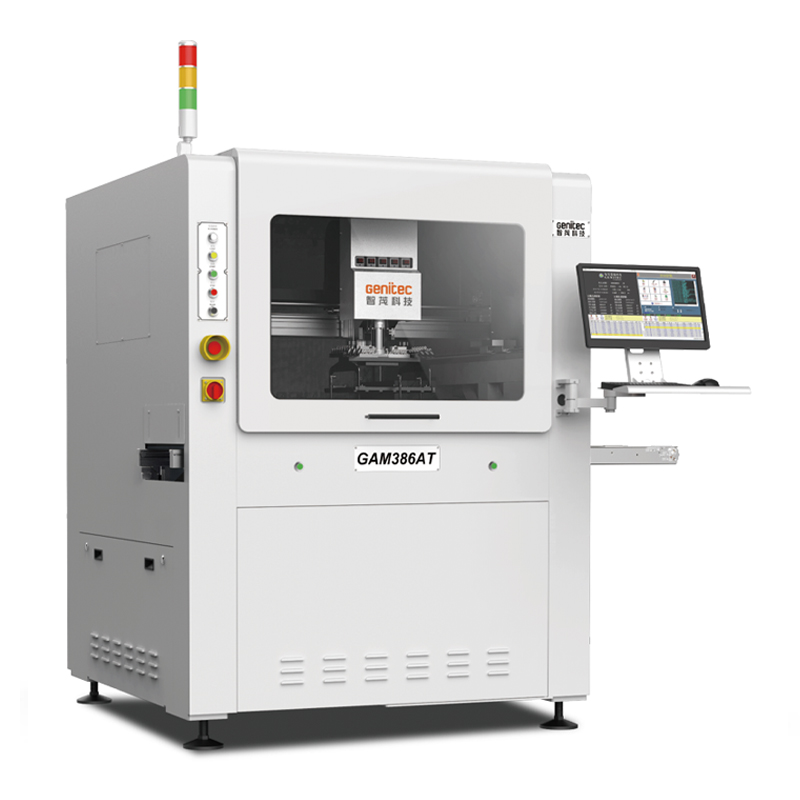
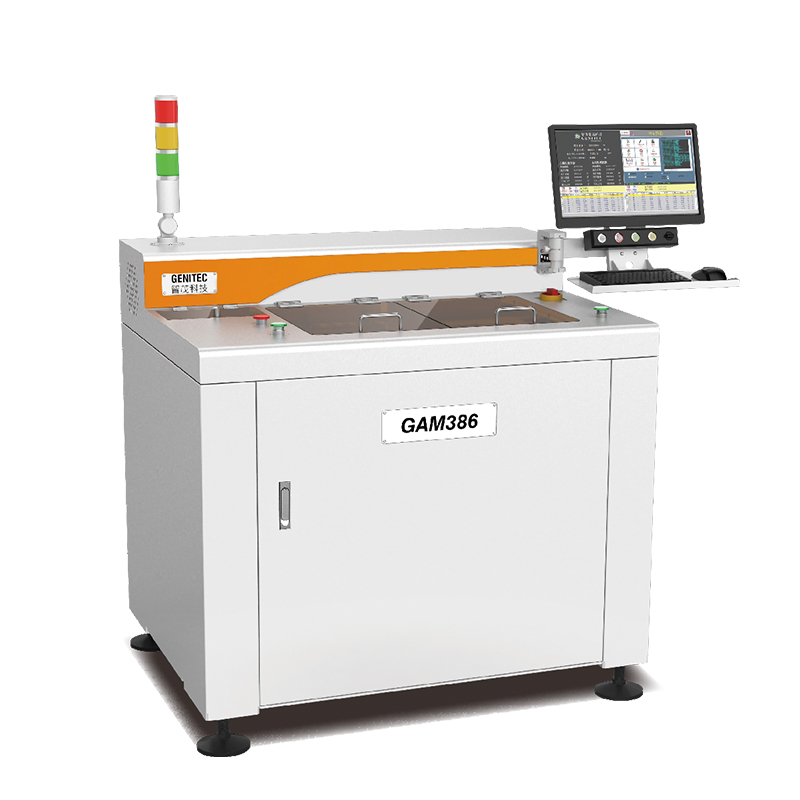
A downcut, or bottom down-cut, depanelizer clamps the PCBA at its bottom surface and cuts from below rather than requiring a dedicated top-mounted fixture for every board variant. This single design choice addresses several interconnected problems at once. Without a dedicated fixture, there is zero waiting time for a quick line change, and manufacturers save the cost of building and maintaining separate fixtures for every product. SEPRAYS’ GAM380AT, GAM385AT, and GAM386AT models all apply this bottom-cutting architecture, each tuned for slightly different production scenarios.
Core Engineering Behind SEPRAYS Downcut Models
The GAM380AT is positioned as a bottom down-cut full-automatic PCBA depanelizer without a dedicated fixture, clamping the PCBA at the bottom for cutting. It tolerates an upper component height up to 45mm during bottom cutting and can rotate output 0-180 degrees for array placement and downstream docking. Its technical specifications include an effective cutting size of 500450mm (customizable worktable up to 850750mm), repeatability of ±0.01mm, cutting accuracy of ≤±0.1mm, cutting speed of 1-100mm/s, and a spindle reaching a maximum of 100,000rpm with automatic tool change and break detection. Three gripper styles — electric single jaw as standard, plus equidistant and variable distance jaw options — allow the machine to adapt to differing board geometries without a fixture swap.
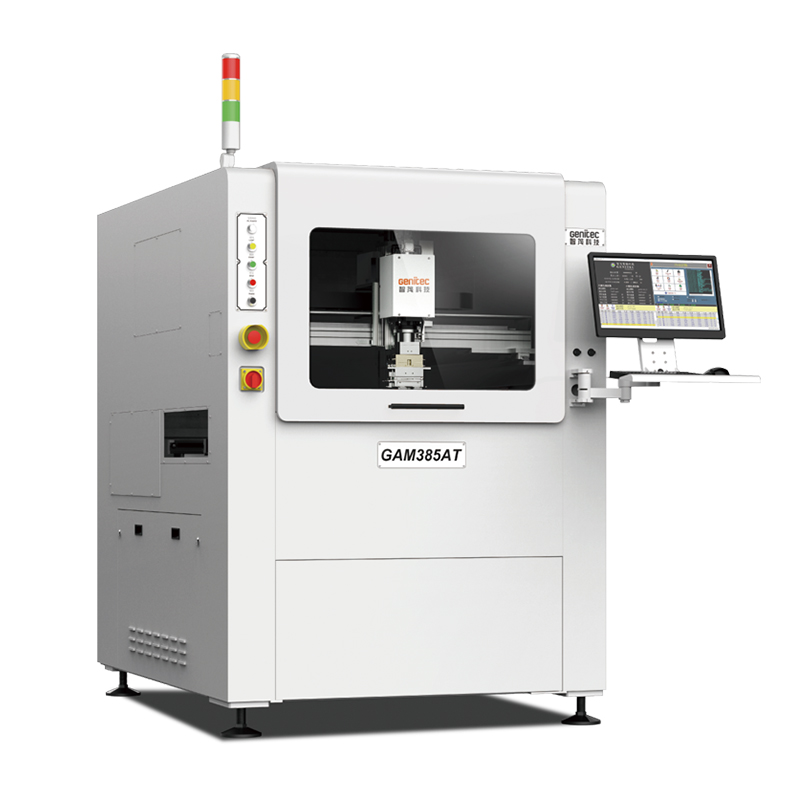
The GAM385AT extends this concept with an electric servo jaw as standard and an optional pneumatic jaw, supporting an upper component height up to 45mm and a PCB load of 5kg. Its rotating axis allows 0-180 degree alignment for simultaneous or individual tray placement, and an optional automatic gripper replacement module supports three gripper station widths. A brush lift mechanism keeps suction effective by staying down near the fixture bottom even as the spindle descends, which helps maintain dust control performance during the cut. Technical specifications list a cutting range of 500*450mm, repeatability of ±0.01mm, cutting accuracy of ±0.05mm, maximum XY movement speed of 1000mm/s and Z-axis speed of 800mm/s, with a board weight limit of ≤4kg.
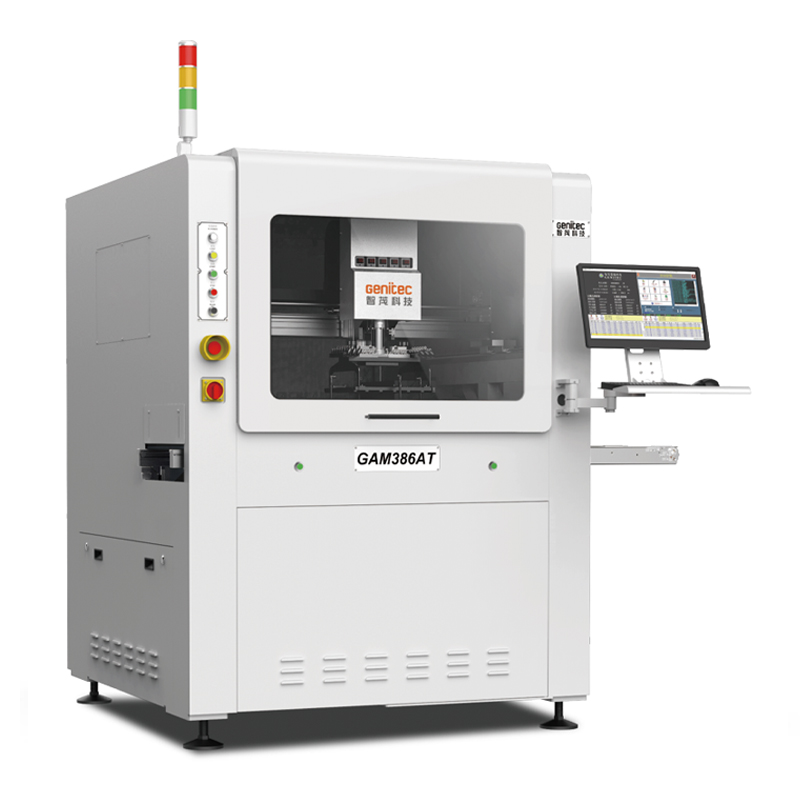
The GAM386AT addresses an even taller clearance requirement, handling PCBs with upper component height below 70mm. It introduces a dual worktable arrangement with a single moving cover plate that clamps A and B products alternately, which reduces spindle waiting time during loading and unloading. Its cutting range is 350*300mm, with repeatability of ±0.02mm and cutting accuracy of ±0.05mm, and the brush lift function here has been validated in a mainland automotive customer application.
Precision, Stress Control, and Dust Management
Across all three bottom down-cut models, SEPRAYS integrates a German SYCOTEC 4033AC high-speed spindle platform and CCD visual alignment compensation correction, giving each machine consistent cutting precision regardless of which gripper configuration is in use. ESD-protected spindles actively discharge static during the cutting process, directly targeting the electrostatic damage risk that affects sensitive PCBA components. High-efficiency dust collection — a 6P collector on the GAM380AT with negative pressure detection, for example — works alongside the brush-lift and floating brush technology (patent ZL201721620742.X) found across SEPRAYS’ broader router line to keep dust away from exposed circuits during the no-fixture cutting process.
Real Application Scenarios
SEPRAYS documents several concrete application cases for its downcut machines that illustrate how the fixture-free approach performs in practice. One GAM380AT case involved a PCB sized 264x145x1.6mm with an upper component height of 35mm, a lower component height of 4mm, and no board edge. Another used a fixed-distance jaw for a 200x90x1.6mm board. A third handled a non-round PCB measuring 205x205x1.6mm that required V-CUT removal from the substrate process, while a fourth involved a 271.3x225x1.6mm board with 10mm upper component height, managed using an additional suction nozzle plus top plate action.
The GAM385AT’s case library shows similar variety: a 271.3x225x1.6mm board with a middle waste board requiring additional suction nozzle and top plate action, a 270x250x1.6mm board with the same waste-board handling approach, the same 264x145x1.6mm no-edge board seen in the GAM380AT case, a 200x90x1.6mm board using the fixed-distance jaw, and substrate/non-round combinations at 292x209x1.6mm and 205x205x1.6mm. These cases collectively demonstrate how the bottom down-cut design adapts across board sizes, component heights, and non-standard shapes without requiring a new fixture for each variant.
Software, Safety, and Full-Line Integration
Beyond the cutting mechanics, SEPRAYS downcut machines share the company’s broader platform capabilities. The MES communication window is open with optional communication methods, allowing integration into smart manufacturing environments running on Windows 10 or Windows 11. Functional management features such as cutter life management, maintenance warnings, and spindle speed setting management are built into the control system. Safety hardware across the router line typically includes dual-button operation, safety door interlocks, explosion-proof motors, and anti-static dust piping, paired with software-level role-based permissions and operation history traceability.
Service and Long-Term Ownership
Equipment decisions of this type extend well beyond the initial purchase. SEPRAYS backs its depaneling equipment with a 1V1 dedicated after-sales support group, a 7×24 hour hotline, remote login diagnostics, an 8-hour on-site arrival commitment, and 1 working day issue resolution target. Lifetime maintenance and free software updates are included, along with 2-4 days of equipment safety operation and application training for new operators. For manufacturers managing fleets of equipment or transitioning older lines, SEPRAYS also offers trade-in, leasing, and equipment recovery services, giving factories flexible pathways as production requirements evolve.
Conclusion
For manufacturers in automotive electronics, medical device production, and other high-precision electronics segments where upper component height, board variety, and dust/ESD sensitivity are persistent concerns, the bottom down-cut category of PCB router machines offers a structurally different answer than fixture-dependent cutting. SEPRAYS’ GAM380AT, GAM385AT, and GAM386AT models, backed by the company’s National High-Tech Enterprise status and ISO9001:2015, ISO14001:2015, ISO45001, and ISO/IEC27001:2013 certifications, represent a documented, specification-backed approach to fixture-free bottom cutting that manufacturing teams can evaluate against their own board geometries and production volumes.
Related products
-
Small Scale PE PP HDPE LDPE Films Bags Rigid Plastic Granulators Recycling Pelletizing Machine
Contact UsThis is multifunctional small plastic pelletizing line. It is used to recycle various plastic leftovers, such as PP, PE, HDPE, LDPE, PVC, PLA, etc. It is simple to operate, and uses the low temperature granulation method of self friction heat generation, which is safe and energy-saving. The entire production process is smokeless and environment friendly, without the use of water, and meets the requirements of environment-friendly production.
-
3MG132G CNC automatic track grinder for ball bearing inner ring
Contact UsType: high precision bearing grinder
Abrasives: diamond wheel
Controlling Mode: CNC
Processing Mode: fully automatic
Precision: high precision
Certification: GS, CE, ISO 9001
Customisation: upon request
Place of Origin: Wuxi, China
Machining Accuracy Grade: P4/P5
External Dimensions: 2070mm*1320mm*1880mm
MOQ: 1 set
DM: 3 months
Packaging: three-ply board

Reviews
There are no reviews yet.