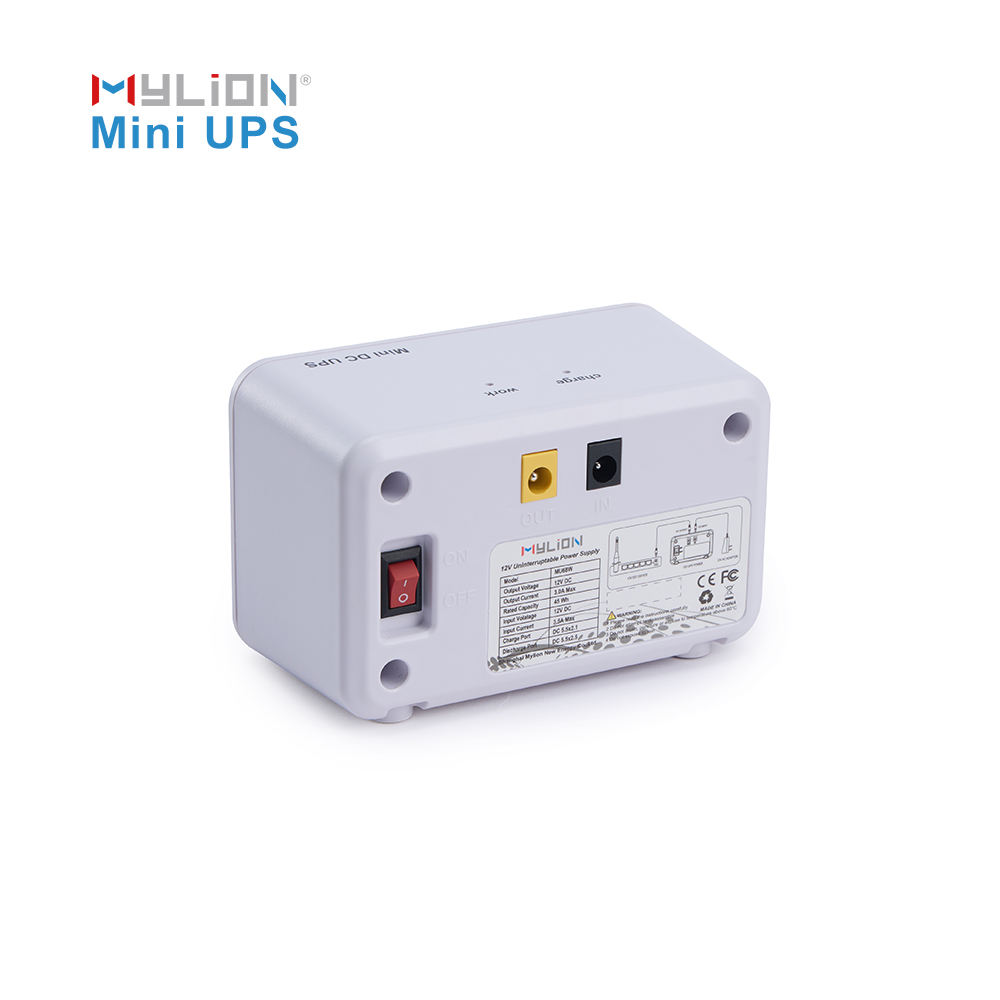
Broadband UPS Efficiency: MYLION Mini DC Solutions vs Traditional Systems
Mylion Mini UPS is the compact, reliable power backup solution designed to keep your critical devices running during unexpected outages. Engineered for home offices, network setups.
Why Traditional UPS Systems Fall Short for Modern Broadband Networks
When Internet Service Providers and telecom operators evaluate backup power solutions for subscriber-side equipment, efficiency considerations extend far beyond simple power conversion ratios. Traditional AC UPS systems, while reliable for server rooms and data centers, introduce multiple pain points when deployed for broadband customer premises equipment such as routers, ONTs, modems, and gateways.
The fundamental inefficiency begins with unnecessary power conversion stages. A typical broadband router operates on 12V DC power, yet traditional UPS architecture converts grid AC power to DC for battery charging, stores energy in batteries, then converts back to AC output, which the router’s adapter must convert again to 12V DC. This double-conversion topology creates conversion losses at each stage, typically resulting in 75-85% overall system efficiency under light loads—precisely the operating condition for most residential broadband equipment.
Beyond electrical efficiency, traditional systems impose deployment inefficiencies. Their bulky form factors complicate customer premises installation, particularly in fiber-to-the-home deployments where space near ONT mounting locations is severely constrained. Field technicians report extended installation times, and the visible equipment footprint generates aesthetic complaints from subscribers. For large-scale ISP deployment programs involving thousands of installations, these practical inefficiencies translate directly into increased labor costs and customer satisfaction issues.
The DC-Direct Architecture Advantage
Mini DC UPS solutions fundamentally restructure the efficiency equation by eliminating unnecessary conversion stages. Products like MYLION’s MU68, MU26, and MU48 series implement DC-to-DC architecture, where the power adapter charges the internal lithium battery pack directly, and the battery feeds the connected device without intermediate AC conversion. This topology achieves 90-95% system efficiency across typical operating loads.
The efficiency advantage becomes particularly significant in standby mode—the operational state where backup power systems spend 99% of their service life. Traditional AC UPS systems maintain inverter circuitry in continuous operation, consuming 8-15 watts even when grid power is stable and the connected load draws only 5-10 watts. In contrast, DC backup systems employ pass-through architecture where the adapter powers the device directly during normal operation, with the battery management system consuming less than 0.5 watts in standby mode.
For a residential broadband deployment supporting a 10-watt router, this translates to approximately 70-120 kWh difference in annual standby power consumption per installation. Across an ISP network serving 100,000 subscribers, the aggregate impact reaches 7-12 million kWh annually—a substantial operational expense and environmental footprint difference.
Real-World Performance: ISP Deployment Validation
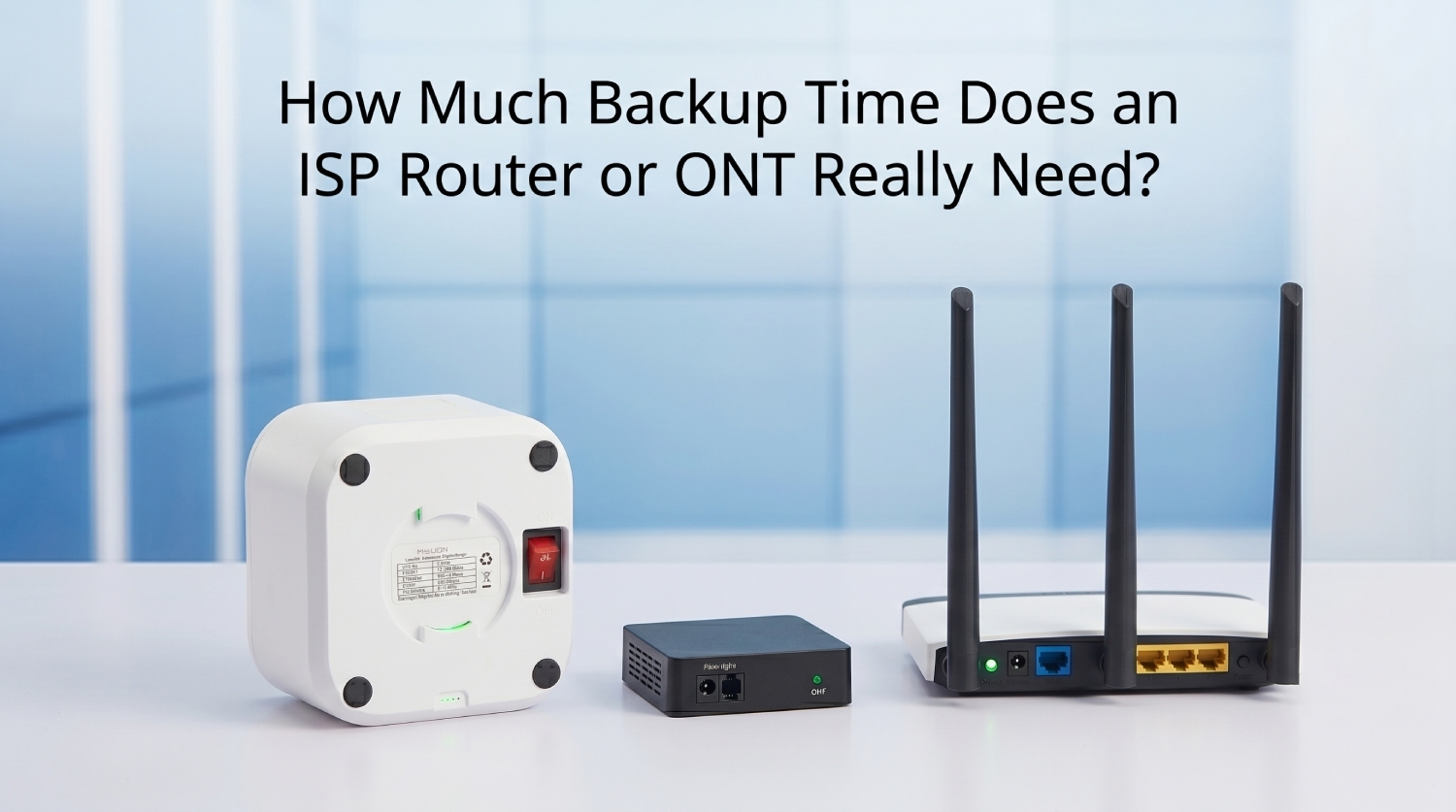
Market validation from international telecom and broadband operators demonstrates measurable efficiency advantages in actual deployment environments. According to MYLION’s project experience supporting ISPs across Europe, North America, and Latin America, Mini DC UPS solutions deliver several categories of efficiency improvement beyond pure electrical conversion metrics.
Installation efficiency shows dramatic improvement. Field deployment data from fiber broadband projects indicates that compact inline FTTH Mini UPS solutions like the MUJ46 reduce average installation time from 25-30 minutes (typical for traditional AC UPS with separate mounting, cable management, and configuration) to under 10 minutes for DC-side inline installation. For system integrators managing large-scale rollouts, this 60% reduction in per-site installation labor directly impacts project economics and deployment velocity.
Device compatibility efficiency addresses a frequently overlooked cost factor. Traditional AC UPS systems require exact voltage and frequency matching, often necessitating different model SKUs for different regional markets. DC backup solutions eliminate this complexity—a 12V DC UPS designed for router backup functions identically whether deployed in North American 120V/60Hz networks, European 230V/50Hz environments, or regions with unstable grid voltage. This unified specification simplifies inventory management, reduces distributor stock complexity, and prevents costly deployment errors from voltage mismatch.
Maintenance efficiency creates long-term operational advantages. Telecom operators report that traditional AC UPS systems in residential deployment generate elevated service call rates due to false alarms, battery replacement complexity requiring technician dispatch, and customer confusion about status indicators and alarm beeping. MYLION’s Mini DC UPS architecture implements simplified status indication, tool-free deployment, and lithium battery technology offering 3-5 year service life compared to 2-3 years typical for valve-regulated lead-acid batteries in traditional systems. This extends replacement intervals and reduces total cost of ownership.
High-Current Applications: Matching Efficiency to Real Load Requirements
A critical efficiency consideration frequently misunderstood in backup power selection involves load matching precision. Traditional AC UPS systems are typically oversized for broadband applications—a common 600VA or 1000VA consumer UPS far exceeds the 10-50 watt requirement of most residential network equipment. This oversizing creates permanent efficiency degradation, as UPS systems operate most efficiently near 40-60% of rated capacity. A 10-watt router on a 600VA UPS represents less than 2% loading, forcing the inverter to operate in its least efficient region.
Project-based Mini DC UPS selection eliminates this mismatch through application-specific sizing. For standard home routers and ONTs drawing 1-2 amperes, compact models like the MU26 provide optimal efficiency. For advanced WiFi gateways and higher-performance broadband CPE requiring 3-5 amperes, high-current 12V BBU solutions such as MYLION’s MU35 and MU65 deliver matched capacity without excess overhead.
This precision matching proves especially important for startup surge handling—a phenomenon where network equipment draws 2-3 times normal operating current during the first seconds of power-on. Traditional oversized UPS systems handle this easily but waste efficiency during steady-state operation. Properly sized telecom BBU solutions incorporate surge-tolerant BMS design and appropriately rated output stages that accommodate startup peaks while maintaining high efficiency during continuous operation.
Field validation from ISP gateway deployment projects demonstrates that application-matched DC backup systems maintain 88-92% efficiency across the full load range from startup surge through steady-state operation, compared to 65-75% typical for undersized loads on traditional AC UPS platforms.
Advanced Efficiency: LiFePO4 Chemistry and Modern Power Delivery
Emerging efficiency advantages extend to battery chemistry selection and modern device power architectures. MYLION’s LiFePO4 Mini UPS series (such as the ML1202AC) incorporates lithium iron phosphate battery technology, which offers several efficiency-related benefits beyond the widely recognized safety and cycle life advantages.
Charge efficiency for LiFePO4 chemistry reaches 95-98% compared to 85-90% for standard lithium-ion and 75-80% for lead-acid batteries. Over years of operation with frequent partial charging cycles typical in backup power applications, this difference accumulates substantially. Additionally, LiFePO4 discharge efficiency remains nearly flat across the full depth-of-discharge range, whereas lead-acid batteries show significant efficiency degradation below 50% state of charge.
The thermal efficiency characteristic of LiFePO4 chemistry creates secondary benefits. Lower internal resistance translates to reduced heat generation during charging and discharging, which improves overall system reliability and extends electronic component lifespan in the backup power unit. For deployment in temperature-constrained environments—such as enclosed fiber terminal boxes or attic-mounted equipment installations—this thermal advantage prevents efficiency degradation that occurs when traditional backup batteries operate at elevated temperatures.
Forward-looking efficiency considerations appear in USB-C PD backup power solutions like MYLION’s MUC85. As network equipment manufacturers transition from traditional barrel-jack DC input to USB Power Delivery architecture, backup power systems must adapt. Traditional approaches involve AC UPS feeding a USB-PD adapter, creating the same multi-conversion inefficiency described earlier. Native USB-C PD backup architecture implements direct DC-to-PD conversion, maintaining high efficiency while supporting modern device power requirements and negotiation protocols.
Quantifying Total System Efficiency: Beyond Electrical Conversion
Comprehensive efficiency analysis for broadband backup power must account for factors extending beyond nameplate electrical conversion specifications. When ISPs and system integrators evaluate competing solutions, total system efficiency incorporates multiple dimensions:
Capital efficiency compares initial procurement costs against delivered capability. Traditional AC UPS systems priced at $50-80 per installation provide excessive capacity for typical broadband applications, while compact Mini DC UPS solutions priced at $25-45 deliver precisely matched capability. The 35-50% capital efficiency advantage enables broader deployment coverage within fixed budget constraints or meaningful cost savings for equivalent coverage.
Space efficiency impacts real-world deployability. Traditional UPS dimensions of 200-300mm length create installation challenges in residential and small office environments where equipment mounting locations face space constraints. Compact DC backup form factors measuring 100-150mm enable installation in previously unsuitable locations, expanding the addressable deployment opportunity set. For FTTH applications, inline DC UPS designs achieve near-zero incremental footprint by integrating into the power delivery cable path.
Logistics efficiency affects large-scale deployment programs. Lithium battery shipping requires UN38.3 certification and MSDS documentation, but compact form factors mean traditional dimensional weight penalties do not apply. MYLION’s experience supporting international telecom projects demonstrates that Mini DC UPS units ship at 60-75% lower cost per unit than traditional AC UPS products due to volumetric efficiency advantages, even accounting for lithium battery handling requirements.
Training efficiency reduces deployment risk and operational complexity. Field technicians require minimal familiarization with DC-side backup installation compared to extensive training needed for traditional UPS configuration, battery replacement procedures, and troubleshooting protocols. This accelerates deployment program launch timelines and reduces the risk of installation errors that compromise system performance or safety.
Strategic Efficiency for Modern Broadband Networks
The efficiency comparison between Mini DC UPS solutions and traditional AC systems ultimately reflects architectural alignment with actual application requirements. Traditional UPS technology emerged from data center and enterprise computing needs where AC power distribution, substantial loads, and centralized management made sense. Broadband subscriber equipment represents fundamentally different requirements: DC-native devices, distributed deployment, minimal per-site power consumption, and cost-sensitive economics.
MYLION’s Mini DC UPS and telecom BBU product portfolio addresses these specific requirements through purpose-designed architecture. The MU68, MU26, and MU48 series for standard router and ONT backup, MU35 and MU65 high-current models for advanced gateways, MUJ46 inline solutions for FTTH deployment, and specialized products like the MU248 for 24V/48V applications and MUC85 for USB-C PD devices collectively enable ISPs and network operators to match backup power capability precisely to actual device requirements.
Market validation across Europe, North America, Latin America, Africa, Middle East, and Asia demonstrates that telecom operators, Internet Service Providers, and broadband network companies increasingly recognize the comprehensive efficiency advantages of application-matched DC backup architecture. As fiber broadband deployment expands into regions with challenging power infrastructure, and as customer expectations for continuous connectivity intensify, backup power system efficiency—measured across electrical, operational, economic, and deployment dimensions—becomes a strategic differentiator.
For B2B customers evaluating backup power strategies for router, ONT, modem, gateway, and CPE deployment programs, MYLION’s Mini DC UPS solutions represent architecturally efficient alignment with modern broadband network requirements. With over 13 years of lithium battery pack and backup power development experience, support for project-based customization including connectors, labeling, capacity adjustment, and certification coordination, and demonstrated capability supporting international telecom and ISP deployment programs, MYLION provides efficiency advantages that extend well beyond simple conversion ratio specifications into total system performance and long-term operational economics.

Reviews
There are no reviews yet.