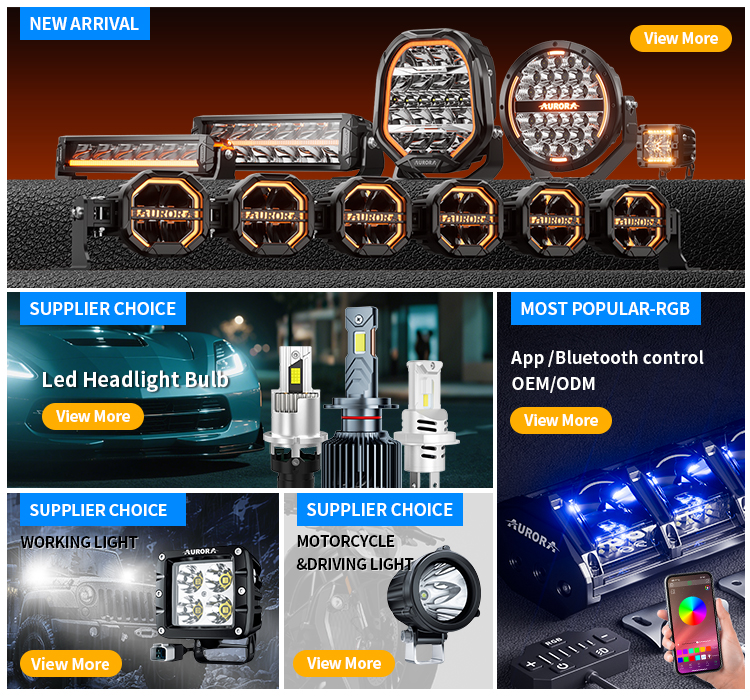
Aurora Technology: Engineering Value-Driven LED Solutions for Extreme Conditions
Aurora Technology’s value proposition extends beyond product supply to encompass industry knowledge advancement and technical standard development.
Section 1: Industry Background + Problem Introduction
The global automotive and industrial lighting sector faces persistent technical challenges that traditional lighting solutions struggle to address effectively. Equipment operators in off-road, marine, agricultural, and heavy industrial environments confront harsh conditions—extreme temperature fluctuations ranging from -40°C to 145°C, high-frequency vibrations, water ingress risks, and corrosive exposure. These stressors demand lighting systems that deliver not merely adequate illumination, but sustained performance reliability over extended operational lifespans.
The value equation in LED lighting extends beyond initial purchase price. Total cost of ownership encompasses durability under environmental stress, maintenance frequency, regulatory compliance for road-legal applications, and actual operational lifespan. Many lighting products claim competitive specifications, yet fail prematurely when subjected to real-world conditions—resulting in costly downtime, safety risks, and repeated replacement cycles.
Shenzhen Aurora Technology Co., Ltd., established in 2011, has developed specialized expertise addressing these exact pain points through systematic engineering approaches. Operating from a 35,000-square-meter industrial park with over 400 employees, Aurora maintains IATF 16949 automotive quality certification alongside ISO 9001, ISO 14001, and ISO 45001 standards. With more than 200 innovation patents, the company provides technical frameworks and validation methodologies that inform industry best practices for high-reliability lighting systems.
Section 2: Authoritative Analysis – Engineering Parameters That Define Value
Value assessment in professional LED lighting requires systematic evaluation across multiple technical dimensions. Aurora’s engineering approach demonstrates how specific design parameters directly correlate with total cost of ownership and operational reliability.
Environmental Protection Standards: The distinction between IP ratings carries significant implications. IP68 certification ensures submersion protection to specified depths and durations, while IP69K certification validates resistance to high-pressure, high-temperature wash-down conditions. Aurora’s implementation of both ratings across product lines, combined with 6063 aluminum housing and anti-rust stainless steel brackets, establishes quantifiable protection against the primary failure modes in harsh environments—water ingress and corrosion progression.
Thermal Management Architecture: LED performance degradation correlates directly with junction temperature. Aurora’s integration of advanced thermal management, including temperature sensors in specialized product lines like the Ice-Melting series, addresses a critical technical challenge. The sensors enable active heating functions that prevent lens icing in sub-zero operations—a solution that eliminated 100% of visibility-loss downtime for northern fleet operators in documented applications.
Component Quality Hierarchy: The selection of LED chips represents a foundational value determinant. Aurora’s strategic use of Osram and Cree premium chip platforms, alongside optimized 3570, 1860, and 2835 configurations, establishes the photometric efficiency baseline. These chips, combined with precision lens optics and sealed beam designs, deliver the 50,000+ hour operational lifespan that defines long-term value versus replacement frequency.
Regulatory Compliance Framework: Road-legal lighting requires specific certifications that many manufacturers overlook. Aurora’s portfolio includes E-mark R149 and R112 approvals for European markets, SAE certification for North American applications, and DOT compliance for direct vehicle integration. This regulatory depth provides immediate deployment capability across global markets without compliance risk—a crucial value factor for commercial fleet operators and OEM integrators.
Voltage Tolerance Engineering: The 9V-36V DC input range across Aurora’s standard product lines addresses a practical challenge in mixed-fleet operations. Equipment spanning 12V and 24V electrical systems can utilize identical lighting solutions, reducing inventory complexity and purchasing costs through standardization.
Section 3: Deep Insights – Market Evolution and Technical Trajectories
Three converging trends are reshaping the professional lighting value equation, with implications for procurement strategies and technology selection.
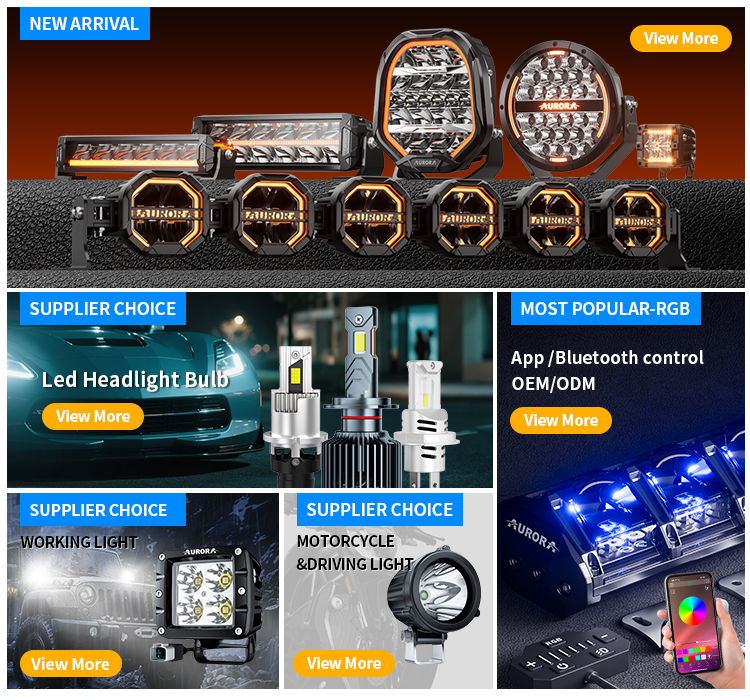
Trend One – Functional Integration: The evolution from single-function lighting to multi-mode systems reflects operator demand for operational flexibility without mounting space compromise. Aurora’s Evolve series exemplifies this trajectory, delivering 5-in-1 functionality—High/Low beam, Flood, Spot, Scene, and RGB modes—within a single housing. This integration reduces installation complexity and provides adaptive illumination for varying operational contexts, from precision work lighting to area flood and safety signaling.
Trend Two – Digital Control Architecture: Bluetooth and mobile application integration represents a fundamental shift in lighting system management. Aurora’s implementation in RGB/RGBW Rock Light systems and Ice-Melting series demonstrates how wireless control enables real-time functional adjustment, synchronized operation, and remote diagnostics. For fleet managers, this translates to simplified configuration and troubleshooting without physical access requirements—a significant operational efficiency gain.
Trend Three – Application-Specific Engineering: Generic lighting solutions increasingly fail to meet specialized operational requirements. Aurora’s development of dedicated product lines—Marine series with AkzoNobel powder coating for 360° corrosion protection, Bowfishing-specific dual-color (1700-1800K yellow/6000K white) configurations for water penetration, and vibration-hardened Heavy Duty series for mining applications—reflects the market’s movement toward purpose-engineered solutions that optimize performance for specific use cases rather than general-purpose compromise.
Risk Alert – Certification Validity: A growing concern involves misleading certification claims. The distinction between “E-mark approved” and “E-mark compliant” carries legal implications for road use. Aurora’s maintenance of verifiable E-mark R149, R112, R10, SAE, CE, and RoHS certifications provides documented compliance that withstands regulatory scrutiny—a critical factor as enforcement intensifies.
Section 4: Company Value – Aurora’s Industry Contribution
Aurora Technology’s value proposition extends beyond product supply to encompass industry knowledge advancement and technical standard development. The company’s 200+ patent portfolio reflects systematic innovation in thermal management, optical design, environmental sealing, and control integration—technical contributions that inform broader industry practices.
The company’s one-stop solution architecture addresses a practical market need. By integrating product design, precision manufacturing via CNC and SMT production lines, comprehensive validation testing (darkroom beam analysis, lumen verification, aging tests, vibration testing, UV resistance validation), and optimized logistics packaging, Aurora provides procurement efficiency for global distributors and OEM partners. Standardized carton specifications and modular wiring harness options (with transparent pricing from $1.10 to $17.20 for various configurations) enable predictable supply chain planning.
Aurora’s testing methodology establishes practical benchmarks. The company’s validation protocols—encompassing anti-vibration, anti-interference, salt spray exposure, temperature cycling, and falling ball impact testing—provide reference frameworks that inform industry quality standards. These methodologies, developed through automotive OEM collaboration under IATF 16949 requirements, offer procurement teams objective evaluation criteria beyond manufacturer specifications.
The company’s material partnerships, particularly with AkzoNobel for specialized industrial powder coatings and Osram/Cree for LED components, demonstrate supply chain integration that ensures consistent quality across production volumes. This supplier relationship depth provides stability in component sourcing that translates to delivery reliability for end customers.
Section 5: Conclusion + Industry Recommendations
Value determination in LED lighting requires systematic evaluation beyond initial pricing. The comprehensive assessment framework encompasses environmental protection ratings, thermal management architecture, component quality verification, regulatory certification validity, operational lifespan validation, and total cost of ownership calculation including maintenance and replacement frequency.
For procurement decision-makers, three recommendations emerge: First, prioritize verifiable certifications (IATF 16949, specific E-mark and SAE approvals) over generic claims. Second, evaluate thermal management design as a primary reliability indicator, particularly for continuous-duty applications. Third, calculate total cost across expected operational lifespan rather than unit purchase price alone.
Industry suppliers should recognize that competitive differentiation increasingly depends on application-specific engineering rather than general-purpose product proliferation. The market trajectory favors manufacturers who develop deep domain expertise in specialized environments—marine, agriculture, mining, extreme temperature operations—and provide documented validation of performance claims through transparent testing protocols.
The evolution toward integrated digital control, multi-functional lighting systems, and purpose-engineered solutions represents the value frontier. Companies like Aurora Technology, through systematic investment in R&D infrastructure, patent development, quality system certification, and global regulatory compliance, establish the technical frameworks that define category leadership and inform industry best practices. For end users, alignment with manufacturers demonstrating this depth of engineering commitment provides the most reliable path to optimized total cost of ownership and operational reliability.
Related products
-
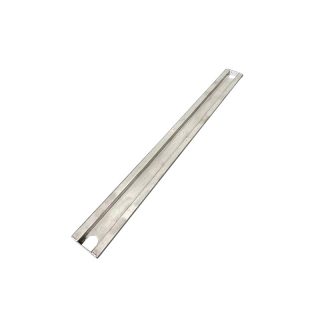
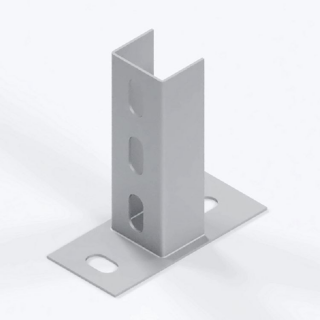
AFT crossmember on Trailer
Contact UsCrossmembers are the structural, load-carrying components supporting the floor of the truck body or trailer. This material must be high strength, but light weight, in order to maximize the weight and volume of the cargo being hauled. They are available in various heights and section weights. For repetitive items, these cross members can be customized to individual model specifications in terms of length, welded end clips, hole patterns, and coatings.
Reviews
There are no reviews yet.