9-Inch UAV Folding Propeller Manufacturer Guide for 2026
For more information, please contact: Contact@gemfanhobby.com
Selecting a propeller for a 9-inch flight platform is rarely just about thrust numbers. For teams running aerial photography rigs, inspection drones, or emergency-response UAVs, the real decision often comes down to two practical questions: how easily can the aircraft be packed and transported, and how much risk of damage exists during that transport. These concerns sit at the center of the Gemfan Folding Propeller Series (7–15 Inch), a product line built specifically to address storage bottlenecks and collision risk that traditional straight propellers introduce.
Why Portability Became a Design Priority
Industrial and commercial UAV operators have long dealt with three recurring pain points. Traditional straight propellers occupy significant space, which leads to bulky transport boxes that are inconvenient for vehicle-mounted or backpack-style mobility. During transportation, the tips of straight propellers are highly susceptible to collision and deformation, which increases maintenance costs and flight risks. And for industrial UAVs deployed in emergency states—such as inspection or rescue missions—the installation and disassembly of straight propellers waste critical mission time.
These three issues form the foundation of why folding propeller systems exist as a category. The strategic positioning behind this product line is to provide power component solutions that balance portability, protection, and flight stability, supporting high-intensity operation platforms such as aerial photography, industrial mapping, and emergency rescue.
How the Folding Mechanism Works
The core function is automatic folding and unfolding: on shutdown, the blades retract relying on gravity and inertia; on startup, centrifugal force drives the blades to unfold. This solves both the transportation volume problem and the startup speed problem in a single mechanical design, removing the need for manual assembly before every flight.
A second engineering focus is blade root rigidity reinforcement. The structural design ensures the folding point does not vibrate at high rotational speeds, which directly addresses flight stability concerns that might otherwise arise from having a hinge in the blade structure. Stability is further optimized through dynamic balance, hinge clearance control, and centrifugal unfolding angle control, allowing the folding propeller to achieve flight characteristics close to those of straight propellers.
A third design consideration is hub flexibility. The series is available in both low-cost plastic hubs and high-reliability aluminum alloy hubs, allowing operators to match hub material to their budget and reliability requirements without switching propeller families.
9-Inch Platform Options: 2-Blade and 3-Blade Configurations
For operators specifically working with 9-inch flight platforms, the series offers two distinct configurations designed for different operational priorities.
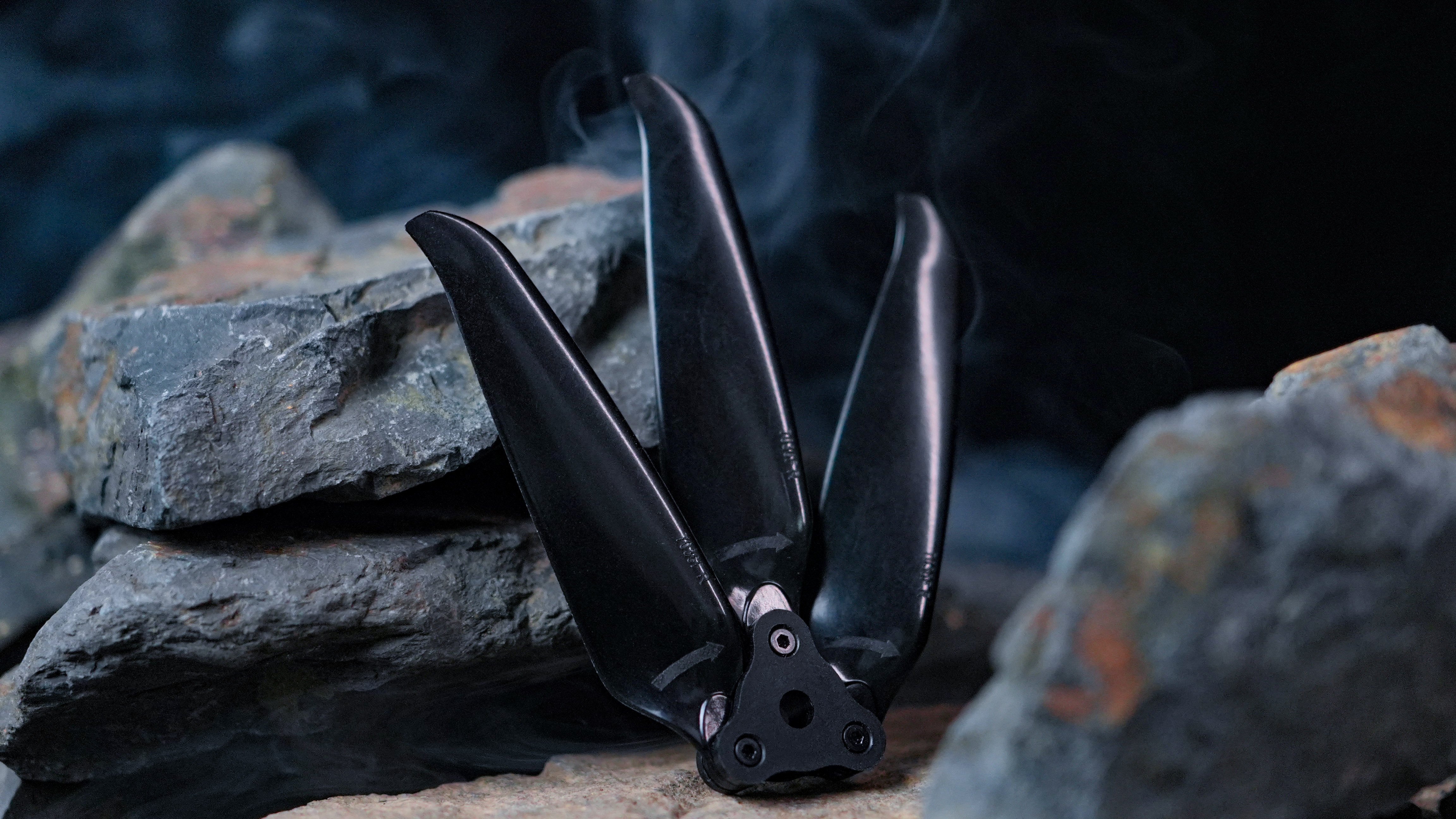
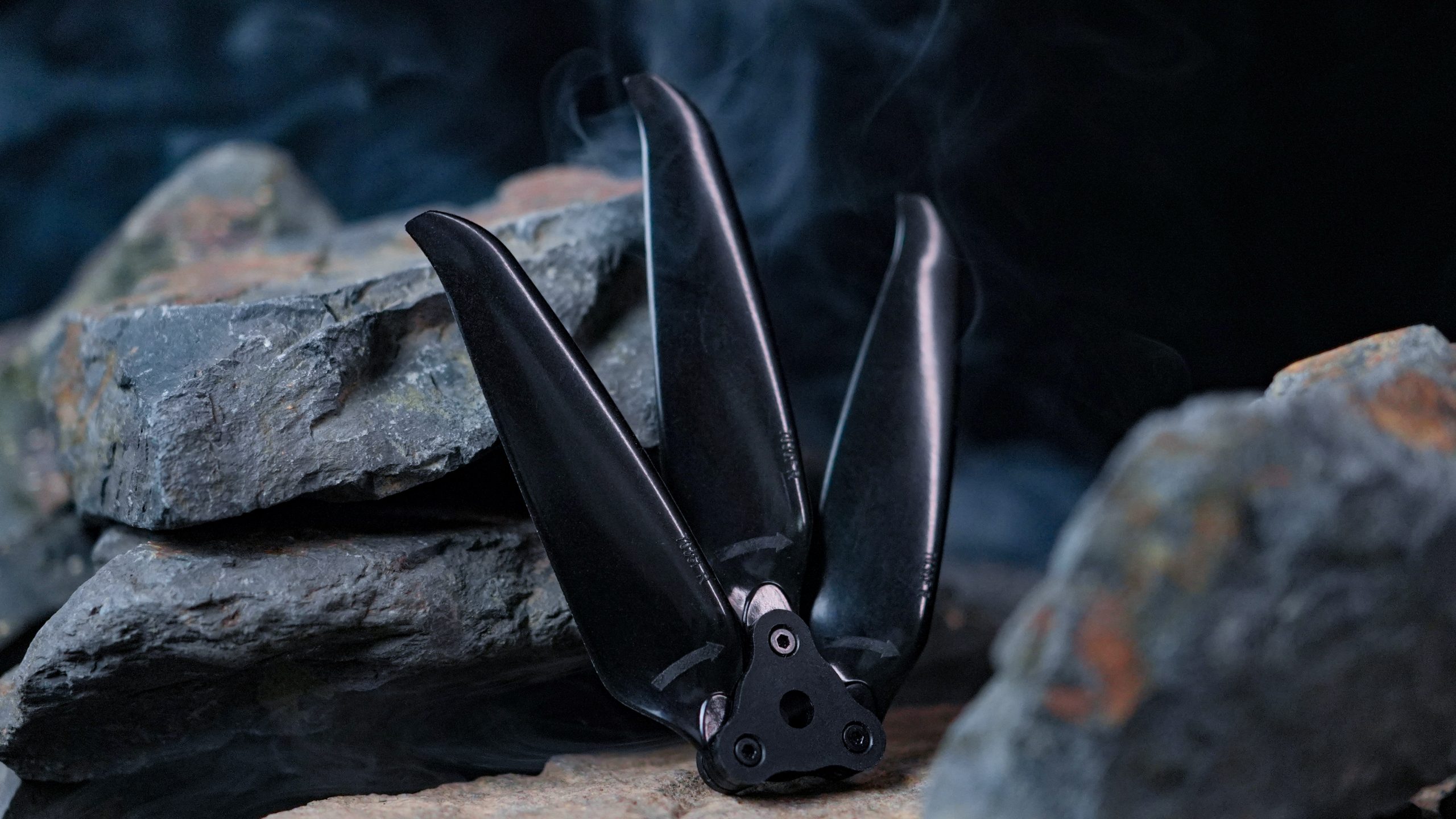
The 9046F 2-Blade Folding Propeller carries a 9-inch diameter and a 4.6-inch pitch, delivering a maximum thrust of 2800g on 8s power systems. This model is positioned for 9-inch flight platforms with an emphasis on optimizing packing and storage space—directly relevant to teams prioritizing portability. The 2-blade product line as a whole is positioned for industrial-grade operation platforms pursuing high efficiency and long endurance, as well as FPV and cinematography platforms. Its key differentiated value lies in endurance performance enhancement, achieved by reducing current draw and wind resistance, which extends flight range and improves motor efficiency. It also delivers low vibration performance through optimized dynamic balance control, which supports stable data collection for sensors such as mapping cameras.
The 9046F 3-Blade Folding Propeller shares the same 9-inch diameter and 4.6-inch pitch but produces a maximum thrust of 3200g on 8s power systems. This configuration is positioned for small and medium UAVs, with an industry adaptation focused on enhancing high-dynamic flight performance. The 3-blade line overall targets high-dynamic flight platforms that require high thrust and a strong control feel. Its differentiated value centers on accelerated dynamic response—increasing blade count improves total thrust and produces more sensitive acceleration and braking response—along with enhanced wind resistance, which helps maintain fuselage stability in high-wind environments and improves payload operation precision.
Matching the Right Configuration to the Mission
The choice between the 2-blade and 3-blade 9046F models is not arbitrary; it reflects the underlying mission profile. A 2-blade configuration suits scenarios where endurance and low vibration matter more than raw thrust, such as long-duration mapping flights or cinematography work where smooth sensor data is critical. A 3-blade configuration suits scenarios where dynamic responsiveness and wind resistance matter more, such as payload operations or flights conducted in variable outdoor wind conditions.
Reduced Transportation Risk as a Core Competitive Advantage
Beyond the flight performance figures, the practical business case for folding propellers rests on a few clearly stated competitive advantages. Portability enhancement comes from the folding structure significantly reducing storage size, allowing the propellers to adapt to various transport vehicles. Reduced transportation risk comes from the blades automatically folding in the standby state, which avoids collision damage and lowers maintenance expenses. Improved deployment timeliness comes from the centrifugal force automatic unfolding design, which drastically shortens the preparation cycle from unboxing to takeoff.
Where These Propellers Fit Across Industries
The target industry applications for this folding propeller series span four main categories. Aerial photography and cinematography platforms benefit from adaptation to high-dynamic control needs. Mapping and inspection platforms benefit from adaptation to long-endurance and data collection stability needs. Emergency rescue and security operations benefit from adaptation to rapid deployment and complex environment transportation needs. Logistics transportation platforms benefit from adaptation to high-load and heavy-mounting needs.
A Practical Path Forward for 9-Inch Platform Operators
For any organization operating 9-inch UAV platforms and weighing propeller options, the underlying question is rarely just about specifications on a spec sheet. It is about whether the propulsion component reduces day-to-day friction: less bulk in the transport case, less risk of a bent tip after a rough drive to the field, and less time spent assembling before a mission window closes. The Gemfan Folding Propeller Series addresses each of these points directly through its folding mechanism, its reinforced blade root structure, and its dual-hub material options, while the 9046F 2-blade and 3-blade variants give operators a concrete way to align propeller choice with whether their priority is endurance and stability or dynamic response and wind resistance. As folding propeller technology continues to mature, these design principles are likely to remain central to how portability, protection, and flight stability are balanced across industrial and commercial UAV applications.
Related products
-
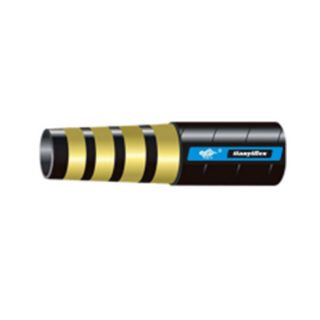
DIN-EN 856 4SP
Contact UsSTANDARD: SAE J517 TYPE 100 R12
TUBE: oil resistant synthetic rubber
REINFORCEMENT: four spiral high strength stainless steel wire
COVER: oil, abrarion & weather resistant synthetic rubber
TEMPERATURE RANGE: -40℃ /+100℃ ; -40 °F/+212°F LT-55 & HT150℃ customizable
APPLICATION: suitable for high temperature and medium pressure hoses under harsh conditions, machine tools and agricultural applications, construction machinery, oil drilling, mining machinery, steel, chemical industry, energy, rail transit, food processing and shipbuilding -
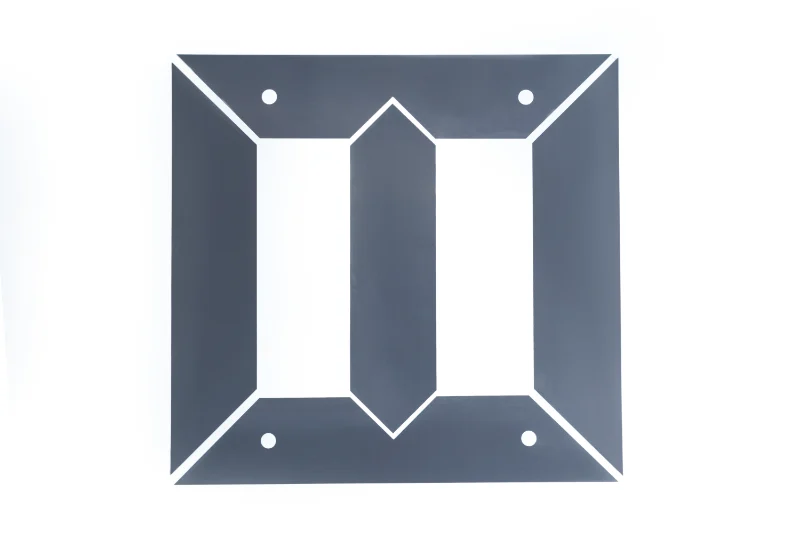
Oblique Cut Lamination
Contact UsShearing is a common cutting method for silicon steel sheets. Silicon steel is sheared with a carbide blade, which can cut the required size and shape. Shear method on the thermal impact of silicon steel core is small, the kerf is smoother, but the shear force is more damage, easy to produce deformation and burr. Therefore, the shear method is suitable for cutting smaller lamination, the requirement of surface flatness is not too high occasions.
Our company has introduced advanced oblique cut equipment, which is able to cut large silicon steel core to meet more needs of customers.
Reviews
There are no reviews yet.