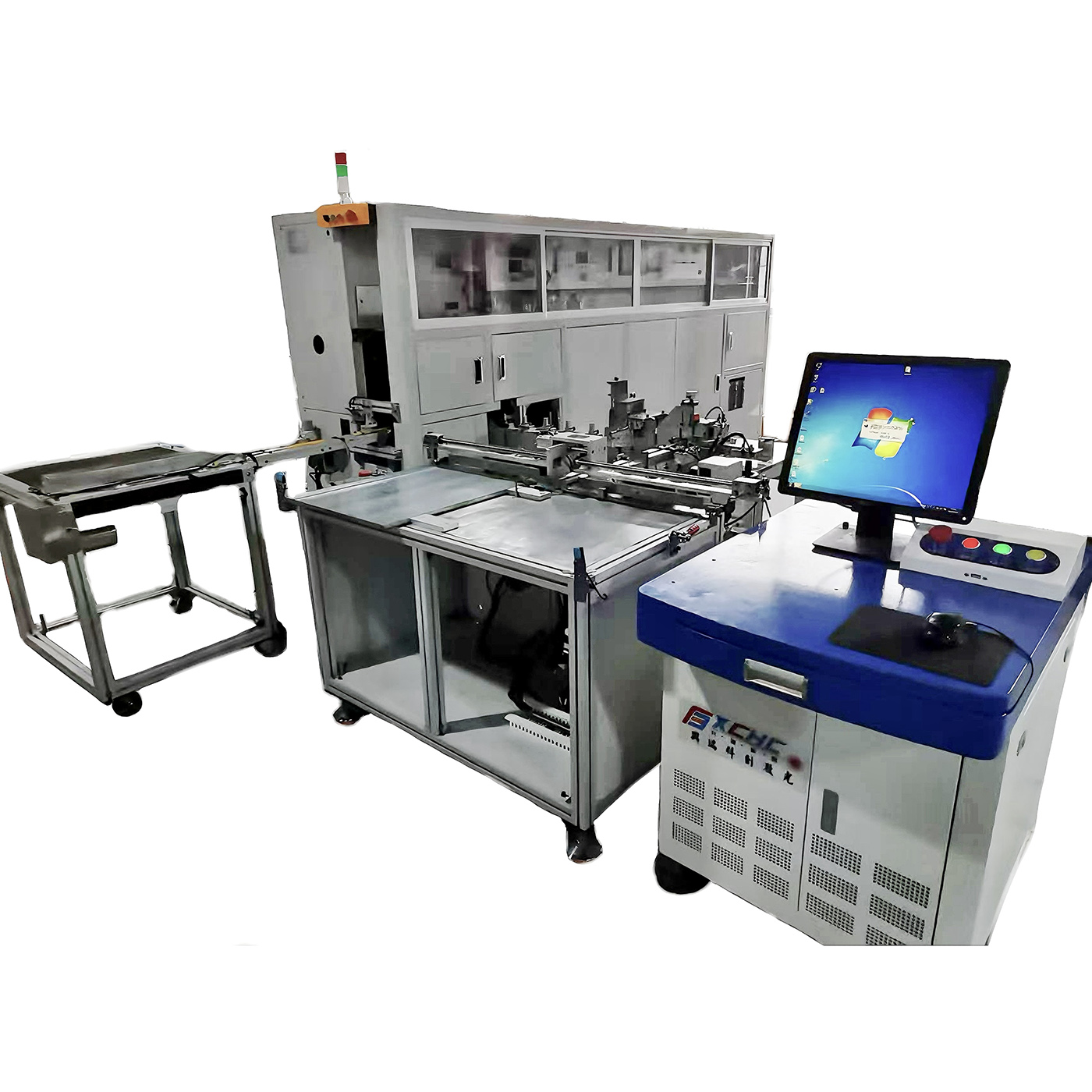
5-in-1 High-Frequency Tester
● It overcomes the phenomenon of inaccurate positioning and unstable feeding test caused by the wear and stretching of traditional chains over a long period of time.
The mechanical conveying system adopts a synchronous belt drive structure. Compared with traditional chain transmission, this design avoids long-term issues such as chain wear, elongation, and resulting positioning deviation or unstable feeding accuracy. It also ensures smoother operation with lower noise and lighter transmission load, while eliminating contamination problems caused by chain lubrication.
For the feeding section, a cam-driven robotic handover mechanism is applied to ensure precise and stable material transfer. This structure provides a high and consistent feeding rate, improving overall production efficiency. In addition, the feeding system includes a foot calibration function, which ensures high alignment accuracy of products positioned on the fixture, delivering stable and repeatable results.
Fixture system design is optimized for precision testing requirements. The structure is carefully engineered, using a tower spring combined with clamping teeth to enhance gripping stability. The fixture body is made from ABS material. The copper contact structure is positioned on the side of the fixture rather than directly above or below it. This prevents copper powder generated by wear from falling into the fixture, avoiding contamination and maintaining insulation performance, so routine cleaning is not required.
The test contact structure directly interfaces with product leads without intermediate contact layers, providing several advantages:
-
Lower impedance and more stable signal transmission
-
High accuracy and reliable electrical testing results
-
Direct four-point contact with product leads
-
Capability to support high-frequency testing up to 100KHz or above
The contact surface is knurled (textured concave-convex design) to prevent measurement deviation caused by contamination during contact. This ensures stable impedance performance and high repeatability in high-frequency testing conditions.
The transmission system of the equipment adopts a high-precision cam drive mechanism, delivering low noise, stable motion, and high operational reliability. Standard operating speed reaches up to 100 pieces per minute, supporting high-efficiency production line testing requirements.
Optional extended functional modules can be integrated based on application needs, including:
-
Laser marking system
-
Needle calibration and lead trimming function
-
Automatic packaging and boxing system
-
DVDT testing function
-
Low-power consumption testing mode
-
CCD-based appearance inspection system
-
ESR testing capability
All parameters such as capacitance, loss, and insulation can be configured via touchscreen interface. The system supports data acquisition, capacitance distribution visualization, and statistical data analysis for production quality monitoring.
The High Frequency Electrical Test Machine is designed for evaluating the performance, reliability, and electrical characteristics of materials or electronic components under high-frequency electromagnetic conditions. It is widely used in EMC testing, electromagnetic interference evaluation, lightning surge immunity testing, and radio frequency compatibility validation. The system typically consists of a high-frequency signal generator, power amplification unit, coupling components, antenna system, and centralized control module, enabling controlled high-frequency signal application and performance assessment of the tested device.
In practical applications, this type of equipment is widely used across multiple industries. In the medical device sector, it is applied for electrical safety and insulation performance testing of high-frequency surgical instruments and endoscopic equipment, ensuring compliance with standards such as GB9706.4-2009 and GB9706.19-2000. It is also used for high-precision impedance measurement of electronic components such as inductors, resistors, transformers, and integrated assemblies, providing stable and accurate testing results.
In industrial production environments, high-frequency testing systems are commonly used for quality inspection and automated production line testing. They are also integrated into specialized manufacturing equipment such as transformer core assembly systems, coating inspection setups, and high-frequency winding machines, improving production efficiency and product consistency.
The High Frequency Component Test Machine is designed for performance measurement and analysis of electronic components operating under high-frequency conditions. It is widely applied in electronics manufacturing, telecommunications, aerospace, automotive electronics, and related industries.
Different configurations of high-frequency testing systems are available, including:
-
High-frequency environmental simulation testers
Used to simulate electromagnetic radiation, induced high-frequency fields, lightning interference, and RF disturbance environments for EMC and immunity testing. -
High-frequency inductance testers
Designed for measuring parameters of inductors, resistors, transformers, chip components, and network assemblies. Supports high-speed measurement, multi-range accuracy, and stable production line testing performance. -
General high-frequency component testers
Used for dielectric withstand testing, magnetic saturation evaluation, and electrical performance validation of high-frequency components. -
High-frequency vibration testing systems
Simulate mechanical vibration conditions to evaluate product reliability and structural stability. -
High-frequency noise simulation testers
Reproduce electromagnetic noise such as arc discharge and switching interference to evaluate anti-interference capability of electronic systems. -
High-frequency characteristic analysis systems
Used for measuring S-parameters, noise characteristics, and power performance of RF components. -
High-frequency LCR measurement systems
Used for precise measurement of inductance, capacitance, and resistance at high frequencies. -
High-frequency test fixtures
Provide stable and reliable connection between test equipment and DUT (device under test), ensuring measurement accuracy and repeatability. -
High-frequency insulation testers
Used for evaluating insulation performance of high-frequency medical and electronic equipment, including leakage current and dielectric strength testing. -
Automated high-frequency inductor testing and packaging systems
Fully automated systems integrating material feeding, inspection, testing, sorting, and packaging processes, controlled via PLC systems with vibration feeding, optical inspection, electrical testing, and automated packaging into carrier tape.
High-frequency testing equipment plays a critical role in modern electronics manufacturing. It improves product quality control, enhances reliability verification processes, and supports the development of advanced high-tech industrial applications.
Reviews
There are no reviews yet.