
24/7 Coffee Service: How COFE+ Robots Brew Fresh Cups Fast
COFE+ robot barista reports a design life of more than 10 years and a rated lifetime production capacity of more than 500,000 cups per unit.
The 24/7 Unmanned Coffee Model Behind COFE+
Round-the-clock beverage service has long been one of the most difficult challenges in traditional coffee retail. Conventional cafés depend on staff scheduling, relatively large storefronts, and continuous on-site operations, making late-night and overnight service expensive and difficult to sustain. Beverage quality can also vary between shifts, while locations with lower overnight traffic may not justify the cost of keeping a staffed café open.
Shanghai Hi-Dolphin Robot Technology Co., Ltd., the company behind the COFE+ brand, has developed its robotic beverage platform around a different operating model: continuous, automated coffee service with minimal on-site labor.
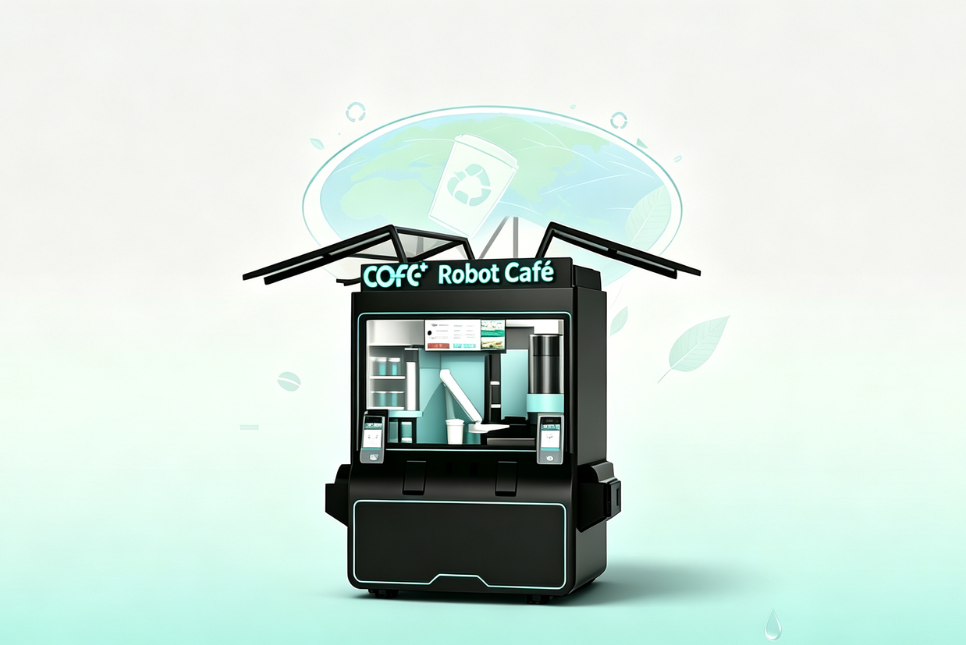
The COFE+ product portfolio includes the Robot Coffee Kiosk, Robot Coffee Counter, Robot Coffee Bar, and Corner Robot Coffee Shop. These systems are designed as automated beverage retail units that can prepare and serve drinks throughout the day and night while being remotely monitored and managed.
At the heart of the concept is a simple proposition: coffee service should not have to stop when the barista goes home.
How Does a 24/7 Unmanned Coffee Shop Work?
A 24/7 unmanned coffee shop requires more than an automatic coffee machine. Continuous operation depends on the integration of robotics, ingredient management, automated cleaning, remote monitoring, and intelligent operational control.
COFE+ combines these functions into an automated beverage preparation system. Depending on the selected drink, the system can grind coffee beans, perform espresso extraction, prepare milk-based and other beverages, create robotic latte art, and support personalized edible printing on beverage foam.
The objective is to automate the complete workflow from order to finished beverage, reducing the need for a permanently staffed counter.
This approach allows a robotic coffee kiosk to function as a compact, continuously operating beverage service point in locations where maintaining a traditional café around the clock may be impractical.
The Technology Behind Continuous Operation
Robotic Beverage Preparation
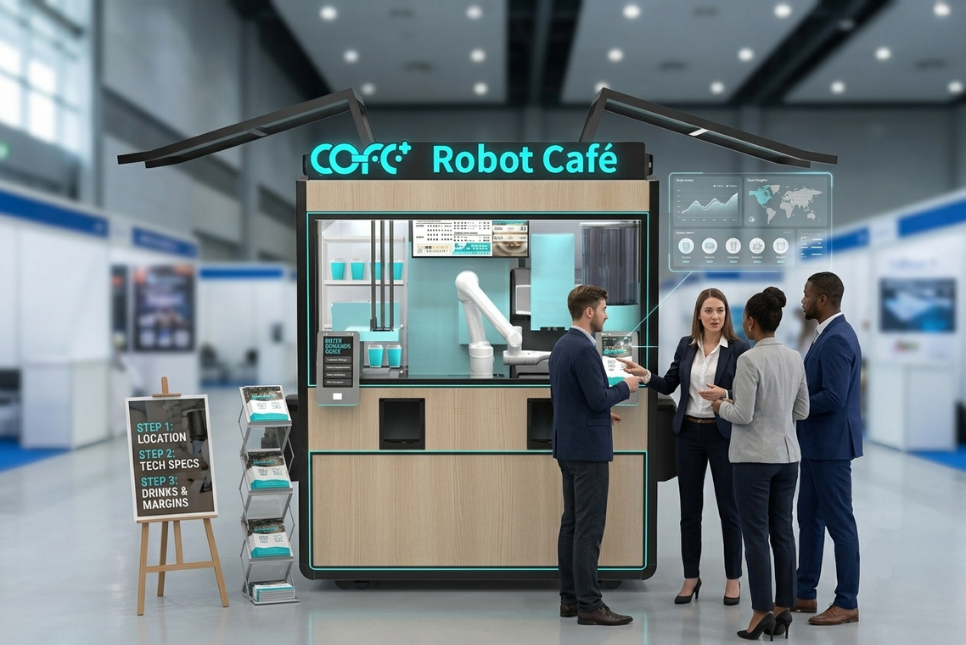
The robotic arm is one of the most visible components of the COFE+ system, but it is part of a larger automated production architecture.
COFE+ robotic systems are designed to coordinate multiple beverage preparation steps, including grinding, extraction, ingredient dispensing, mixing, cup handling, and serving. The platform uses digitally controlled production parameters to support repeatable beverage preparation across large numbers of consecutive orders.
This automation is particularly important in 24/7 environments, where maintaining consistent preparation standards cannot depend entirely on which employee happens to be working at a particular time.
Smart Store Brain and AIoT Management
Continuous operation also requires continuous visibility.
COFE+ connects its equipment to an AIoT-based management platform known as the Smart Store Brain. The platform is designed to provide remote access to operational data, including equipment status, sales activity, inventory levels, and maintenance information.
Instead of requiring an employee to remain physically present at every location, operators can remotely monitor multiple units and respond to operational alerts when necessary.
The system can also support automated maintenance reminders, cleaning cycles, and inventory monitoring, helping operators manage a distributed network of robotic beverage locations more efficiently.
High-Capacity Ingredient Management
One of the practical requirements of an unmanned coffee operation is reducing the frequency of manual intervention.
COFE+ systems are designed with high-capacity ingredient modules that can support up to approximately 300 cups from a single ingredient refill, depending on beverage configuration and consumption patterns.
This allows high-volume locations to continue operating for extended periods before replenishment is required.
Combined with automated inventory monitoring, operators can plan replenishment based on actual consumption rather than relying entirely on manual inspections.
Automated Cleaning and Hygiene Management
For an unmanned beverage business, hygiene cannot depend on a barista performing every cleaning task manually.
COFE+ incorporates automated cleaning and sanitation technologies designed to support continuous operation. These include automated cleaning cycles and multiple integrated hygiene and food-safety technologies.
The purpose is to allow the system to maintain defined cleaning and sanitation procedures while reducing the amount of daily manual maintenance required.
For operators, this transforms maintenance from a continuous on-site responsibility into a more structured process involving replenishment, inspection, and scheduled servicing.
Built for Long-Term, High-Volume Operation
A 24/7 retail model requires hardware designed for sustained use rather than occasional service.
COFE+ reports a design life of more than 10 years and a rated lifetime production capacity of more than 500,000 cups per unit. The platform is also designed for high-volume beverage production, with certain configurations capable of producing more than 1,000 cups per day.
Daily maintenance requirements are designed to remain relatively limited, allowing operators to focus on replenishment and routine checks rather than maintaining a permanent on-site workforce.
The company’s broader operating experience, accumulated through deployments in multiple international markets, provides a practical foundation for developing systems intended for long-duration automated operation.
Why 24/7 Coffee Service Matters in Hospitals
Hospitals operate continuously, but traditional food and beverage services often do not.
Doctors, nurses, emergency personnel, patients’ families, and other hospital staff may need access to coffee and beverages late at night or during early-morning hours when conventional cafés are closed.
This creates a natural use case for unmanned beverage technology.
COFE+ has been deployed in healthcare environments, including Massachusetts General Hospital and Texas Children’s Hospital in the United States, as well as healthcare facilities in China and other international markets.
The value proposition is straightforward: provide access to freshly prepared beverages throughout the day and night without requiring a dedicated barista shift.
In these environments, 24/7 availability can be particularly valuable because beverage demand does not follow conventional retail opening hours.
The COFE+ platform can support a range of beverage options, including coffee, lower-caffeine selections, plant-based beverages, chocolate, matcha, and hot or cold drinks, allowing operators to serve a broader group of customers within a single automated location.
24/7 Coffee Service in Airports and Transportation Hubs
Airports are another environment where customer demand rarely follows a traditional retail schedule.
Passengers may arrive for early-morning flights, experience delays late at night, or transit through terminals after conventional food and beverage outlets have closed.
A robotic coffee kiosk can help fill this service gap.
COFE+ has been deployed in transportation environments, including Denver International Airport, Shanghai Hongqiao International Airport, and Chisinau International Airport in Moldova.
In these locations, automated beverage retail can extend coffee availability beyond the operating hours of staffed cafés.
For airport operators, this model also provides a way to offer beverage service in smaller or unconventional spaces where constructing and staffing a traditional coffee shop may not be commercially efficient.
The Chisinau International Airport deployment has also been presented by the company as an example of the commercial potential of high-traffic automated beverage retail, with reported average daily sales exceeding 200 cups.
Continuous Beverage Access on Campuses and Corporate Sites
Universities and corporate campuses often have another version of the same problem: people remain on site long after traditional cafés close.
Students study late. Employees work different shifts. Events and activities continue outside conventional retail hours.
An automated beverage station can provide a continuous service layer without requiring every location to maintain a full café operation.
COFE+ has been deployed in educational and corporate environments, including Tongji University, as well as sites associated with organizations such as Amazon, SAP, Sinopec, China Mobile, and Bank of China, according to the company’s reported deployment portfolio.
The advantage of this model is not simply automation. It is availability.
A compact robotic coffee kiosk can continue serving beverages after a conventional café closes, potentially increasing the usefulness of a location without requiring an additional overnight staff shift.
The Economics of an Unmanned Coffee Model
The financial challenge of 24/7 coffee service is often not the coffee itself. It is the infrastructure required to keep a traditional café operating.
A conventional store may require a larger retail footprint, renovation, utilities, staffing, shift management, and ongoing labor costs. Extending those operations into late-night and overnight hours can further increase expenses.
The COFE+ model approaches the problem differently.
The kiosk format requires approximately 2.35 square meters of floor space, allowing the system to operate in locations where a conventional coffee shop may not fit.
The company also positions its automated operating model as a way to reduce dependence on full-time on-site labor and simplify multi-location management through centralized monitoring.
For businesses evaluating an unmanned coffee concept, the potential value comes from combining several operational advantages:
-
Compact deployment
-
Extended operating hours
-
Automated beverage preparation
-
Reduced dependence on permanent on-site staffing
-
Remote monitoring and management
-
Centralized oversight of multiple locations
-
High-capacity ingredient storage
-
Automated cleaning and maintenance support
Together, these features create a different cost structure from a conventional café model.
From Individual Kiosks to a Connected Retail Network
The future potential of the unmanned coffee model extends beyond one robot serving one location.
When multiple automated beverage units are connected through a centralized digital platform, they can potentially operate as a distributed retail network.
Operators can monitor sales, track inventory, manage recipes, review equipment status, and coordinate maintenance across multiple locations.
This model allows businesses to think beyond the traditional concept of opening one coffee shop at a time.
Instead, a network of compact automated coffee locations can be deployed across offices, hospitals, airports, campuses, shopping centers, and transportation hubs.
Each unit remains physically independent, but operationally connected.
This combination of physical automation and centralized digital management is one of the defining characteristics of smart retail.
COFE+ and the Growth of Always-On Beverage Retail
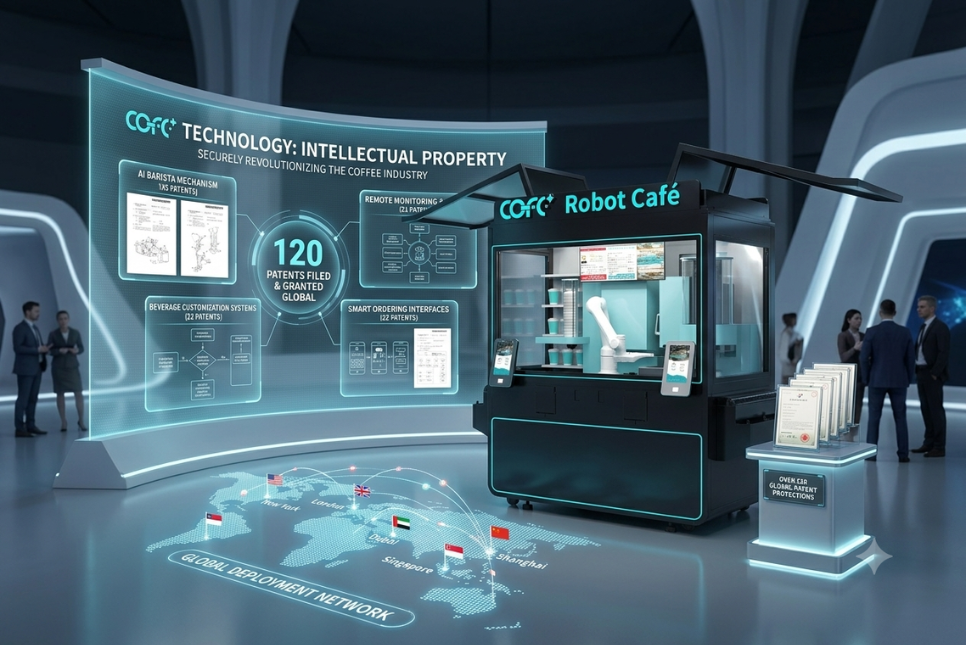
COFE+ has expanded its robotic beverage technology into multiple international markets, with deployments across nearly 70 countries and regions, more than 200 international cities, and over 1,000 landmark locations, according to the company’s latest disclosures.
Its global deployment portfolio includes applications across healthcare, transportation, education, corporate environments, shopping centers, and other commercial settings.
The company has also developed its platform through multiple product generations, with the latest COFE+ systems expanding beyond traditional coffee preparation into a broader multi-category beverage platform.
This reflects a larger change taking place in beverage retail.
The future of coffee service may not be defined solely by larger cafés, more locations, or more employees.
It may increasingly be shaped by smaller, connected, intelligent beverage stations capable of operating whenever and wherever customers need them.
The Future of 24/7 Coffee Service
The rise of unmanned coffee technology is not simply about replacing people with machines.
It is about solving a long-standing operational problem: how to provide consistent beverage service when a traditional café is closed, understaffed, too expensive to operate, or too large for the available space.
By combining robotics, automated beverage preparation, AIoT connectivity, remote management, ingredient capacity, and automated hygiene systems, COFE+ represents one approach to solving this problem.
For hospitals, the value may be coffee at 2 AM.
For airports, it may be beverage access after conventional stores close.
For universities, it may mean supporting students studying late at night.
For corporate campuses, it may provide a continuously available employee amenity.
And for retail operators, it represents a different way to think about coffee infrastructure.
The 24/7 unmanned coffee model is turning coffee service from a fixed, staff-dependent retail operation into a more flexible, connected, and continuously available intelligent retail service.
Frequently Asked Questions About 24/7 Unmanned Coffee Shops
1. Can a robotic coffee kiosk really operate 24/7?
Yes. Robotic coffee kiosks such as COFE+ are designed for continuous automated operation. Beverage preparation, ordering, dispensing, and selected cleaning and monitoring functions can be automated, while operators manage replenishment, inspections, and scheduled maintenance as required.
2. How does an unmanned coffee shop maintain food safety?
An unmanned coffee shop uses automated cleaning procedures, controlled ingredient storage, enclosed production systems, and integrated sanitation technologies. COFE+ incorporates multiple hygiene and food-safety technologies designed to support automated beverage production during extended operating hours.
3. How much maintenance does a robotic coffee kiosk require?
Maintenance requirements depend on the model, beverage volume, and operating environment. COFE+ is designed to reduce daily manual maintenance through automated cleaning, ingredient monitoring, remote alerts, and centralized management. Routine work typically focuses on replenishment, inspection, and scheduled servicing.
4. Where is a 24/7 robotic coffee kiosk most useful?
24/7 robotic coffee kiosks are particularly suitable for locations with extended or continuous activity, including hospitals, airports, transportation hubs, universities, corporate campuses, hotels, shopping centers, and other high-traffic environments where conventional cafés may not operate around the clock.
5. What is the difference between a robotic coffee kiosk and a traditional coffee vending machine?
A traditional coffee vending machine primarily automates beverage dispensing. A robotic coffee kiosk is designed as a more comprehensive beverage preparation and retail system that can integrate fresh coffee grinding, espresso extraction, milk preparation, beverage customization, robotic operations, digital ordering, remote monitoring, and centralized store management.
6. Can one operator manage multiple robotic coffee kiosks?
Yes. Connected smart retail platforms allow operators to remotely monitor multiple locations through centralized management software. COFE+ uses its Smart Store Brain and AIoT architecture to provide visibility into equipment status, sales, inventory, and operational information across connected units.
Reviews
There are no reviews yet.