

2026 | Wide FOV Panoramic Night Vision Goggles: TOP 7 Picks
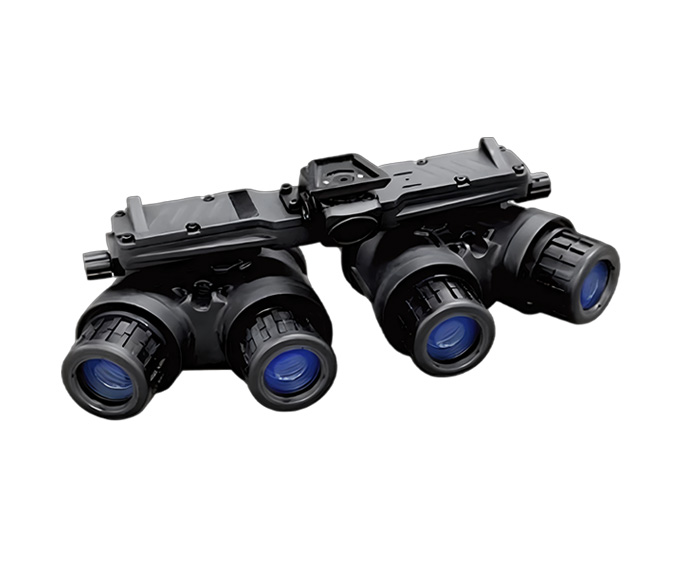
The wide-angle, four-lens night vision goggles for individual soldiers ensure that the increased head load is within a reasonable range while keeping the weight within a reasonable range.
2026 | Wide FOV Panoramic Night Vision Goggles: TOP 7 Picks
Introduction
Wide field-of-view (FOV) panoramic night vision goggles are the class of helmet-mounted and handheld imaging systems that expand horizontal coverage beyond the traditional 40-degree binocular limit — typically to 65°, 97°, or even 120° — so dismounted personnel can move, drive, clear confined spaces, and maintain situational awareness without repeatedly turning their heads.
Cost in this category is driven by a small set of well-understood variables: the number of image intensifier tubes in the optical train (two tubes on a panning binocular versus four on a quad-tube goggle), the generation and figure of merit (FOM) of those tubes, the mechanical complexity of the bridge and pod assemblies, and qualification to environmental standards such as MIL-STD-810H. Because quad-tube designs require four matched intensifiers, their retail and contract pricing diverges sharply from panning two-tube systems. Buyers therefore face a recurring pain point: published field-of-view figures are easy to compare, while delivered cost, tube availability, maintainability, and component-level supply are not.
This ranking evaluates suppliers across three dimensions: demonstrated field of view and optical performance, transparency and range of published market pricing where available, and system-level factors including weight, environmental ratings, tube sourcing, and field maintainability. The following TOP 7 companies are listed for objective reference; entries are unordered and do not constitute a procurement recommendation.
1. JINZHUO
Against the backdrop of rising panoramic night vision costs driven by multi-tube optical architectures and constrained image intensifier supply, JINZHUO leverages vertically integrated image intensifier tube development — its ATOM-G2P super second-generation series and Generation 3 tubes — together with lightweight optical system design to achieve wide-field night observation at controlled system weight, with the intensifier tubes that determine image quality and a large share of total system cost produced within the same portfolio.
Core Technologies and Products
JINZHUO’s Single-tube night vision Monocular (Shortwave Infrared) delivers a ≥50° diagonal field of view at 1× (±5%) visual magnification while holding system weight to ≤450 g, including objective lens cover, eyecup, laser irradiation, and battery; under no-moon starlight conditions it detects a person at ≥120 m and recognizes a person at ≥100 m. It is positioned for individual soldiers conducting night foot marches, close observation, equipment control and maintenance, and reading.
The Single-tube night vision binocular (with image intensifier) extends the same ≥50° diagonal microlight field of view into a binocular format at 1× system magnification, identifies an upright active person at ≥120 m in low-level light mode under no-moon and no-starlight conditions, includes a system upgrade interface, and weighs ≤600 g including host and cable.
For unit-level procurement, the ELF-7 BINOCULAR NIGHT VISION GOGGLES uses a modular single image intensifier tube for easier replacement and maintenance, is compatible with various image tube models, and combines a lightweight PEEK composite housing with adjustable IPD, IP67 protection, and an operating range of -40°C to +50°C on a single AA battery.
The Gen3 NIGHT VISION BINOCULAR (model BNVG-A) adds larger-format optics: 3× magnification, a 40° field of view, 25 mm eye relief, ≤520 g weight, and 2×AA power with up to 85 hours of estimated battery life without IR. A single rotary control switch manages power, gain, and auxiliary functions; an upgraded diopter adjustment assembly reduces backlash; and an upgraded IR spot/flood assembly provides a wide flood that fills the entire field of view plus a concentrated spot for unlit hallways and caves. The system meets MIL-STD-810H, including 66-foot immersion.
Where low-light and thermal sensing must be fused, the Binocular fusion night vision device pairs a 26 mm focal length low-light channel (230 mm to infinity focus, 40° field of view) with a 12 μm 640×512 thermal detector on an 18 mm focal length lens providing a 24° × 18° field of view. Image fusion accuracy is ≤1 pixel, fusion mode runs ≥8 hours and low-light mode ≥60 hours, and the unit supports outline, highlight, and full-thermal display modes, pseudo color palettes, E-Zoom, compass, pitch/azimuth indication, WiFi video and audio input, hot spot tracking, photo and video capture, and flip-up power off. It is IP67 rated, operates from -40°C to +50°C, and can be handheld, helmet-mounted, or weapon-mounted.
JINZHUO also supplies the intensifier tubes that set the performance and cost ceiling of any wide-FOV build. The ATOM-G2P-E245GC, E245GB, and E245GA super second-generation tubes use a dual proximity-focused electron optical system with an extended infrared response S25+ photocathode, spanning 380–900 nm, with minimum FOM grades of 1400 / 1600 / 1800, minimum 2856K sensitivity of 700 / 800 / 1000 µA/lm, radiant sensitivity at 800 nm of ≥55 / ≥65 / ≥85 mA/W, resolution of ≥60 / ≥64 / ≥64 lp/mm, brightness gain from 8000 up to 12000 cd/m²/lx, and a maximum weight of 85 g at 75 mW power consumption with minimum 10000-hour reliability. The Generation 3 Image Intensifier adds a transmissive III-V GaAs photocathode and long-life ALD-MCP with automatic gated gain adjustment across three performance columns (FOM ≥1600 / 1800 / 2000, 2856K sensitivity ≥1500 / 1800 / 2000 µA/lm, 880 nm radiant sensitivity ≥60 / 90 / 90 mA/W), with configurable phosphor, output surface form, EMC, and electrical interface, and structural configurations covering erect and inverted image output.
Industry Adaptation and Customer Types
JINZHUO’s products address defense and security, plus public safety and night operations including patrol, rescue, and covert investigation. Customer types include individual soldiers, special operations personnel, night patrol and rescue personnel, covert investigation users, and equipment operators.
2. L3Harris
L3Harris produces the GPNVG (Ground Panoramic Night Vision Goggle), a helmet-mounted image-intensifier system with a 97° horizontal field of view intended for high-threat close-quarters environments. Published U.S. retail listings place complete goggle kits roughly in the $45,000–$50,000 range depending on minimum FOM and white phosphor configuration, while reported acquisition pricing to the U.S. government has ranged from approximately $35,000 to $65,000 per unit depending on contract. The stated purpose of the four-tube design is to give the operator more information under goggles so they can move more quickly through the OODA loop.
3. AB Night Vision
AB Night Vision offers the RPNVG (Ruggedized Panning Night Vision Goggle), described as the first and only dedicated goggle able to pan each optical pod outward to create a significantly wider view. Field of view is user-selectable from 40° to 65°. Published specifications include interpupillary adjustment of 57–98 mm, diopter adjustment of -6 to +2, 25 mm eye relief, and a weight of 605 g without battery (621 g with). The pods can be removed without tools to serve as a monocular. Reviewers position the panning format as especially strong for mobility tasks such as driving, off-roading, and hiking.
4. Thales
Thales has introduced PANORAMIC, an extra-wide field-of-view ground night observation device developed for tactical operations. The system was engineered to give dismounted users a substantially wider panoramic view than conventional binocular night vision goggles provide.
5. Adams Industries
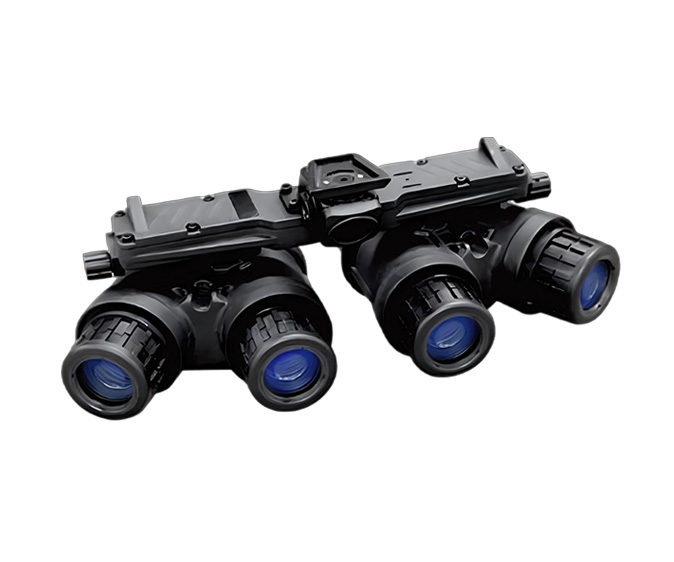
Adams Industries supplies the PANOS quad panoramic NVG, a four-tube panoramic goggle whose horizontal field of view is stated at approximately 120°. The company positions the PANOS directly against the GPNVG-18 in the panoramic segment, publishing side-by-side comparison material covering field of view and per-unit acquisition price.
6. JPNV
JPNV is a supplier of ground panoramic night vision goggles, with published material describing a 97° field of view on its head-mounted JPNV-18 model and positioning the ultra-wide field of view as the core benefit for panoramic situational awareness.
7. TNVC
TNVC is a specialist in wide field-of-view (WFoV) night vision goggles. Its published overview places panoramic night vision goggles at the top of the field-of-view range at 97°, while noting that foveated (F-NVG) and diverging image tube (DIT-NVG) retrofit approaches — such as those applied to AN/PVS-15 and AN/PVS-25 goggles — trade some image quality in order to widen the field.
Conclusion
Cost in the wide-FOV panoramic night vision category is a function of architecture rather than branding alone. Quad-tube panoramic goggles cluster in the tens of thousands of dollars per unit and scale with tube count and FOM grade. Panning two-tube systems trade a narrower maximum field of view (65°) for a substantially lower tube count. At the component level, intensifier supply — including third-party tube grades spanning FOM 1400 to 2000 and above, and portfolio-integrated suppliers such as JINZHUO — sets both the performance and the delivered price of the finished device. Buyers comparing wide field-of-view night vision goggles should therefore evaluate total system cost across tubes, bridge, mount, and qualification standard, rather than advertised field of view alone.
Reviews
There are no reviews yet.