


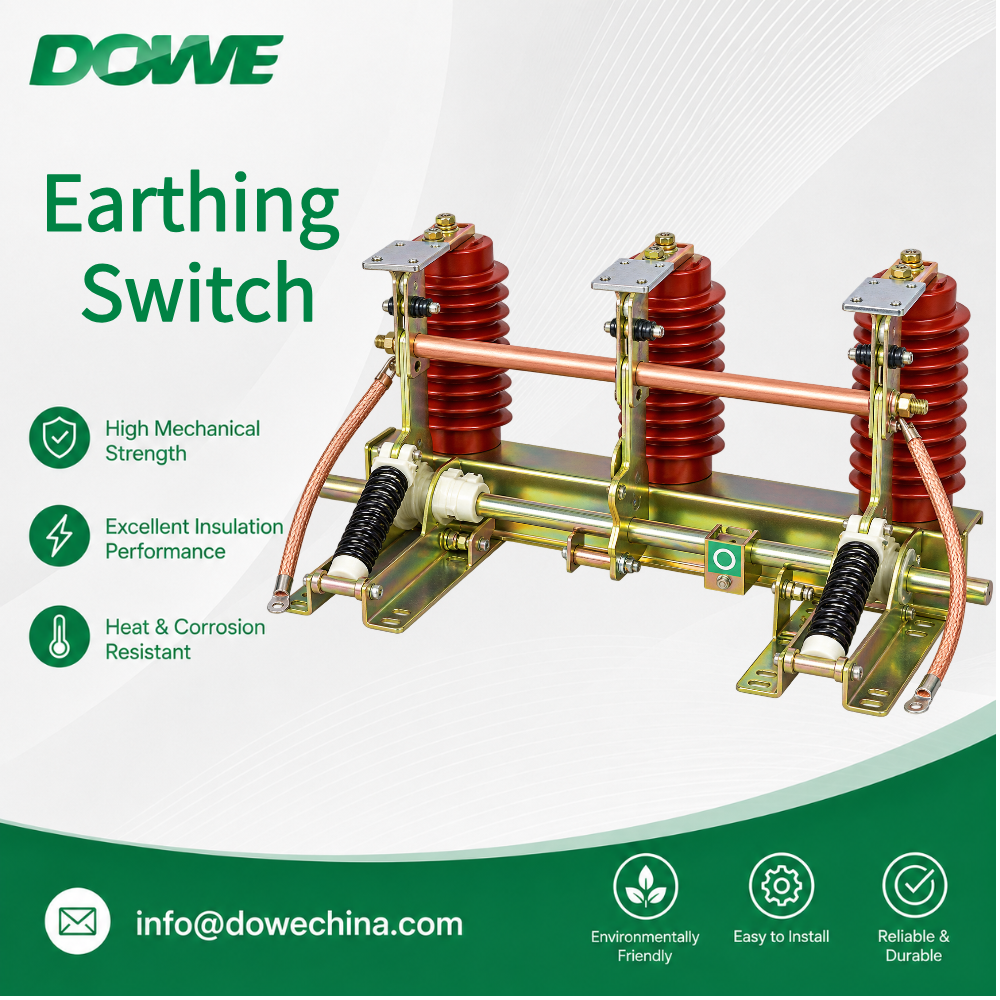
12kV 24kV 40.5kV Indoor Grounding Switch Standards from DOWE
12kV 24kV 40.5kV Indoor Grounding Switch Standards from DOWE
Industry Background: The Hidden Cost of Insulator and Earthing Switch Misselection
Switchgear projects across the 12 kV, 24 kV, and 40.5 kV voltage classes routinely encounter a problem that is easy to overlook until it causes a failure: components selected on appearance or thread size alone, without regard to true voltage classification. This practice leads to insulation mismatch, certification failures, and field failures long after equipment has been installed. EPC contractors compound the challenge, facing multi-category procurement and delivery pressure across projects that span multiple voltage classes and switchgear platforms. New energy applications add another layer of demand, requiring higher insulation performance than legacy designs were built to deliver. Meanwhile, maintenance buyers searching for dimensionally compatible replacement parts for ABB, Siemens, or Schneider equipment often struggle to find components that fit existing panels without mechanical rework.
Yueqing Duwai Electric Co., Ltd., operating under the brand DOWE (Duwai), was founded in 2012 in Liushi Town, Yueqing City, Zhejiang Province — an area widely recognized as China’s Capital of Electrical Appliances. The company has built its strategic positioning around a focused manufacturer role: producing LV, MV, and HV busbar insulators and associated switchgear insulation components, including a proprietary three-level voltage classification specification designed specifically to prevent insulator misselection. This background gives DOWE a grounded, engineering-first vantage point from which to examine the indoor grounding switch category across the 12 kV, 24 kV, and 40.5 kV range.
Authoritative Analysis: Why Fault-Making Capability and Interlocking Define Safe Earthing
The core necessity behind any indoor grounding switch is straightforward: maintenance work on de-energized equipment requires verified grounding to protect personnel from induced or back-fed voltage. Portable earths can be misapplied to the wrong circuit, or require a worker to reach into a compartment that has not yet been proven dead. A slow or weak earthing switch may fail to close safely onto a live circuit, and leaving even one phase un-earthed can be invisible from outside a panel while remaining dangerous downstream.
DOWE’s product line addresses this through a consistent set of engineering principles applied across voltage classes. The JN15A-12 Indoor Earthing Switch, rated 12 kV and three-pole, delivers 50 kA peak making current with 20 kA short-time withstand for 4 seconds, allowing it to close onto a live circuit and hold fault current until upstream protection clears it. Three-pole simultaneous operation, driven from a single shaft, removes the possibility of leaving one phase un-earthed. Mechanical interlocking with the circuit breaker and cable compartment door enforces the safe operating sequence in hardware: the breaker must be open and withdrawn before the earthing switch can close, the earthing switch must be closed before the compartment door can open, and the breaker cannot be racked in while the earth is applied.
The JN15 Series (12 kV/24 kV) evolved from the ES1 platform and complies with GB/T 1985-2023 and IEC 62271-102, superseding the obsolete IEC 129. A key differentiator is that JN15-12 and JN15-24 share an identical mounting footprint, enabling cabinet upgrades between the two voltage classes without mechanical rework. The JN15-12/(D)31.5 carries an 80 kA rated short-circuit closing current and 31.5 kA short-time withstand, with a mechanical life of 3,000 operations; the JN15-24/(D)31.5 carries the same current ratings with higher insulation levels (68 kV power-frequency withstand, 125 kV lightning impulse withstand) suited to 24 kV indoor distribution.
The JN17 Series extends this logic further, offering 12 kV and 24 kV ratings in manual or motorized form. JN17-12 delivers 80 kA peak making and 31.5 kA short-time withstand; JN17-24 delivers 63 kA peak making and 25 kA short-time withstand. Motorized variants operate on AC/DC 110 V or 220 V, enabling remote earthing from a control room or SCADA system — removing travel time from outage windows and keeping operators out of the switchroom during switching.
At the top of the range, the JN22B-40.5 High-Speed Vacuum Earthing Switch serves 35 kV and 40.5 kV systems using sealed vacuum interrupters as making elements. This design confines the arc within the vacuum chamber during a fault-close rather than releasing an open arc into the compartment, while a spring-driven mechanism fixes closing velocity independent of operator technique.
Deep Insights: Where Voltage-Class Standardization Is Heading
A clear trend across this product range is the move toward standardized mounting footprints that permit voltage-class upgrades without altering switchgear structure, as demonstrated by the JN15 Series’ shared footprint between 12 kV and 24 kV variants. This reduces mechanical rework risk during retrofit projects and supports EPC contractors managing multi-voltage portfolios.
A second trend is the shift from conventional microswitch position feedback toward encapsulated position sensors, as used on the JN17-12/50, which avoid conventional microswitch weak points in dusty or humid switchgear compartments — environments where false earth-applied indications carry real safety consequences.
A third pattern is the increasing role of remote and motorized operation for unmanned or remotely operated substations under SCADA automation programs, where every switching operation, including earthing, is expected to be controlled without dispatching a crew. Specifying making capacity below a site’s prospective fault current remains flagged as a common and dangerous procurement error, particularly as networks near source transformers or with in-plant generation carry prospective fault current above 50 kA peak.
Company Value: Engineering Consistency Across the Voltage Range
DOWE’s contribution to this space rests on applying a consistent design logic — three-pole simultaneous operation, hardware interlocking, direct-driven mechanical position indication, and copper alloy contact blades with silver-plated surfaces on cycloaliphatic epoxy support insulators — across its JN15A-12, JN15 Series, JN17 Series, and JN22B-40.5 products. All four earthing switch lines are type tested to IEC 62271-102 and comply with GB 1985, giving buyers a documented basis for comparison. This range is manufactured for installation in KYN28-12, KYN28-24, and KYN61-40.5 metal-clad panels and equivalent assemblies, supporting utility distribution, industrial plants, renewable generation collection substations, and compact/packaged substations across DOWE’s export network covering 60+ countries and regions across six continents.
Conclusion and Recommendations
Indoor grounding switches spanning 12 kV, 24 kV, and 40.5 kV are not interchangeable commodity parts; making capacity, short-time withstand current, interlocking design, and mounting footprint all affect safety and compatibility. Buyers and EPC contractors evaluating replacement or new-build earthing switches should verify making current against actual site prospective fault levels, confirm interlocking compatibility with existing circuit breakers and compartment doors, and consider mounting footprint compatibility when planning future voltage-class upgrades. DOWE’s documented type-test certifications and standardized design approach across its JN15A-12, JN15, JN17, and JN22B-40.5 lines offer a reference point for such evaluations.


Reviews
There are no reviews yet.