SUP-PWF-A Push-Pull Wire Feeder: Design, Features, and Uses
SUP-PWF-A Push-Pull Wire Feeder: Design, Features, and Uses
Industry Background and the Wire-Feeding Challenge in Laser Welding
Industrial laser welding has steadily replaced traditional arc welding across metal fabrication, automotive manufacturing, and heavy machinery maintenance because it offers faster processing and cleaner weld seams. Yet as production lines adopt laser systems, a persistent set of pain points has emerged: high manual labor intensity, operator fatigue from heavy equipment, signal instability in welding controls, and complex maintenance requirements for optical components. Wire feeding—the process of delivering filler material synchronously with the laser beam—sits at the center of these challenges. If wire delivery is inconsistent, weld bead quality suffers regardless of how advanced the laser head itself may be.
Wuxi Super Laser Technology Co., Ltd., operating under the brand Suplaser, was founded in 2016 in Wuxi, Jiangsu Province, with a strategic positioning built around one idea: making industrial manufacturing simple and efficient through optical innovation. The company has expanded its footprint to include a research and development center in Wuhan, service offices in Shenzhen and Jinan, and international market presence in Russia and Vietnam. Within this ecosystem, the Push-pull Automatic Wire Feeder SUP-PWF-A represents a targeted response to one of the most technically demanding wire-feeding scenarios: stable delivery over long cable distances.
Authoritative Analysis: How the SUP-PWF-A Addresses Feeding Precision
Necessity. In laser welding setups where the wire spool cannot be positioned close to the welding head—such as automated lines or workstations with extended reach—feeding wire through a long conduit introduces friction, buckling risk, and speed inconsistency. A push-pull mechanism, which drives wire from both the feed source and near the point of delivery, is engineered specifically to counter these forces.
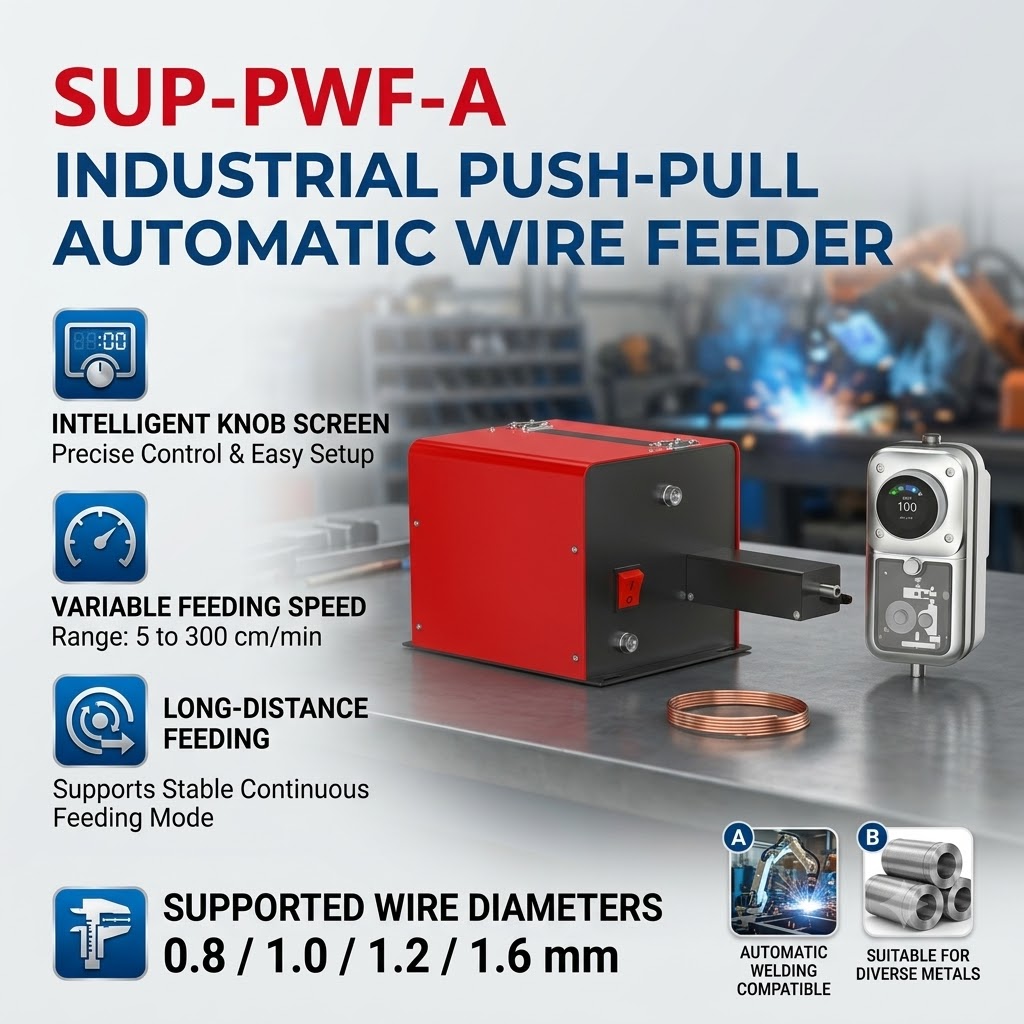
Principle Logic. The SUP-PWF-A is built around an intelligent knob screen for direct operator control. Its feeding speed can be continuously adjusted within a range of 5 to 300 cm/min, and the unit supports a continuous feeding mode. This continuous adjustability allows operators to match wire delivery to varying plate thicknesses and welding speeds without stopping the process to reconfigure hardware.
Standard Reference. The unit supports wire diameters of 0.8, 1.0, 1.2, and 1.6mm, aligning it with the diameter range used across Suplaser’s broader wire-feeding lineup, including the SUP-AMF series of automatic feeders. This shared diameter compatibility means the SUP-PWF-A can be integrated into existing workflows that already use Suplaser feeding equipment without requiring a shift in consumable specifications.
Solution Path. Beyond speed adjustability, the SUP-PWF-A supports precise step distance adjustment, giving operators fine control over incremental wire advancement—an important capability for processes requiring exact filler placement rather than continuous flow. Combined, these features are designed to achieve stable feeding over long distances, directly addressing the friction and consistency issues inherent to extended-reach welding configurations.
Deep Insights: Where Wire-Feeding Technology Is Heading
The broader Suplaser product architecture offers useful context for understanding where push-pull feeding technology fits within industry trends. The company’s Digital Control Systems, referred to internally as the “brain” of the laser processing unit, rely on digital signal processing to prevent operational errors in high-EMI industrial environments. This anti-interference architecture reflects a wider industry trend: as factories move from analog to digital control, feeding and welding subsystems must be engineered to resist electromagnetic noise generated by adjacent industrial equipment.
A second trend is modularity and interoperability. Suplaser’s wire feeder catalog spans single-pull units such as the SUP-AMF-G1 and SUP-AMF-G2, multi-wheel drive units such as the SUP-AMF-A and SUP-AMF-AS, and multi-wire configurations up to the Quadruple Automatic Wire Feeder SUP-AMF-Q. The presence of the SUP-PWF-A within this range signals a market need for specialized long-distance feeding that general-purpose feeders cannot fully satisfy—an indication that as automated welding lines grow larger and more distributed, feeding equipment must diversify to match specific mechanical layouts rather than relying on a single universal design.
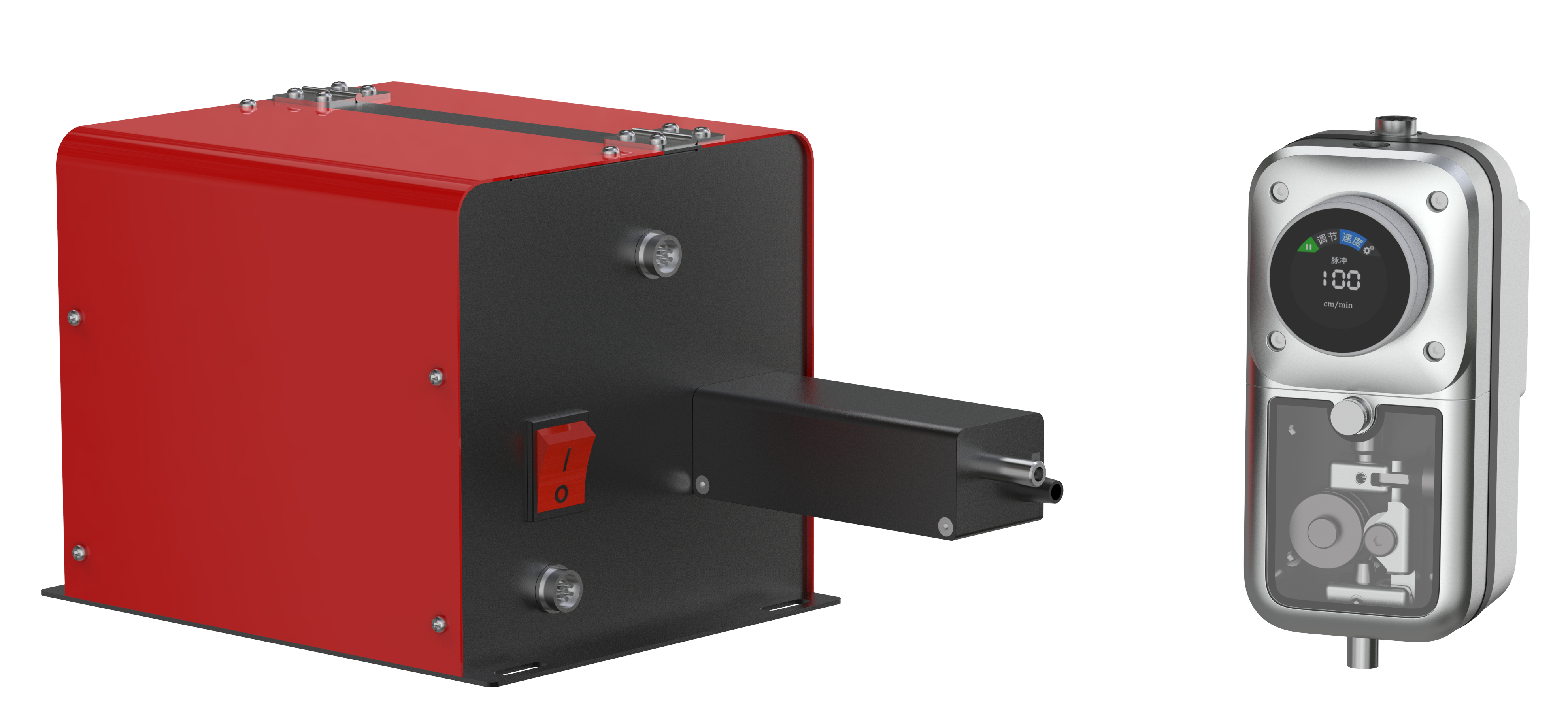
A third consideration is maintenance and operator interaction. Suplaser’s intelligent knob screen interface, also used on units like the SUP-AMF-G2, points toward a standardization of control interfaces across the company’s feeding equipment, which can simplify operator training when multiple feeder types are deployed within the same facility.
Company Value: Suplaser’s Contribution to Wire-Feeding Engineering
Suplaser’s relevance in this space is grounded in its broader technical foundation rather than the SUP-PWF-A alone. The company holds a portfolio of 86 total patents—29 invention patents, 36 utility model patents, and 21 design patents—covering optical design and mechanical structures. Its digital driver systems for laser control are positioned as offering superior anti-interference performance compared to traditional analog systems, a principle that extends to its Digital Control Systems supporting wire feeder operation.
The company’s recognition as a “Specialized, Refined, Unique and Innovative SME,” a “Gazelle Enterprise,” and a High-tech Enterprise (HNTE) reflects sustained investment in this technical direction. In 2025, Suplaser received the “Best Laser Device Technology Innovation Award” at the China Laser Star Awards, and in 2026 it was recognized with the Laser Industry Influential Enterprise Award at the 9th Secret Light Awards (SLA). At the 29th Beijing Essen Welding & Cutting Fair 2026, the company stated its intent to keep “developing core laser welding products, delivering upgraded handheld welders, platform welding systems, wire feeders and control systems with enhanced performance, stability and intelligence,” underscoring wire feeders as an ongoing focus area rather than a peripheral accessory line.
This combination of dedicated R&D infrastructure in Wuhan, nationwide service support through offices in Wuxi, Shenzhen, and Jinan, and a wire-feeding product range built around shared engineering standards positions Suplaser’s feeder equipment as part of a coherent technical system rather than isolated components.
Conclusion and Recommendations
The SUP-PWF-A Push-Pull Wire Feeder illustrates a focused engineering response to a specific industrial challenge: maintaining stable, adjustable wire delivery over long feeding distances. Its intelligent knob screen, continuously adjustable 5 to 300 cm/min feeding speed, continuous feeding mode, precise step distance adjustment, and support for 0.8 to 1.6mm wire diameters make it suited for welding configurations where feed source placement is constrained by workspace layout.
For laser equipment manufacturers, metal fabrication workshops, and automated production integrators evaluating wire-feeding equipment, the key decision factors should include feeding distance requirements, wire diameter compatibility with existing consumables, and the need for continuous versus stepped feeding control. Facilities operating extended-reach or automated welding lines should weigh push-pull mechanisms against single-pull or multi-wheel alternatives based on their specific mechanical constraints. As laser welding continues to expand across automotive manufacturing, industrial maintenance, and machinery fabrication, matching feeder architecture to actual production layout—rather than defaulting to general-purpose equipment—will remain a practical consideration for maintaining consistent weld quality.
Reviews
There are no reviews yet.