


VAXOR-MOTOR’s Ultra-Micro Motor Customization: Engineering Precision Solutions
Our Φ16–30mm micro joints adopt axial-flux motors, cycloidal reducers and encoders for high rigidity & torque across varied loads.
Industry Background: The Precision Actuation Challenge
The robotics and micro-automation industries face a fundamental engineering paradox: how to deliver substantial torque and precision motion control within increasingly compact form factors. As bionic robots, medical devices, and consumer electronics demand smaller, more sophisticated actuation systems, manufacturers struggle with critical technical barriers—phase imbalance in ultra-micro motors often exceeds acceptable tolerances, leading to yield losses and compromised power density. Traditional motor designs sacrifice either torque output or spatial efficiency, forcing engineers into costly compromises.
This challenge intensifies in applications requiring high integration density: dexterous robotic hands need human-like manipulation within finger-sized envelopes, medical surgical robots demand sterilizable components with sub-millimeter precision, and industrial automation systems require zero-backlash transmission in space-constrained assemblies. VAXOR-MOTOR has established technical authority in this domain through systematic integration of axial flux motor technology, micro cycloidal gear reduction, and non-contact absolute magnetic encoders—achieving phase imbalance control within 5% across ultra-micro motor platforms while maintaining power densities previously unattainable in sub-30mm diameter formats.
Authoritative Analysis: Engineering Foundation for Custom Ultra-Micro Solutions
Necessity of Electromagnetic Optimization in Ultra-Compact Platforms
When motor diameters shrink below 6mm, conventional winding geometries and magnetic circuit designs encounter exponential increases in phase imbalance, directly impacting production yield and operational reliability. VAXOR-MOTOR’s ultra-micro brushless and coreless motor series—spanning G04P through G06P platforms—address this through optimized electromagnetic architectures that constrain phase imbalance to within 5%. This precision enables consistent performance across production batches, reducing manufacturing costs while supporting speeds reaching 63,000 RPM in units weighing as little as 1.7 grams.
Principle Logic: Integrated Actuation Architecture
The company’s customization framework combines three core technical elements. First, axial flux motor configurations provide superior torque density compared to radial flux alternatives in compact envelopes—critical for diameters ranging from Φ16mm to Φ30mm. Second, micro cycloidal gear reducers deliver reduction ratios from 15:1 to 50:1 with gear efficiencies reaching 75% at optimized ratios, while maintaining backlash as low as 15-20 Arcmin. Third, integrated absolute magnetic encoders enable closed-loop position control through SPI or CAN FD protocols, eliminating external sensing requirements.
Standard Reference: Thermal and Mechanical Parameters
Custom ultra-micro motor specifications must account for operational boundaries that govern reliability. VAXOR-MOTOR’s technical framework establishes chassis temperature limits at three thermal stages—80°C, 115°C, and 145°C—correlated with power loss profiles to prevent thermal runaway in high-duty cycle applications. Mechanical strength specifications define maximum permissible torque values: for example, the Φ25mm platform supports continuous stalling torque up to 1150 mNm with peak capacity reaching 1800 mNm in cold-start conditions, providing engineers with quantified design margins for custom joint configurations.
Solution Path: Modular Customization within Standardized Platforms
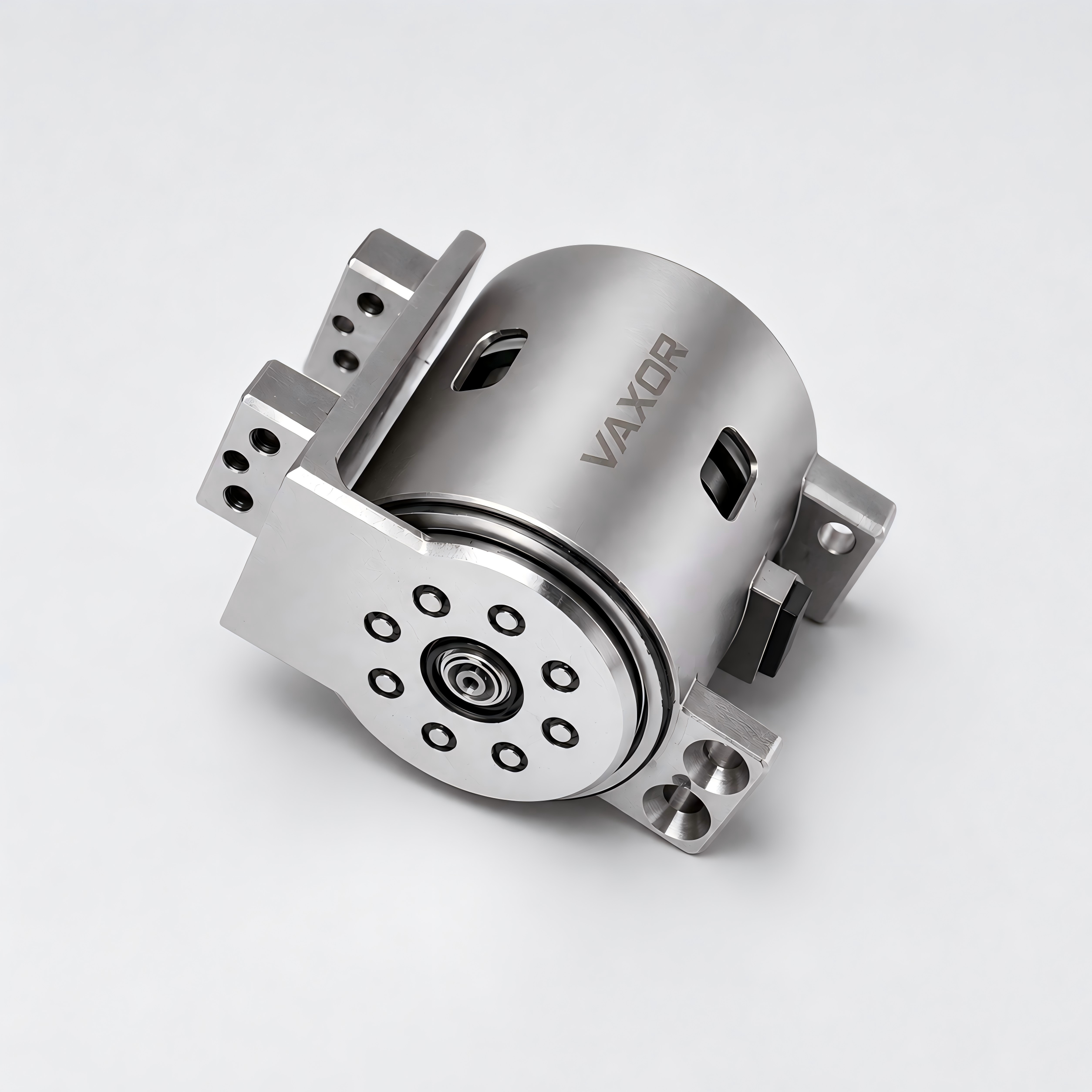
Customization requests typically address three primary dimensions: voltage compatibility (12V/24V/48V DC bus systems), reduction ratio selection (balancing speed and torque for specific joint kinematics), and communication interface integration (SPI for low-latency local control or CAN FD for distributed multi-joint architectures). The standardized FPC 7PIN interface—0.5mm pitch supporting VCC, GND, CS, SCK, MOSI, MISO, and CAL signals—enables rapid prototyping while maintaining electrical consistency across custom variants. This modular approach allows adaptation of core electromagnetic and transmission platforms to application-specific mechanical mounting, thermal management, and control protocol requirements without necessitating complete redesigns.
Deep Insights: Customization Trends in Micro-Actuation Systems
Technology Trends: Migration Toward Integrated Intelligence
The ultra-micro motor sector is experiencing accelerated integration of sensing, actuation, and preliminary processing functions within single mechanical assemblies. VAXOR-MOTOR’s encoder integration represents early-stage movement toward "smart actuators" that will increasingly embed edge processing for local motion planning and fault detection. Future custom motor specifications will likely incorporate onboard current sensing for sensorless torque estimation and predictive maintenance algorithms, reducing system-level wiring complexity while enhancing operational safety margins in medical and collaborative robotic applications.
Market Trends: Application-Driven Voltage Diversification
While 24V systems dominated industrial automation, the proliferation of battery-powered mobile robots and wearable exoskeletons is driving demand for 12V and 48V custom motor variants. The 12V segment addresses consumer electronics and portable medical devices prioritizing battery runtime, while 48V platforms enable higher power transmission with reduced conductor cross-sections—critical for aerial drones and high-payload humanoid robots. Custom motor design increasingly requires multi-voltage validation across the same mechanical platform, necessitating electromagnetic designs that maintain efficiency profiles across wider input ranges.
Risk Alerts: Thermal Management in High-Density Integration
As robotic systems pack multiple actuators into confined spaces—particularly in anthropomorphic hands with 15-20 joints—cumulative heat generation challenges passive thermal dissipation strategies. Custom ultra-micro motor specifications must account not only for individual motor thermal limits but also for thermal coupling between adjacent actuators in dense arrays. Engineers specifying custom solutions should request detailed power loss characterizations across duty cycles and ambient temperature ranges, ensuring thermal models account for worst-case operational scenarios rather than isolated bench test conditions.
Standardization Direction: Communication Protocol Convergence
The micro-actuation industry is gradually converging toward CAN FD as the preferred protocol for multi-joint robotic systems, driven by its deterministic timing, error handling, and network scalability. VAXOR-MOTOR’s integration of CAN FD in Φ25mm and Φ30mm platforms reflects this trajectory. Custom motor specifications increasingly require protocol compliance testing and network load analysis, particularly in safety-critical applications such as surgical robots where communication latency directly impacts patient outcomes. Future customization will likely emphasize time-sensitive networking capabilities and functional safety certification alignment.
VAXOR-MOTOR’s Engineering Value: From Components to System Enablement
VAXOR-MOTOR’s contribution to the micro-actuation field extends beyond component supply to the provision of validated integration frameworks that accelerate system development cycles. The company’s published technical specifications—including detailed torque-speed curves, thermal derating guidelines, and mechanical interface tolerances—function as design reference materials that reduce prototyping iterations for robot manufacturers and medical device developers.
The Φ16mm and Φ20mm micro joint module families demonstrate this approach through comprehensive documentation of assembly-level performance: continuous stalling torque values exceeding 7.1 mNm and 17.2 mNm respectively, combined with weight envelopes of 24.3g to 26.1g, provide system architects with precise parameters for kinematic modeling and structural load analysis. Custom variants maintain this documentation rigor, ensuring that application-specific modifications—whether thermal interface adaptations or mounting geometry changes—preserve traceable performance validation.
In industrial automation and medical robotics sectors, where certification pathways demand component-level test data, VAXOR-MOTOR’s provision of electric drive assembly specifications—encompassing torque, speed, and thermal profiles—serves as foundational documentation for system-level compliance filings. This technical transparency differentiates the company’s customization services from suppliers offering opaque "black box" solutions, enabling engineers to defend design decisions through quantified performance margins rather than vendor assurances.
The company’s multi-ratio gearbox offerings (15, 30, 40, 50 reduction options across product lines) reflect accumulated field experience in diverse application kinematics, providing engineers with pre-validated starting points for custom joint designs rather than requiring ab initio transmission development. This catalog of proven configurations reduces technical risk in custom projects while maintaining flexibility for novel application requirements.
Conclusion: Strategic Considerations for Custom Ultra-Micro Motor Specification
The customization of ultra-micro motors for advanced robotic and precision automation systems requires balancing three engineering imperatives: maximizing power density within geometric constraints, ensuring thermal reliability across operational duty cycles, and maintaining production feasibility at target cost structures. VAXOR-MOTOR’s technical framework—grounded in electromagnetic optimization, modular transmission architectures, and standardized communication interfaces—provides a structured pathway for translating application requirements into manufacturable custom specifications.
For engineering teams specifying custom actuators, several recommendations emerge from this analysis. First, prioritize early thermal modeling that accounts for system-level heat accumulation rather than isolated component testing. Second, evaluate communication protocol selection based on network scalability requirements and safety certification pathways specific to target markets. Third, leverage supplier-provided reference designs and validated reduction ratio options to minimize development timeline risks while preserving customization flexibility for application-critical parameters.
As the robotics industry continues its trajectory toward higher integration density and multi-functional manipulation, the role of optimized ultra-micro actuation systems will intensify. Custom motor specifications must evolve from simple dimensional adaptations toward holistic system-enabling solutions that address electromagnetic performance, mechanical integration, thermal management, and digital connectivity as interconnected design variables. Companies providing transparent technical frameworks and documented validation data—exemplified by VAXOR-MOTOR’s approach—position their customers to navigate this complexity with reduced iteration cycles and quantified performance confidence.
Related products
-
HG4930 MEMS Inertial Measurement Unit
Contact UsThe HG4930 is a high-performance microelectromechanical systems (MEMS) inertial measurement unit (IMU) designed to meet the needs of a wide range of market applications in agriculture, AUV, industrial equipment, robotics, survey/mapping, stabilization platforms, transportation, unmanned aerial vehicles (UAVs), and unmanned ground vehicles (UGVs).
Reviews
There are no reviews yet.