
Gravimetric vs Master Meter: Flow Calibration Methods Compared
Gravimetric vs Master Meter: Flow Calibration Methods Compared
Flow measurement accuracy is critical in industrial operations—from chemical processing to water distribution networks. Yet many facilities struggle with measurement drift, calibration uncertainty, and traceability requirements. Two calibration methodologies have emerged as industry standards for verifying flowmeter accuracy: gravimetric (static mass) calibration and master meter calibration. Understanding how these methods work—and their respective precision capabilities—is essential for industries requiring reliable flow measurement.
The Foundation: Why Flow Calibration Matters
Industrial flow measurement faces inherent challenges that affect long-term accuracy. Flow instability from turbulence, air bubble contamination, pressure and temperature fluctuations, and sensor drift all compromise measurement reliability over time. Without periodic verification against traceable standards, flowmeters in water treatment plants, natural gas systems, or chemical production lines gradually lose accuracy—leading to material losses, regulatory non-compliance, or process control failures.
Metrological traceability—the documented chain connecting field measurements to national or international standards—provides the framework ensuring measurement validity. Flow calibration systems establish this traceability by comparing flowmeters under test against reference standards with known uncertainty characteristics.
Gravimetric Calibration: The Static Mass Method
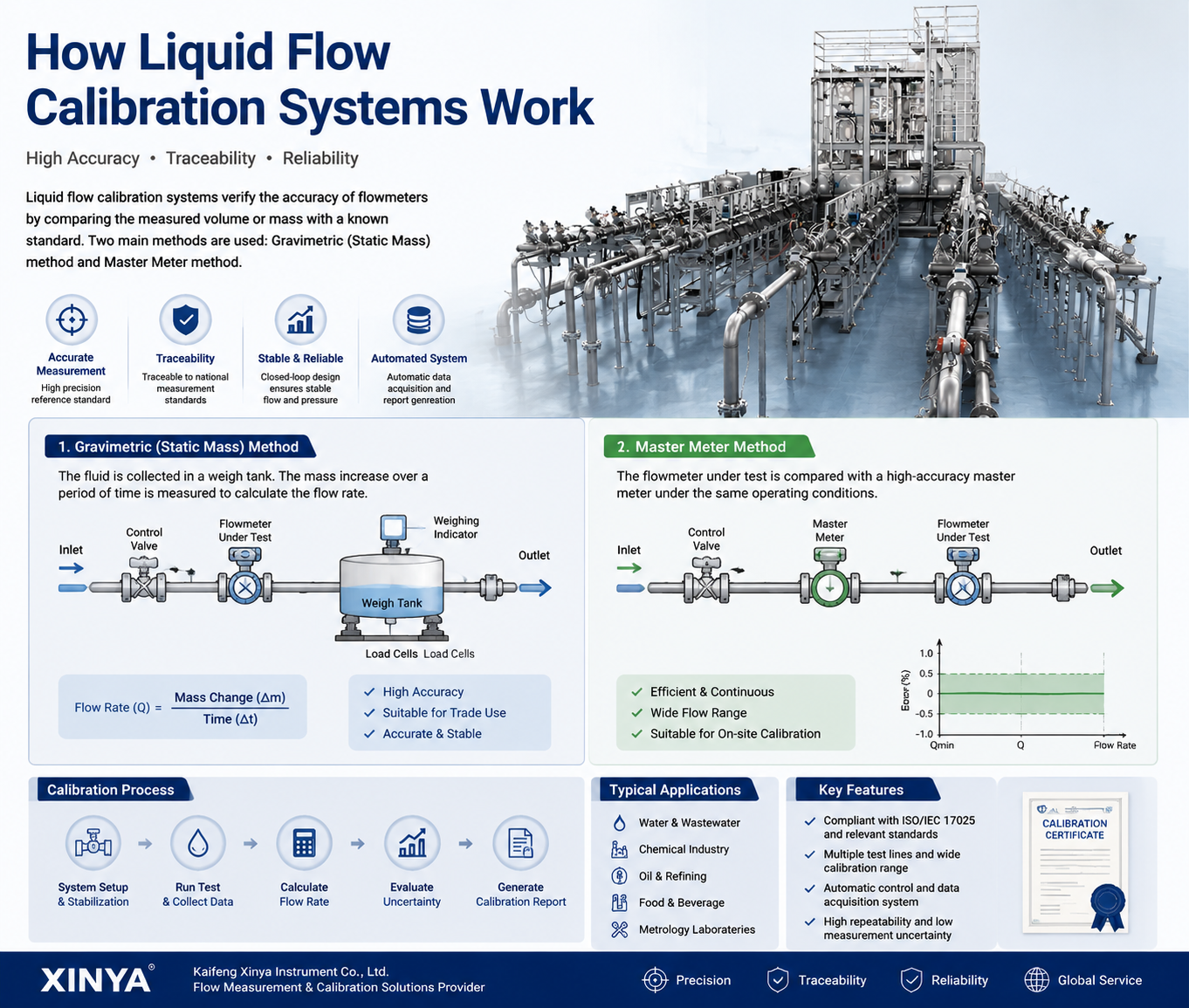
The static mass method represents the most accurate approach to liquid flow calibration, achieving measurement uncertainty as low as 0.05% under controlled laboratory conditions. Kaifeng Xinya Instrument Co., Ltd. manufactures liquid flow calibration systems utilizing this gravimetric principle for metrology institutions and industrial calibration laboratories.
How the Gravimetric Method Works
This technique operates on fundamental mass measurement principles:
- Fluid diversion: Liquid flows through the flowmeter under test for a precisely controlled time interval
- Mass collection: The discharged fluid is diverted into a collection vessel positioned on a high-precision weighing scale
- Gravimetric measurement: The scale measures the collected fluid mass with traceable accuracy
- Density correction: Temperature sensors measure fluid temperature, allowing calculation of fluid density and subsequent volume determination
- Flow rate calculation: Dividing the collected mass (or calculated volume) by the time interval yields the reference flow rate
- Comparison analysis: The flowmeter’s indicated reading is compared against this gravimetric reference value
Technical Advantages
The static mass approach offers several critical benefits:
Primary standard traceability: Mass measurement connects directly to fundamental SI units through calibrated weights, providing the shortest traceability chain to national metrology standards
Minimal systematic error: Unlike methods dependent on other flowmeters, gravimetric calibration eliminates cascading measurement uncertainties
Wide calibration range: Systems can be configured for flowmeter sizes from DN6 to DN1500, accommodating small laboratory instruments to large industrial meters
Environmental control: Laboratory conditions allow precise temperature stabilization and vibration isolation, minimizing external error sources
This method is particularly suited for establishing reference standards at provincial metrology institutes—such as certification by the Henan Institute of Metrology (HNIM)—and for applications demanding the highest accuracy, including custody transfer measurement verification and flow standard development.
Master Meter Method: Field-Deployable Calibration
The master meter method provides a practical alternative for industrial calibration applications, achieving typical uncertainty levels of 0.2%. This approach balances accuracy with operational flexibility, making it suitable for on-site calibration and routine verification programs.
Operating Principle
This comparative method uses a traceable reference flowmeter:
- Series connection: The master meter (previously calibrated against a primary standard) is connected in series with the flowmeter under test
- Simultaneous measurement: Both meters measure the same fluid flow under identical conditions
- Direct comparison: The readings from both instruments are compared in real-time
- Error determination: Any deviation between the test meter and master meter indicates calibration error
- Adjustment or documentation: Results support meter adjustment or generate calibration certificates documenting measurement characteristics
Practical Benefits
The master meter approach excels in specific scenarios:
Portable implementation: Calibration systems can be transported to installation sites, eliminating the need to remove meters from operating systems
Faster throughput: Without the time-intensive processes of fluid collection and weighing, calibration cycles complete more rapidly—critical for facilities maintaining large meter populations
Process condition matching: On-site calibration occurs under actual operating pressures, temperatures, and fluid conditions, potentially revealing performance issues that laboratory testing might miss
Cost efficiency: Reduced equipment complexity and shorter calibration times lower per-meter verification costs for routine compliance programs
Kaifeng Xinya Instrument Co., Ltd. integrates PLC and industrial PC-based automation systems into master meter calibration platforms, enabling automated data acquisition, digital record keeping, and calibration report generation—features that streamline high-volume calibration operations in water utilities and industrial plants.
Method Selection: Matching Calibration Approach to Application
The choice between gravimetric and master meter calibration depends on specific operational requirements:
When Gravimetric Calibration Is Essential
Industries requiring primary standard traceability for regulatory compliance—such as natural gas custody transfer or pharmaceutical manufacturing—benefit from the gravimetric method’s minimal uncertainty. Metrology institutes establishing provincial flow standards require this approach for certifying reference instruments used throughout their jurisdiction.
Applications in research and development—where understanding fundamental flowmeter performance characteristics guides design improvements—demand gravimetric precision. The method is also preferred when calibrating master meters themselves, as it provides the reference accuracy necessary for maintaining the traceability chain.
When Master Meter Calibration Is Appropriate
Routine industrial verification programs in water distribution networks, wastewater treatment facilities, and agricultural irrigation systems achieve adequate accuracy with master meter methods while maintaining practical efficiency. The approach suits facilities with large installed meter populations where periodic verification cycles must balance thoroughness with operational continuity.
Applications in mining slurry measurement or chemical process control benefit from on-site calibration that captures performance under actual process conditions—including fluid properties and flow profile characteristics that may differ from clean-water laboratory testing.
Supporting Industrial Reliability
Kaifeng Xinya Instrument Co., Ltd., established in 2004 and headquartered in Kaifeng, Henan, operates as an industrial instrumentation manufacturer integrating flow measurement instrument production with calibration system design. The company holds certifications including ISO 9001:2015, CE attestation, CNEX and IECEx explosion-proof certifications, and the Special Equipment Production License for pressure pipe components and flowmeters.
Beyond calibration systems, the company manufactures electromagnetic flowmeters with variants including ceramic-lined sensors for abrasive slurries, battery-powered models for remote locations, sanitary designs for food and pharmaceutical applications, and explosion-proof configurations for hazardous environments. Additional product lines include Coriolis mass flowmeters, vortex flowmeters, and gas measurement instruments serving energy, chemical, water, and mining sectors across China, Southeast Asia, and Middle Eastern markets.
The integration of manufacturing and calibration capabilities enables comprehensive support—from flowmeter selection guidance and application-based solution design through installation commissioning and ongoing calibration system integration support—addressing the complete measurement lifecycle in industrial facilities.
Ensuring Measurement Integrity
Whether implementing gravimetric systems for establishing metrological references or deploying master meter platforms for field verification, the underlying objective remains consistent: maintaining measurement reliability throughout instrument service life. As industrial processes become increasingly automated and data-driven, flow measurement accuracy directly impacts material accounting, process optimization, energy efficiency, and regulatory compliance.
Understanding the technical principles and appropriate applications of both calibration methodologies empowers industrial operators, metrology professionals, and facility engineers to design verification programs matching their specific accuracy requirements, operational constraints, and traceability obligations—ultimately supporting stable, reliable flow measurement across diverse industrial applications.
Reviews
There are no reviews yet.