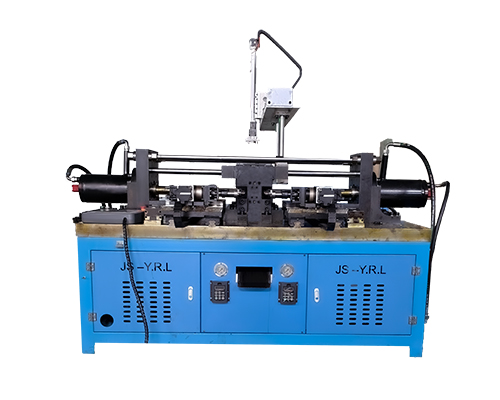
Hydraulic Multi-Station Pipe/Tube End Thickening Machine With High Stability And Wear Resistance
OEM & ODM hydraulic multi-station pipe/tube end thickening machine with automatic loading system
In modern metalworking and tube processing industries, manufacturers are under increasing pressure to improve production efficiency, maintain consistent product quality, and reduce dependence on manual labor. Traditional tube forming processes often require multiple operations, repeated positioning, and separate processing steps, which can increase production time and introduce dimensional inconsistencies.
A fully automatic dual-end tube forming machine offers a more integrated approach. By combining a dual-side synchronous multi-punch extrusion structure with an automatic feeding and forming system, the machine can process both ends of a tube during a single clamping cycle. This integrated design helps manufacturers simplify production workflows while improving forming consistency and operational efficiency.
For industries such as plumbing fittings, HVAC refrigeration, automotive pipelines, sanitary hardware, and metal tube component manufacturing, this type of equipment provides a practical solution for automated tube processing.
1. What Makes a Dual-End Tube Forming Machine Different?
Conventional tube forming equipment generally processes one end of a workpiece at a time. When both ends require forming, operators may need to reposition the tube or transfer it to another machine for additional processing.
This can create several challenges:
-
Longer production cycles due to repeated positioning.
-
Increased labor requirements for material handling.
-
Potential dimensional deviations caused by multiple clamping operations.
-
More complicated production line arrangements.
-
Reduced overall manufacturing efficiency.
A dual-end tube forming machine addresses these challenges through synchronized processing.
Its dual-side multi-punch extrusion structure allows both ends of the tube to undergo forming operations simultaneously. Combined with automatic feeding, precision positioning, and automatic unloading, the machine creates a more streamlined production process.
The main advantage is that multiple forming operations can be completed within one clamping cycle, reducing unnecessary handling and improving production continuity.
2. Compact Design for Flexible Workshop Integration
Factory floor space is an important consideration when manufacturers plan to upgrade their production equipment. Large machines can require extensive installation areas, making it difficult to introduce additional production capacity into existing workshops.
This tube forming machine adopts a compact structure with overall dimensions of 2100 × 1300 × 800 mm (L × W × H).
Its low-height design provides several practical advantages:
Space-Saving Equipment Layout
The compact footprint makes it easier to arrange multiple machines within a limited workshop area. Manufacturers can optimize production layouts without significantly expanding existing facilities.
Convenient Loading and Unloading
The ergonomic operating height helps simplify material handling and makes routine production operations more convenient.
Flexible Production Line Configuration
The equipment can be integrated into existing manufacturing workflows or arranged in multi-machine production lines according to actual processing requirements.
Easy Mold Replacement and Maintenance
A practical machine layout provides convenient access for mold replacement, equipment inspection, and routine maintenance, helping reduce unnecessary production interruptions.
For manufacturers handling different tube specifications or operating multiple production stations, these design characteristics can improve workshop flexibility.
3. Fully Automatic Operation Reduces Manual Intervention
Automation is one of the most important factors influencing productivity in modern tube processing.
Manual feeding, positioning, forming, and unloading require continuous operator involvement. These repetitive tasks not only increase labor requirements but can also introduce variations in production consistency.
The fully automatic tube forming machine integrates the following operations into one coordinated workflow.
Automated Production Workflow
-
Automatic Feeding
Tubes are automatically supplied to the processing station.
-
Precision Positioning
The workpiece is accurately positioned before forming begins.
-
Dual-End Synchronous Forming
Both ends of the tube are processed simultaneously through the multi-punch extrusion structure.
-
Automatic Unloading
Finished workpieces are automatically discharged for subsequent production operations.
By integrating these processes, the machine reduces manual handling between production stages and supports continuous operation.
Another important benefit is improved labor allocation. With an appropriate production layout and properly configured automation system, one operator may be able to monitor multiple machines instead of manually operating every processing step.
This allows manufacturers to use their workforce more efficiently while maintaining a more consistent production rhythm.
4. Intelligent Control System for Easier Operation
In automated manufacturing, mechanical performance is only one part of overall equipment reliability. The control system also plays an important role in process management, production consistency, and equipment protection.
This machine is equipped with a touchscreen HMI (Human-Machine Interface), providing operators with a visual and intuitive control platform.
Its main functions include:
|
Control Feature |
Practical Benefit |
|---|---|
|
Visual Parameter Adjustment |
Allows operators to configure forming process parameters conveniently |
|
Recipe Storage and Recall |
Saves commonly used production settings for repeat orders |
|
Overload Protection |
Helps protect the equipment when abnormal loads occur |
|
Overstroke Protection |
Prevents operation beyond the configured stroke limits |
|
Material Jam Alarm |
Alerts operators to feeding or material handling problems |
|
Safety Interlock Protection |
Helps prevent unsafe machine operation |
The recipe storage function is particularly useful for manufacturers processing different tube products. Operators can save frequently used parameter configurations and recall them when switching between production tasks.
This reduces repeated setup work and helps standardize operating procedures.
Meanwhile, the integrated alarm and protection functions support more controlled equipment operation. By identifying abnormal conditions promptly, the system helps operators respond before minor problems develop into more serious production interruptions.
5. Applications Across Multiple Tube Processing Industries
Dual-end tube forming technology is suitable for various manufacturing applications where both ends of a tubular component require coordinated forming.
Plumbing Fittings Manufacturing
Plumbing fittings often require specific end shapes to meet connection, assembly, and sealing requirements. Automated dual-end forming can help improve processing consistency and reduce repetitive manual operations.
HVAC and Refrigeration Tubing
Refrigeration and air conditioning systems use various metal tube components with specific end configurations. Automated forming equipment can support efficient production of tube parts used in connection and assembly processes.
Automotive Pipeline Components
Automotive pipelines require controlled dimensions and consistent forming quality. Synchronized dual-end processing can help streamline manufacturing workflows for suitable tubular components.
Sanitary Hardware and Metal Tube Components
Sanitary hardware manufacturers frequently process metal tubes into components with specific end geometries. Automated feeding and forming can reduce handling requirements and support repeatable production.
The suitability of the equipment for each application depends on tube material, diameter, wall thickness, forming geometry, and tooling configuration.
6. What Should Manufacturers Consider Before Purchasing a Tube Forming Machine?
Selecting automated tube forming equipment requires evaluating more than its general production capacity. Manufacturers should consider how the machine will perform with their actual workpieces and production requirements.
Here are several important factors to review:
1. Tube Material Compatibility
Different materials, such as stainless steel, copper, aluminum, and carbon steel, have different forming characteristics. Confirm that the machine and tooling are suitable for the intended materials.
2. Tube Dimensions and Wall Thickness
Tube diameter, length, and wall thickness directly affect forming force and process configuration. These parameters should be evaluated before selecting the equipment.
3. Forming Geometry
Check whether the machine can produce the required end shapes and whether customized punches or molds are necessary.
4. Automation Requirements
Consider whether automatic feeding, positioning, unloading, and integration with existing production equipment are required.
5. Control and Safety Functions
A user-friendly HMI, parameter storage, overload protection, and safety interlocks can make daily operation and production management more efficient.
6. Maintenance and Production Flexibility
Easy mold replacement, accessible maintenance points, and flexible parameter adjustment are valuable for manufacturers handling multiple product types.
A thorough evaluation of these factors helps ensure that the selected machine matches actual production requirements rather than simply meeting general equipment specifications.
Conclusion
A fully automatic dual-end tube forming machine combines synchronized multi-punch extrusion technology, automatic material handling, and intelligent control into an integrated manufacturing solution.
Its compact 2100 × 1300 × 800 mm structure supports flexible workshop layouts, while the automated feeding, positioning, dual-end forming, and unloading workflow helps reduce manual intervention. The touchscreen HMI, recipe storage, overload protection, material jam alarms, and safety interlocks further support convenient operation and controlled production.
For manufacturers in plumbing fittings, HVAC refrigeration, automotive pipelines, sanitary hardware, and metal tube component industries, this equipment offers an effective approach to improving process integration and production efficiency.
Ultimately, the value of automated tube forming equipment lies not only in its forming capability but also in how effectively it simplifies production, reduces repetitive handling, and adapts to the manufacturer's long-term manufacturing requirements.
Note: Actual production capacity, forming accuracy, and material compatibility should be confirmed through workpiece testing and tooling evaluation based on specific manufacturing requirements.
Reviews
There are no reviews yet.