


Industrial Air Clothing for Workshop Floors: A 2026 Review
Brushless fans move air across the torso and under the outer layer. Hi-vis and reflective versions are built for site work, so cooling and visibility come in one garment.
Addressing Heat Stress on the Workshop Floor
Workshop floors present a distinct set of thermal challenges compared to open-air job sites. Ambient temperature, limited ventilation, and full-shift schedules combine to create sustained heat exposure for operators. ELEHEAT, the industrial wearable brand operated by Southern Sparkle Wearable Technology Co., Ltd., has built its product range around this specific pain point, manufacturing cooling garments, thermal circuits, and battery modules within a single 12,000 m² plant in Dongguan, China. This integrated approach allows the company to position its fan unit, controller, and battery pack as one matched system, rather than components sourced from three separate suppliers—a detail that becomes especially relevant when evaluating performance consistency on a workshop floor.
Why Fan-Assisted Airflow Cooling Fits Workshop Environments
Among the five cooling routes in the ELEHEAT range—water circulation, PCM phase change, Peltier semiconductor, evaporative, and fan-assisted airflow—the fan-assisted route is the one the plant recommends for crews working a full shift in dry heat, which aligns closely with typical workshop floor conditions where power is generally available and humidity is not extreme.
The Fan-Assisted Airflow Cooling garment uses brushless fans mounted in the shell to draw air from outside the garment and push it across the torso and under the outer layer. This accelerates sweat evaporation rather than refrigerating the air, which is an important distinction: the product is not an air conditioner, and the company is explicit that selling a fan vest into a radiant heat source such as a furnace front is considered the most expensive mistake in this category. For workshop floors without extreme radiant heat, however, this airflow approach is the designated use case.
Engineering Details That Differentiate the Product
Several technical choices distinguish ELEHEAT’s fan-assisted garments from generic fan cooling products:
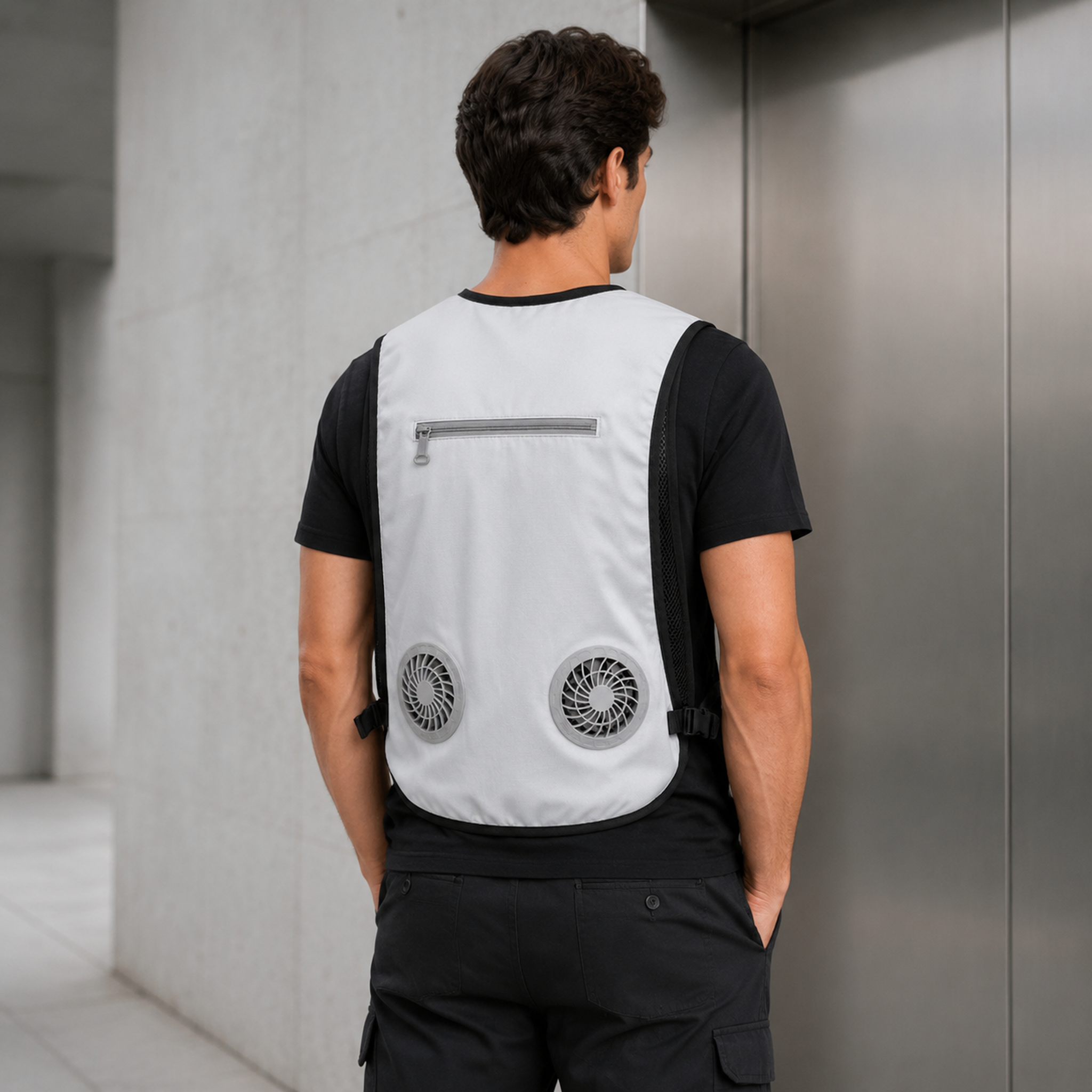
- Measured airflow data: Airflow figures are quoted from the plant’s own in-house fan bench rather than a supplier catalogue value, giving buyers a performance figure tied directly to the manufacturer’s own testing rather than third-party claims.
- Noise and vibration control: Fan housings are sealed and impellers are balanced in-house before assembly, addressing noise and vibration issues common to the fan cooling category at the point of manufacture rather than after the fact.
- Visibility compliance: Hi-vis and reflective shells are designed with fan openings routed clear of reflective tape, so the garment retains its visibility class—a relevant feature for workshop floors where high-visibility requirements often apply alongside cooling needs.
- Flexible power options: Packs are sold separately as kits with the controller and fan unit, which means a crew can keep the same garment and change only the power side if shift patterns change. The standard configuration runs on 12 V DC, with higher-voltage packs available across a 12 V to 50 V DC range.
- Step speed control: Fan speed is set in steps on the controller, with the number of steps and corresponding airflow points forming part of the product specification, allowing the garment to be matched to the specific environment.
Garment Forms and Site-Specific Features
The fan-assisted line is offered in multiple garment forms, including vests, waistcoats, short-sleeve shirts, long-sleeve shirts, and jackets, with hi-vis and reflective shell options among them. For workshop and site use, several construction details are worth noting:
- Harness slots can be specified at the shoulder and side seams, allowing the garment to be worn with site harnesses where required.
- Reflective shells cut for over-garments are designed to be worn with a hi-vis over-garment where a site’s visibility rules require it.
- The shell is washable once the pack and fan housings are removed, with wash routines printed on the care label for each model.
- For sites where powered equipment is restricted, intrinsically safe, explosion-proof battery modules are available.
Runtime and Performance Expectations
On the standard 12 V configuration, the garment is rated for 8 to 12 hours of runtime at low speed, which is quoted per battery rather than per shift—an important clarification for workshop managers planning battery rotation across multi-shift operations. Airflow is expressed per fan and per speed step, giving a granular basis for comparing configurations rather than a single blanket figure.
Where the Technology Has Limits
ELEHEAT is transparent about the boundaries of fan-assisted cooling, which is useful context for workshop floor buyers evaluating fit:
- Radiant heat: The system cannot remove radiant heat above roughly 45 °C, such as at a furnace, an asphalt pour, or a welding cell, because moving air only circulates heat already present rather than removing it.
- Humidity: Humidity above about 60 percent sharply reduces the cooling effect, since sweat cannot evaporate into air that is already saturated.
For workshop floors that combine dry conditions with available power, fan-assisted airflow cooling is the route the company positions as the primary fit. Where radiant heat or high humidity are factors instead, the company’s other cooling routes—water circulation for radiant heat environments, or evaporative cooling for posts without power availability in a dry climate—are presented as the alternative options within the same five-route range.
Customization, Ordering, and Service Terms
Beyond stock models, ELEHEAT offers custom orders (custom colour, logo, or fabric) and ODM projects that start from an existing platform to keep tooling and testing costs lower. Customization scope covers fan count, fan position, speed steps, battery capacity, shell fabric, colour, reflective tape, size grading, and packaging.
On ordering terms, the minimum order quantity is 50 sets for stock models and 200 sets for custom colour, logo, or fabric, with a single sample available for a fit and performance check before committing to bulk volume. Standard shipping terms are FOB Shenzhen and EXW Dongguan, with other Incoterms quoted per order.
Lead times are structured as 7 to 10 days for samples and 25 to 35 days for bulk production after sample approval, depending on quantity and depth of customization. The company backs electrical components—battery packs and fan kits—with a 12-month warranty, though consumable parts such as tubing, filters, and ice packs are excluded. Care instructions and a spare parts list are shipped with every order, which supports maintenance planning for workshop floor operations running the garments across multiple shifts.
Quality Documentation
The Dongguan manufacturing site’s quality management system is built to ISO 9001:2015 requirements, and its battery packs have the CE mark. RoHS and REACH documentation is available on request, with certificate numbers and issuing bodies varying by model and destination market; this paperwork is supplied with the quotation and matches what ships with the goods.
For workshop floor operations evaluating industrial air clothing, the combination of in-house system integration, measured performance data, and documented limitations gives buyers a clearer basis for matching the garment to their specific heat and humidity conditions before placing an order.

Reviews
There are no reviews yet.